
At the 3 nm node and beyond, the margin for error in thermal processing has all but disappeared. Roughly 18 to 22 percent of front-end-of-line and middle-of-line process modules in modern 3 nm and sub-2 nm logic and memory fabrication are thermal steps, and that share keeps climbing as atomic-layer processing, selective epitaxy, and heterogeneous integration spread. Every bake, cure, and anneal now lives inside an ever-tighter thermal budget, where a degree of non-uniformity or a few stray particles can translate directly into critical-dimension variation, sheet-resistance drift, or yield loss. This article maps where ovens and thermal-processing equipment sit across the 3 nm flow, the parameter windows those steps demand, and how YanSyn YSHG series ovens are built to satisfy them.

Where ovens sit in a 3 nm process flow
A 3 nm wafer sees thermal energy at almost every stage. The equipment ranges from giant vertical diffusion furnaces and single-wafer rapid-thermal-processing tools at the front end to compact, clean, atmosphere-controlled ovens that handle the high-volume bake and cure work.
Front-end oxidation, diffusion, and anneal
Gate oxidation, dopant diffusion, and junction formation rely on tube furnaces and RTP spike anneal. At 3 nm, source-drain extension and channel doping demand millisecond-to-sub-second thermal cycles to activate dopants while suppressing diffusion; the most advanced logic even combines RTP spike anneal with laser or flash annealing. These are extreme-transient steps where thermal budget, not peak temperature, is the controlled variable.
Lithography module bakes
Photoresist processing is where clean ovens earn their keep on the production floor. Pre-bake or soft-bake, roughly 90 to 150 °C, drives solvent out of the resist after coating; post-exposure bake drives the chemical reaction that defines the pattern; hard bake or cure stabilizes the resist after development. Each step needs uniform, particle-free, tightly controlled heating so the resist does not skin over or distort the pattern.
Interlayer dielectric and low-k cure
Modern interconnect stacks use porous low-k dielectrics that are mechanically fragile. Curing these films demands carefully profiled thermal cycles at controlled atmosphere to set the film without collapse, outgassing, or moisture pickup, an area where programmable, clean, convection ovens are the practical tool.
Metallization and advanced packaging
Back-end and packaging steps are oven-intensive: silicide and metal alloy anneal, TSV copper-pillar anneal, underfill cure, often 250 to 350 °C, die-attach cure, and the low-temperature oxide pre-treat plus controlled anneal used in hybrid bonding. 3D NAND production adds repeated high-temperature anneal cycles, sometimes above 400 °C, to manage charge-trap states across hundreds of layers.
R&D, pilot lines, and substrate prep
Beyond the high-volume line, development labs, pilot lines, and substrate preparation lean on flexible clean ovens for material screening, reliability bake, and process development where a configurable, traceable oven beats a fixed single-purpose tool.
The parameter windows 3 nm steps require
Advanced-node thermal processing is specified far more tightly than general industrial heating. The key parameters:
- Temperature uniformity - advanced nodes generally require uniformity tighter than plus or minus 2 °C across the work zone, with high-end clean ovens quoting plus or minus 0.5 to 1 °C. Non-uniformity propagates straight into device-parameter variation.
- Accuracy and stability - setpoint accuracy around plus or minus 1 °C, with minimal fluctuation, so repeated runs stay inside the process window.
- Thermal budget and ramp control - programmable ramp and soak profiles, from slow, gentle cures to fast cycles, matched to each step's budget. Front-end anneal is transient, while module bakes are slower but precisely profiled.
- Cleanliness - Class 100 or better interiors, HEPA or ULPA filtration, 99.99 percent at 0.3 micrometer and ULPA up to 99.9995 percent at 0.12 micrometer, because a single particle can kill a die.
- Atmosphere control - nitrogen or other inert purge holding oxygen in the tens of ppm or lower for oxidation-sensitive films and metals; some steps need vacuum.
- Traceability and monitoring - recipe storage, curve display, data export, and remote or IoT monitoring so every thermal cycle is logged and auditable, increasingly tied to MES or SCADA.
- Reliability and safety - over-temperature protection and safe unattended operation, plus energy-efficient design to control lifetime cost and emissions.
How YanSyn YSHG series meets the requirement
YanSyn YSHG series electric heating constant-temperature blower ovens are engineered around precisely these demands, with customization that lets them be tuned to a given node and step.
Programmable, accurate thermal control
An intelligent PID system with a touch-screen PLC supports multi-segment program control, curve display, and data export at plus or minus 1 °C accuracy. That gives process engineers the repeatable, profiled ramps and soaks the thermal budget requires, and the exported data feeds traceability.
Uniform, clean heating
High-pressure forced-air circulation delivers excellent uniformity, empty-box deviation not exceeding plus or minus 2 °C and customizable to plus or minus 1 °C on request. The mirror-finish SUS304 stainless-steel interior and the optional 100-level, Class 100, dust-free clean-oven configuration make YSHG suitable for lithography-module bakes, low-k cure, and other particle-sensitive work.
Controlled atmosphere options
Through YanSyn customized-solutions engineering, YSHG ovens can be configured with inert-gas or nitrogen purging and sealed circulation to hold oxygen low for oxidation-sensitive films, metals, and hybrid-bonding prep, while the all-stainless, sealed structure keeps external contamination out.
Monitoring, safety, and total cost of ownership
Dual over-temperature protection and alarm functions allow safe unattended operation, and YanSyn IoT remote-monitoring options add 24/7 visibility and alarms on temperature and process state. Long-life stainless-steel U-shaped heaters, 50,000 to 60,000 hours, and an energy-saving airflow design lower lifetime operating cost, an increasingly important criterion as fabs weigh emissions and energy in equipment selection.
One platform, many steps
With a temperature range from room temperature up to 500 °C and multiple models, a single YSHG line covers resist bakes in the 90 to 150 °C band, cure and anneal work around 250 to 400 °C, and high-temperature 3D NAND anneal profiles, while conveyor-belt and other custom oven types extend coverage for volume steps.

How YanSyn serves 3 nm-era customers
YanSyn Intelligence Technology, Shanghai, Co., Ltd. designs and manufactures temperature- and humidity-control equipment for semiconductor, new-energy, biomedical, military, and research customers worldwide. For advanced-node programs, the value is not just a catalog oven but a configurable thermal platform: YanSyn works with customers to specify the right uniformity, cleanliness, atmosphere, and monitoring for each step, delivers Class 100 clean and plus or minus 1 °C precision variants, and supports integration with plant monitoring through data export and IoT options. Whether the need is a development-lab oven, a pilot-line cure station, or a production clean oven for packaging and module bakes, YSHG is built to meet the spec and to grow with the roadmap.
YanSyn YSHG series: precise PID-controlled, clean, and customizable ovens for the bake, cure, and anneal steps of advanced semiconductor manufacturing.
Related Posts
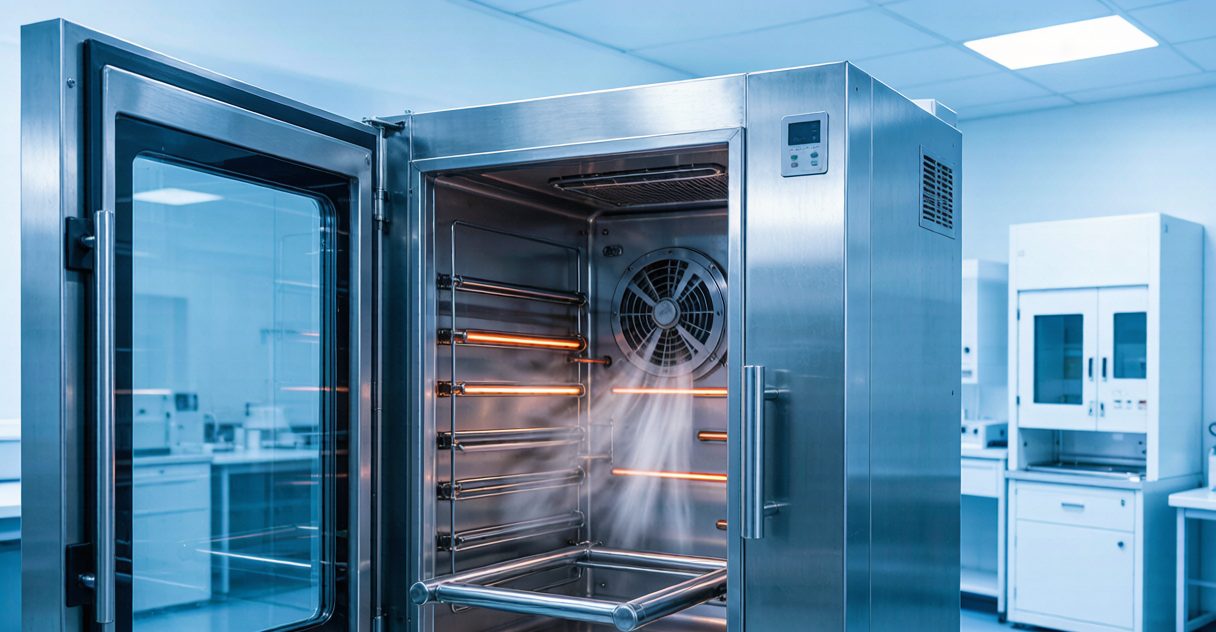
Oxygen-Free Ovens Demystified: When You Need Below 1 ppm O₂
Search for an industrial oven and you will quickly meet two very different promises. One is precise temperature. The other is an oxygen-free atmosphere, sometimes quoted as "below 1 ppm O₂". The difference is not…
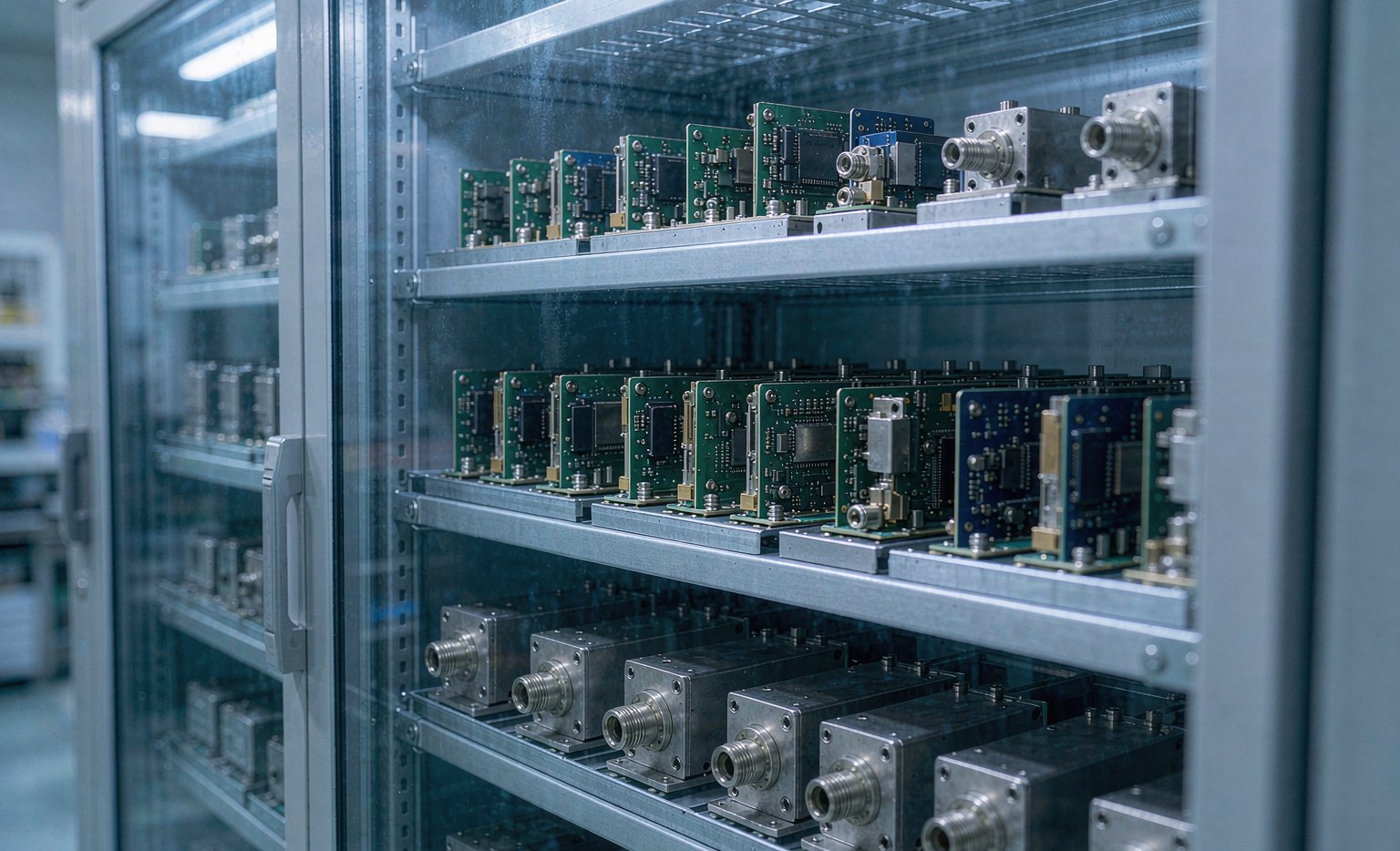
Telecom and 5G Hardware: Moisture Defense for RF and Base-Station Parts
5G base stations, small cells, and radio units are packed with parts that are far more moisture-sensitive than their industrial appearance suggests. High-frequency RF printed circuit boards, gallium arsenide and gallium nitride MMICs, silver- and…
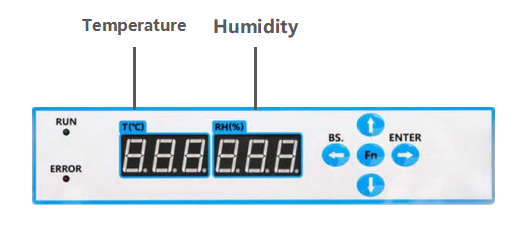
How to Choose the Humidity for an Electronic Dry Cabinet?
The core principle for selecting the humidity setting on an electronic dry cabinet is "match the humidity to the item" — meaning it depends entirely on the specific items you are storing. There is no "one-size-fits-all" humidity…