
Search for an industrial oven and you will quickly meet two very different promises. One is precise temperature. The other is an oxygen-free atmosphere, sometimes quoted as "below 1 ppm O₂". The difference is not marketing — it decides whether your parts come out bright and functional or discolored and rejected. This article explains what oxygen-free really means, which processes genuinely need residual oxygen in single-digit ppm, which ones tolerate hundreds of ppm, and how to specify an oxygen-free oven without paying for capability you will never use.
What "Oxygen-Free" Actually Means
No production oven removes every oxygen molecule. "Oxygen-free" describes the residual oxygen concentration left in the chamber after purging, expressed in parts per million (ppm) by volume. Some reference points:
- Ambient air: about 20.9% oxygen, or 209,000 ppm.
- An uncontrolled electric oven: essentially room air inside, so oxidation runs at full speed.
- A lightly purged oven (about 1,000 ppm O₂): slows heavy oxidation but is not inert for sensitive metals.
- A well-purged inert oven (below 100 ppm): suitable for many bright annealing and curing jobs.
- A genuinely oxygen-free oven (below 1–10 ppm): where reactive surfaces such as bare copper, titanium, or metal powders survive heating without measurable oxidation.
The ppm scale matters because oxidation rate does not fall off linearly as oxygen drops. Many oxides keep forming at noticeable rates until oxygen is driven down by two or three orders of magnitude. A process can look "protected" at 500 ppm and still show film growth or discoloration that fails inspection.
When You Really Need Below 1 ppm O₂
Not every anti-oxidation job needs single-digit ppm. Over-specifying wastes nitrogen and cycle time; under-specifying scraps parts. The process families below commonly specify sub-1 ppm targets. Treat these as indicative starting points — your material datasheets and customer specs always override them.
Reactive-metal annealing and bright heat treatment
Copper, titanium, stainless, and nickel alloys form surface oxides within seconds at annealing temperatures. Oxide scale then must be removed by pickling or abrasive cleaning — both costly. Annealing at residual oxygen below roughly 1–10 ppm keeps surfaces bright and solderable, with the tighter end applying to the most reactive alloys and to parts that go straight into vacuum or hermetic assembly.
Fluxless joining, reflow, and brazing of bare copper
Flux strips oxide so solder can wet metal; an inert purge does the opposite job of preventing oxide from re-forming while the joint is molten. Nitrogen reflow with flux typically runs well at 100–1,000 ppm. No-clean and low-residue systems push lower; fluxless or near-fluxless joining targets single-digit ppm because there is no flux to clean up afterwards.
Battery and electronic-material processing
Lithiated electrode materials, conductive pastes, and some separators degrade with both moisture and oxygen at elevated temperature. Drying and curing for these materials run under inert atmosphere with low-ppm oxygen targets, often alongside a dew-point requirement. It is the same logic as low-temperature inert storage in a nitrogen cabinet — the oven simply extends the protected atmosphere to higher temperature.
Powder metallurgy and additive-manufacturing post-processing
Fine metal powders have enormous surface area. Heating them in air oxidizes the bulk, changes sintering behavior, and — with reactive powders — creates a combustion risk. Debinding and sintering of reactive-alloy parts, for example titanium, run under argon or nitrogen with oxygen continuously monitored at roughly the tens-of-ppm level or below.
Semiconductor and advanced-packaging bakes
Photoresist bakes and adhesive cures are usually oxygen-tolerant. The exceptions matter: curing oxygen-sensitive die-attach films, annealing reactive metal stacks such as aluminum or titanium nitride, and any bake following plasma cleaning of a bare reactive surface. At the 3 nm node the thermal budget is already tight; uncontrolled oxidation turns a marginal process into a failing one. The broader thermal picture is covered in our article on ovens and thermal processing at the 3 nm node.
An Indicative Oxygen-Level Ladder by Process
Use this table as a conversation starter with your process owner, not as a qualified specification. Every value is an indicative assumption drawn from common practice; your own data overrides it.
| Process family | Indicative residual O₂ target | Atmosphere gas |
|---|---|---|
| General anti-discoloration baking | 1,000–10,000 ppm | Nitrogen |
| Nitrogen reflow / brazing with flux | 100–1,000 ppm | Nitrogen |
| Bright annealing, common alloys | 10–100 ppm | Nitrogen / argon / forming gas |
| Battery-material drying and curing | Below 100 ppm, often below 10 ppm | Nitrogen or argon |
| Fluxless joining, reactive-metal annealing | 1–10 ppm | Argon / forming gas |
| Reactive powder debind and sinter | At or below about 10 ppm, monitored | Argon / nitrogen |
How an Oven Actually Reaches Low Oxygen
An oven can hold temperature beautifully and still ruin copper if its atmosphere handling is poor. Four design elements decide the achievable residual O₂.
Purge strategy
Continuous nitrogen flow through the chamber is the simplest approach, but it consumes gas all shift and reaches very low ppm slowly. Faster, leaner designs use a vacuum-purge cycle: evacuate to remove bulk air, backfill with nitrogen or argon, and repeat two to four times before heating. Each cycle cuts residual oxygen by a large fixed fraction, so a few cycles reach single-digit ppm far faster than flow alone.
Chamber tightness and door design
Every door opening dumps room air into the chamber. A low-ppm oven needs a tight gasketed door, a sensible chamber volume for the workload, and a defined recovery time — the time to return below the O₂ setpoint after a scheduled opening. Ask suppliers to state recovery time for your load and opening frequency, not for an empty chamber.
Oxygen analysis, not hope
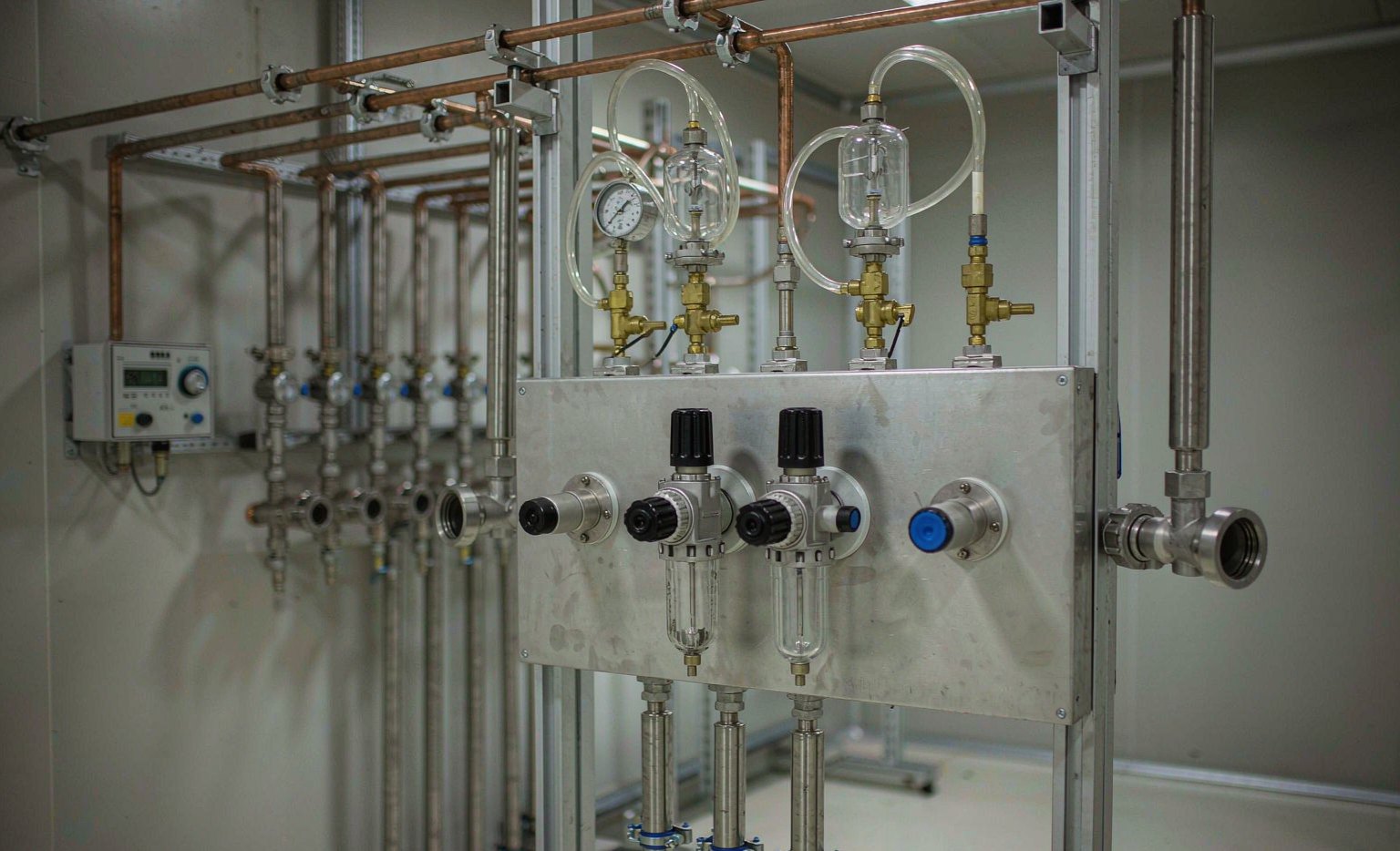
You cannot manage what you do not measure. A serious oxygen-free oven includes a zirconia or electrochemical oxygen analyser sampling the chamber, with alarm or interlock at the process setpoint. Sampling point matters: a reading at the gas inlet flatters the machine; one near the workload or in the exhaust tells the truth. The same principle drives the savings in our nitrogen flow-control ROI article — measurement plus control beats running gas at full blast.
Gas selection and safety
Nitrogen is the economical default for most metals. Argon is preferred for titanium and some stainless grades that form nitrides at temperature. Forming gas (dilute hydrogen in nitrogen) adds reducing capability for certain anneals and requires equipment designed and monitored for hydrogen service.
A Practical Specification Checklist
- Target residual O₂ and measurement point — the ppm value, the sampling location, and whether it is displayed, alarmed, or interlocked.
- Recovery time after a door opening, with your representative load inside.
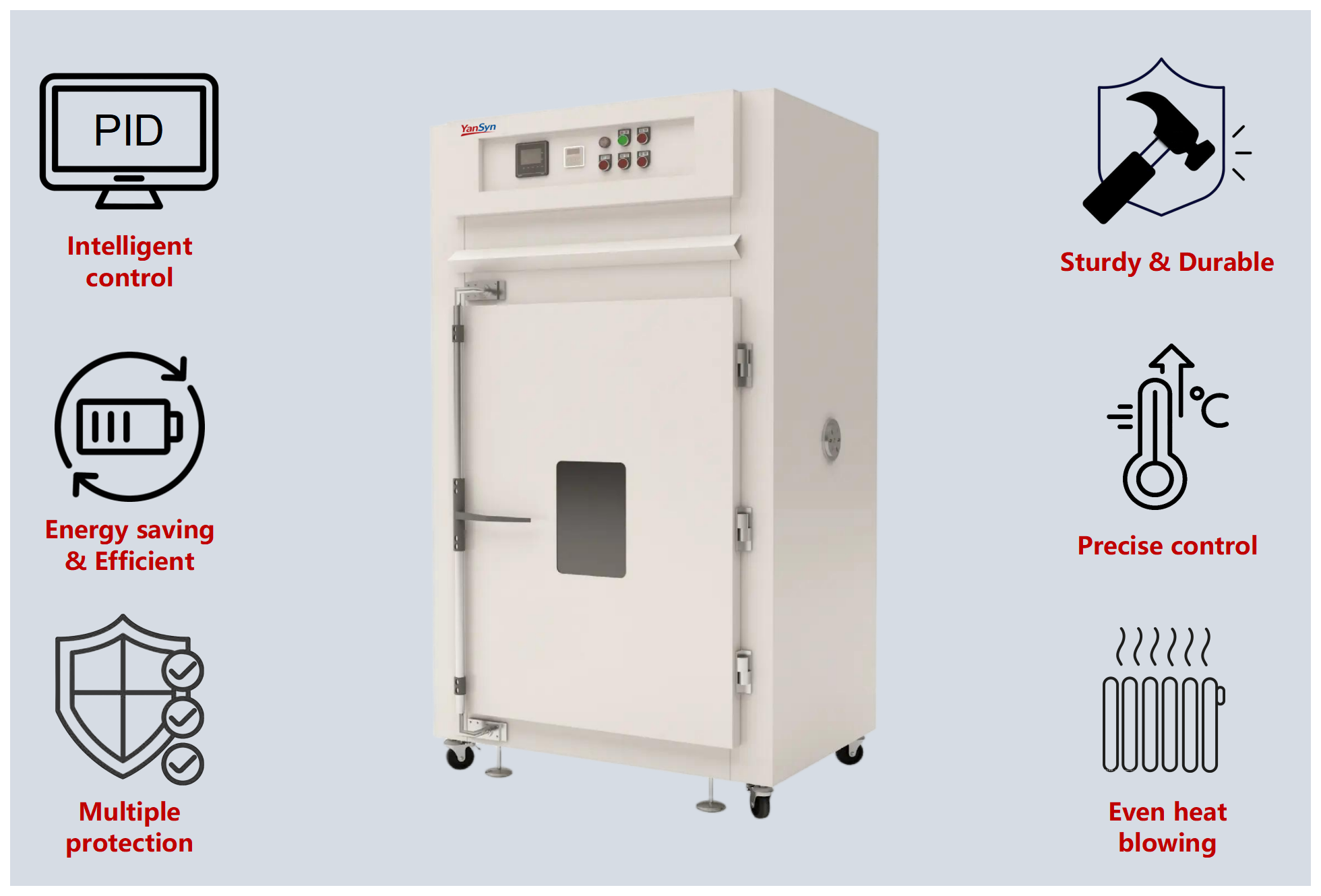
- Temperature range and uniformity — the YanSyn YSHG series covers room temperature to about 500 °C with PID control and uniformity within ±2 °C, customizable to ±1 °C; confirm the band your process needs.
- Purge mode — continuous flow, vacuum-purge cycles, or both, with expected nitrogen consumption per cycle.
- Workload and throughput — trays, racks, and parts per day, which drive chamber size and door cycles.
- Cleanliness — if parts are particle-sensitive, add a Class 100 (ISO 5) clean-chamber option.
- Data and connectivity — temperature and O₂ logging, alarms, and remote monitoring so quality can prove the atmosphere per batch.
- Safety review for any atmosphere other than plain nitrogen.
These options map onto configurable features of the YanSyn YSHG electric heating oven series, offered with PID control, optional clean-chamber construction, optional nitrogen atmosphere, and IoT monitoring. YanSyn model suffixes are internal build variants — the authoritative configuration is always the datasheet of the quoted model; our model-code selection guide helps you shortlist first.
Operating Costs and Common Mistakes
Atmosphere costs are dominated by gas, not electricity. As an indicative illustration only — replace with your own utility prices and cycle data — a continuously purged chamber can consume several times more nitrogen per shift than the same chamber on vacuum-purge plus holding flow. Specify a demand-matched purge: high flow during initial purge-down and post-opening recovery, low flow during soak. The second cost driver is waiting: long recovery times make operators open doors early and re-oxidize the load. Full oven loads instead of frequent partial ones improve both gas cost and effective capacity.
Watch for these recurring buying mistakes:
- Buying 1 ppm when the process needs 100 ppm — a tighter chamber costs more to buy, run, and open.
- Reading the analyser at the inlet — insist on workload-side or exhaust-side sampling.
- Ignoring dew point — wet gas still oxidizes moisture-sensitive materials even at low O₂.
- Forgetting cooldown — parts oxidize while hot; the atmosphere must hold through cooldown.
- No acceptance test — agree in advance on a witness cycle with the O₂ trace the machine must deliver.
Frequently Asked Questions
Is 100 ppm oxygen good enough?
It depends on material and temperature. Many stainless and nickel-alloy anneals run well at low hundreds of ppm. Bare copper at high temperature, reactive powders, and fluxless joining usually need single-digit ppm. Start from your inspection criteria — discoloration, oxide thickness, wettability — and work backwards.
Can a regular oven be converted to oxygen-free?
Light nitrogen purging can be retrofitted and will reduce oxidation, but proving sub-10 ppm residuals generally requires chamber sealing, vacuum-purge capability, and an oxygen analyser designed in from the start. Retrofits rarely meet acceptance targets below about 100 ppm.
Do I need argon instead of nitrogen?
Use argon when the alloy reacts with nitrogen at process temperature, or when density-based blanketing helps. Otherwise nitrogen is economical. Forming gas is a specialized reducing option with additional safety requirements.
What is the difference between an oxygen-free oven and a nitrogen cabinet?
A nitrogen cabinet stores parts at near-ambient temperature in low-oxygen, low-humidity atmosphere; an oxygen-free oven processes parts at elevated temperature. Production lines normally need both — inert storage between steps and an atmosphere-controlled oven at the thermal step. See the YanSyn YSN nitrogen cabinet series for the storage side, and our five-year TCO comparison for the cost logic.
Conclusion
"Oxygen-free" is a measurable requirement, not a label. The real decision is a number: how many ppm of residual oxygen, measured where, held for how long, at what temperature. Processes that genuinely need below 1–10 ppm are the reactive-metal, fluxless-joining, battery-material, and reactive-powder families; most other work runs fine at 100–1,000 ppm with demand-matched nitrogen purging. Write the number into the specification, insist on workload-side oxygen measurement and a stated recovery time, and match purge strategy to your door-opening pattern.
For an oxygen-sensitive process, the YanSyn YSHG electric heating oven series offers PID control, uniformity within ±2 °C (customizable to ±1 °C), room temperature to about 500 °C, and optional clean-chamber, nitrogen-atmosphere, and IoT configurations. Contact our engineering team with your process window and we will match the configuration to your specification.
Related Posts
MSD Management: Why IPC/JEDEC J-STD-033D Matters
Moisture-sensitive devices (MSDs) absorb moisture from the air. During reflow soldering, the rapid heating turns that moisture into steam, causing internal cracks—a defect known as the “popcorn effect.” This leads to latent failures or immediate…

FAQ: Frequently Asked Questions by clients
1. What kind of services do you provide: Orignal manufacturer in China, OEM & customization are available as well. 2.Transportation: Defaulted by sea freight, can also through other ways according to your request. 3.After-sales service Free-maintenance & spare parts for…
How to Specify a Constant Temperature & Humidity Chamber: Buyer's Guide
Specifying a heating oven means controlling one variable: temperature. Specifying a dry cabinet means controlling one variable: relative humidity. A constant temperature and humidity chamber looks like a simple combination of the two, but it…