
Every procurement cycle starts the same way. Two quotes land on the same desk: one for a desiccant dry cabinet, one for a nitrogen purge cabinet holding the same number of trays. The desiccant unit is cheaper, and somebody asks the question that actually decides the purchase: what does each one cost over five years?
This article answers that question with a transparent cost model rather than a rule of thumb. It covers what each technology controls, the cost lines that appear after installation, a worked five-year example with every assumption written down, and the point where the cheaper cabinet stops being the right choice. For the technical background on nitrogen storage, see Nitrogen Cabinets for Oxidation-Sensitive Storage.
What each technology actually controls
The two designs solve related but different problems. Understanding the difference removes most of the confusion in the comparison.
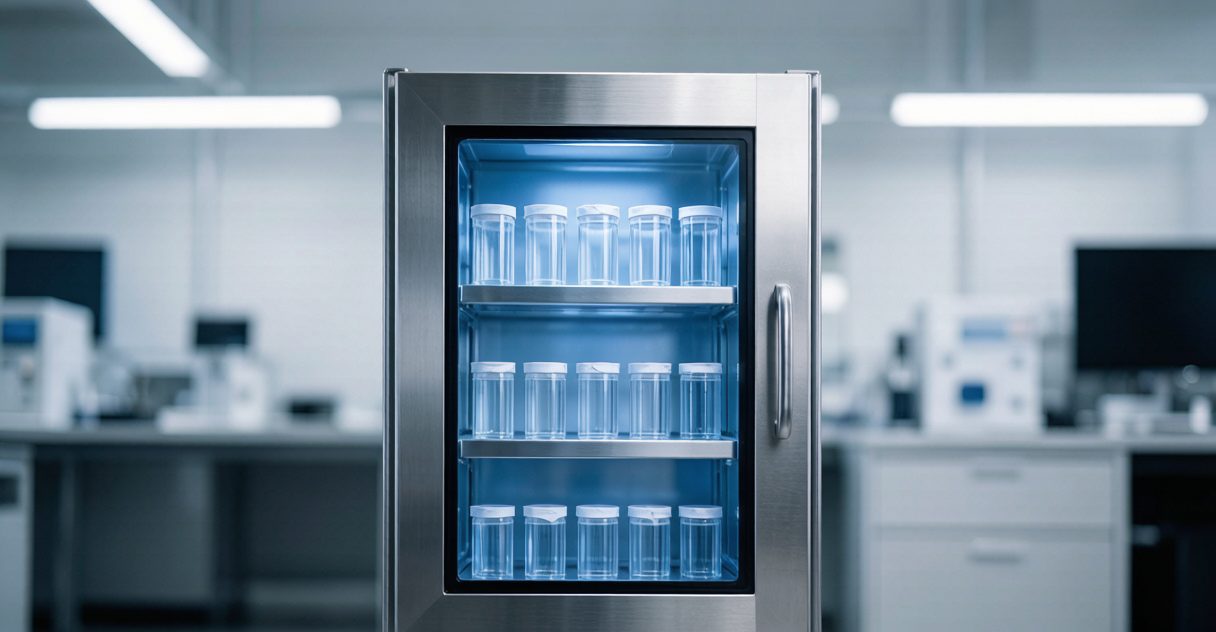
Desiccant dry cabinet
A desiccant cabinet removes water from the air already inside the chamber. The air is circulated through a drying unit — molecular sieve or another adsorbent — that captures water vapour and is regenerated cyclically. Because the process only removes water, humidity is the single controlled variable. The result is a stable set point, typically adjustable across a wide low-humidity band, and recovery to the set point after a door opening is driven by the drying unit rather than by a gas supply.
This is the standard tool for moisture control according to the IPC/JEDEC J-STD-033D handling practice: reels of surface-mount devices, printed board assemblies, and other parts whose failure mechanism is absorbed moisture rather than surface chemistry.
Nitrogen purge cabinet
A nitrogen cabinet takes the opposite route. It does not dry the air; it displaces it. Dry nitrogen enters the sealed chamber and pushes the humid, oxygen-bearing air out, so both humidity and oxygen fall together. Humidity becomes very low as a side effect of the purge, and oxygen falls to a level no desiccant cabinet can reach.
That second control variable is the entire business case. When the stored material forms an oxide film, corrodes at the contact surface, or degrades chemically in the presence of oxygen, low humidity alone does not protect it. Nitrogen is also the choice when parts must be stored without any risk of adsorption-related surprises at the surface.
Head-to-head: capability first
Cost only matters between options that can do the job. The table below compares the two designs on capability, then on the practical consequences that later turn into cost.
| Factor | Desiccant dry cabinet | Nitrogen purge cabinet |
|---|---|---|
| Controlled variable | Relative humidity | Relative humidity and oxygen level |
| Protection against oxidation | None beyond slow drying of the surface | Yes, oxygen is displaced |
| Recovery after door opening | Driven by the drying unit; no consumable involved | Fast, but each recovery consumes gas |
| Infrastructure required | Power outlet | Nitrogen supply, regulator, piping, gas handling rules |
| Main consumable | Electricity for regeneration | Nitrogen gas |
| Safety considerations | Standard electrical equipment | Oxygen-deficiency risk in the room needs assessment |
| Failure mode when the supply stops | Humidity rises slowly | Environment is lost; depends on remaining gas stock |
The six cost lines that decide the answer
Purchase price is one line out of six. The others are where five-year totals diverge.
1. Acquisition cost. A nitrogen cabinet costs more for the same usable volume. The difference pays for gas-tight door seals, a stronger enclosure, the purge control valve and flow logic, and often an oxygen sensor.
2. Installation and gas infrastructure. A desiccant cabinet needs a power outlet. A nitrogen cabinet needs a regulator, piping from the gas source to the cabinet location, and possibly a cylinder manifold or tank connection. In a facility with an existing nitrogen ring main this is a modest plumbing job; in a facility that currently buys cylinders for the laboratory, it becomes a recurring handling cost and a space allocation.
3. Consumables. This is the largest difference. A desiccant cabinet consumes electricity for the regeneration cycle. A nitrogen cabinet consumes gas every hour of every day, with consumption rising each time the door is opened.
4. Energy. Both draw power. The desiccant unit draws more, because regeneration uses heat. In practice this line is small next to gas consumption.
5. Maintenance and calibration. Both need periodic sensor verification. Add the drying module service life on the desiccant side and the gas train — regulator, valve, seals — on the nitrogen side.
6. Risk. Hardest to price and easiest to ignore. If the wrong cabinet is chosen and a lot is scrapped for oxidation, no amount of saving on gas covers it. Risk is the reason the comparison must start from capability, not from price.
Worked five-year example
The model below uses a single mid-size cabinet with roughly 1,000 litres of usable volume, running continuously. All figures are indicative US dollars and every assumption is written down so that you can replace it with your own number. The purpose is the shape of the answer, not the exact total.
| Assumption | Value used | Note |
|---|---|---|
| Acquisition, desiccant cabinet | USD 4,000 | Indicative for the size class |
| Acquisition, nitrogen cabinet | USD 5,600 | Higher because of sealing and gas control |
| Nitrogen installation | USD 1,200 once | Regulator, piping, manifold connection |
| Average nitrogen consumption | 0.30 m³/h | Including door-opening recovery peaks |
| Nitrogen price delivered | USD 0.60 / m³ | Varies strongly by region and supply mode |
| Running hours | 8,760 h per year | Storage cabinets are never switched off |
| Electricity price | USD 0.12 / kWh | Industrial average, replace with your tariff |
| Desiccant unit average draw | 45 W | Regeneration plus control |
| Nitrogen unit average draw | 15 W | Valves, sensors, display |
| Drying module service | USD 600 once, year 4 | Depends on set point and duty cycle |
| Sensor verification | USD 60 per year | Both designs |
Five-year result
| Cost line over 5 years | Desiccant cabinet | Nitrogen cabinet |
|---|---|---|
| Acquisition | 4,000 | 5,600 |
| Installation | 200 | 1,200 |
| Consumables | 0 | 7,884 |
| Energy | 237 | 79 |
| Maintenance and calibration | 900 | 900 |
| Five-year total | USD 5,337 | USD 15,913 |
The nitrogen cabinet costs about three times more over five years. Note how the result is produced: not by the purchase price, which differs by 1,600, but by the gas line, which differs by nearly 8,000. The purchase price is the least important number in the comparison once the supply approach is fixed.
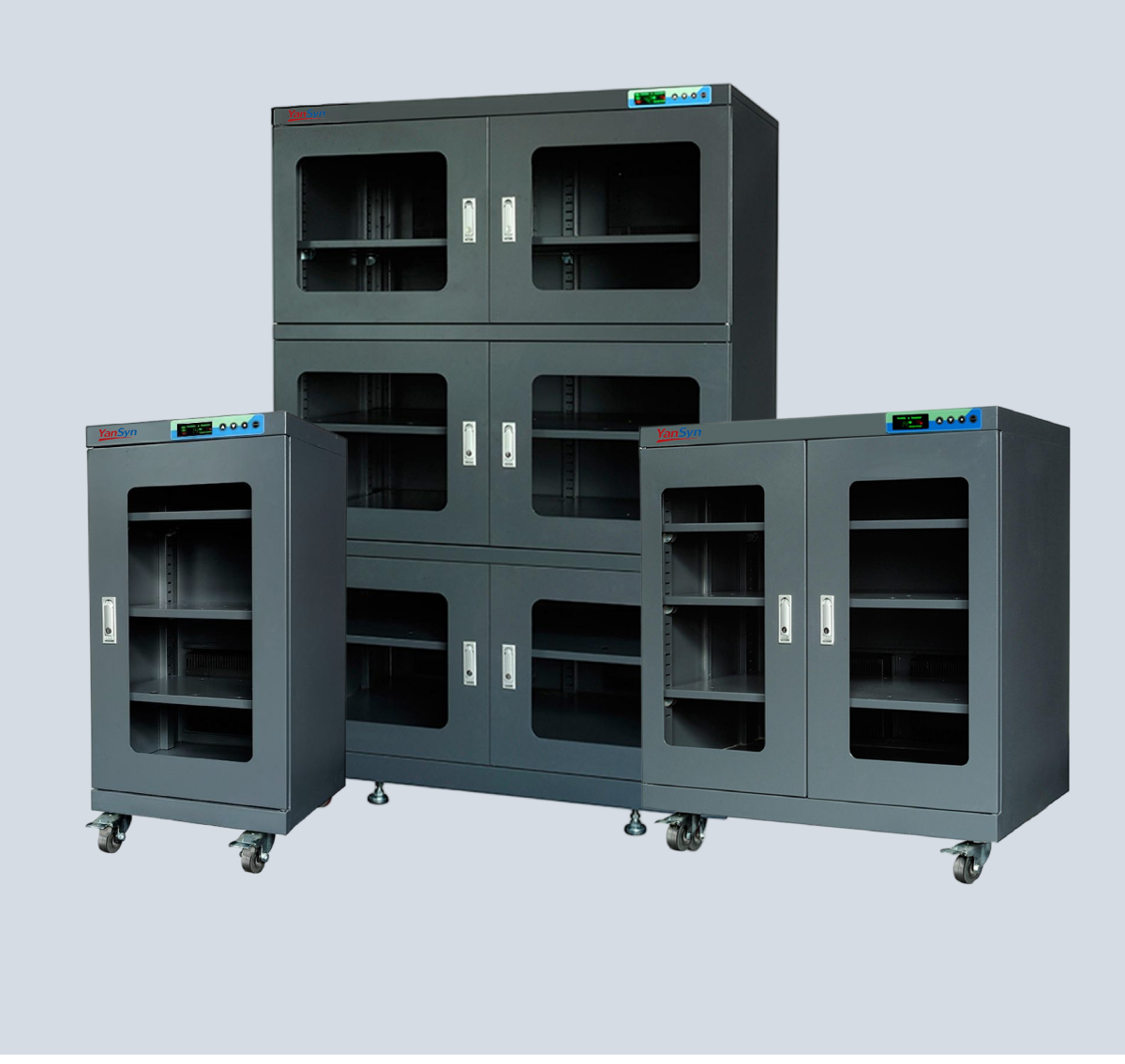
Three variables that move the result a long way
The worked example is not a verdict; it is a starting point. Three variables change the picture more than anything else.
Gas supply mode. Bundled cylinders add supplier handling cost and labour at every bundle change. A bulk tank or a nitrogen ring main lowers the unit cost per cubic metre. An on-site generator carries capital cost but reduces the marginal cost to little more than electricity, which can change the ranking in a facility with many cabinets.
Flow control strategy. Consumption is not fixed. Continuous uncontrolled purging uses far more than set-point-driven control that opens the valve only when the environment drifts. Where nitrogen is genuinely required, cutting unnecessary purge is the fastest improvement available.
Duty cycle and door traffic. A store opened twenty times a shift spends most of its gas budget on recovery, so shelving layout and transfer procedures matter as much as the cabinet specification.
Choosing by failure mechanism, not by price
The practical rule is simple. Identify the failure mechanism of the material first, then buy the cabinet that blocks it.
- Moisture-driven failure. Plastic-encapsulated devices, reels, printed board assemblies, hygroscopic powders. Failure comes from absorbed water. A desiccant dry cabinet blocks it, with the lowest five-year cost.
- Oxidation-driven failure. Bare copper and silver surfaces, certain precision alloys, sensitive electrode materials and active pharmaceutical materials. Humidity control alone does not stop a surface reaction with oxygen. Nitrogen is the correct answer, and the higher running cost is the price of protection that the desiccant cabinet cannot deliver at any cost.
- Unclear mechanism. Start from the failure analysis. If returned units show corrosion, tarnish, or contact resistance growth rather than cracking, the problem is oxidation.
Most facilities end up with a mixed fleet rather than a single answer: desiccant cabinets covering the bulk of moisture-sensitive stock, and one or two nitrogen cabinets covering the smaller set of oxidation-sensitive parts. This arrangement usually produces the lowest cost per unit of risk covered, because gas is spent only where it changes the outcome.
Questions worth asking before signing either quote
- What is the measured recovery time to set point after a 60-second door opening, and how much gas does one recovery consume?
- Can the purge be switched off automatically once the set point is reached, and what restarts it?
- Which gas supply connection size and pressure does the cabinet require, and who pipes it?
- Is an oxygen sensor included, and what is its calibration interval?
- What is the expected service life of the drying module, and is it replaceable without returning the cabinet?
- What does the installed environment look like under a one-day cessation of nitrogen supply?
- Are door seals covered as spare parts, and what is the replacement interval?
Frequently asked questions
Is nitrogen always more expensive than desiccant drying?
Over five years, for the same workload, yes in most regions. The driving line item is continuous gas consumption, not the higher purchase price. Only a low-cost supply arrangement such as an on-site generator combined with set-point-driven flow control narrows the gap to a low value.
Can a desiccant cabinet reach the same humidity as a nitrogen cabinet?
For practical moisture-controlled storage, both operate comfortably in the very low humidity range used by the J-STD-033D practice. The difference is not how dry the air becomes; it is the absence of oxygen in the nitrogen cabinet.
Does a nitrogen cabinet still consume gas when the door stays closed?
Yes, though far less. Small leaks at the seals and a slow drift in the chamber mean the control system adds gas periodically. The consumption then depends on how tightly the cabinet is sealed and whether the control strategy switches the purge off at set point.
Is a nitrogen feed hazardous in a normal production store?
Nitrogen is not toxic, but it displaces oxygen. A large release in a poorly ventilated room creates an oxygen-deficient atmosphere. Enclosed leaks, cylinder handling, and ventilation around the installation are part of the review, together with the applicable national rules for working with industrial gases.
How many years should the comparison cover?
Five years is a sensible horizon because it covers the point where the running cost overtakes the purchase price. Ten years favours the desiccant cabinet further in pure moisture applications; it does not change the capability argument where oxygen must be excluded.
Both answers can be correct in the same building
The comparison is not really between two products. It is between two failure mechanisms. When the stored material absorbs water, a desiccant cabinet delivers the required environment at the lowest five-year cost. When the material reacts with oxygen, no amount of drying substitutes for a displaced atmosphere, and the nitrogen running cost is simply the cost of doing the job.
YanSyn builds both designs, which makes the specification conversation about your parts rather than about which unit we prefer. The YSM series moisture proof cabinet covers active humidity control for moisture-sensitive stock, while the YSN series nitrogen cabinet covers humidity and oxygen together where oxidation is the failure mode.
Send us your material list, failure mechanism, door traffic and local gas price, and we will build the five-year model with your own numbers.
Request a nitrogen versus desiccant TCO comparison for your store
Related Posts

Photovoltaic Module Manufacturing: Storage & Curing Solutions for Moisture, Oxidation, and Heat Control
Photovoltaic module manufacturing is a race against contamination. Between cell sorting and the final flash test, every layer — glass, encapsulant, cells, ribbons, backsheets, and adhesives — passes through multiple humidity, oxidation, and temperature windows.…
Ovens and Thermal Processing at the 3 nm Node: What Advanced Chip Manufacturing Demands, and How YanSyn YSHG Delivers
At the 3 nm node and beyond, the margin for error in thermal processing has all but disappeared. Roughly 18 to 22 percent of front-end-of-line and middle-of-line process modules in modern 3 nm and sub-2…
Nitrogen Cabinets for Oxidation-Sensitive Storage: Pharmaceutical, Battery, and Precision-Alloy Use Cases
Most engineers think of a dry cabinet as a defense against moisture. For a large class of materials, however, water vapor is only half the threat, oxygen is the other. Active pharmaceutical ingredients, lithium-ion battery…