
In biopharmaceutical work, a stability chamber is not storage furniture. It produces regulated evidence. Every shelf-life claim and retest period in a dossier traces back to samples that sat inside a controlled volume for months or years. If that volume was not actually controlled, the data behind it is weak — and nobody may notice until an inspection.
This guide covers what a GMP-compliant stability chamber requires: the ICH Q1A conditions, how to convert them into a written specification, why mapping matters more than the setpoint, what data integrity means in practice, and where audits most often find problems.
Why stability storage is a system, not a cabinet
A chamber that holds 25 °C and 60 % RH on its display is easy to buy. What regulators inspect is different: whether the condition was maintained for the whole storage period, whether deviations were detected and documented, whether the sensors were calibrated, and whether changes to the equipment were controlled.
In practice there are three failure modes, and only the first is a hardware problem:
- Undetected excursion. The chamber drifted out of range overnight and no alarm reached anyone.
- Undocumented excursion. Someone noticed the drift, reset the controller, and did not record it.
- Unqualified change. A sensor was replaced or the chamber was moved, and nobody re-assessed the effect.
All three are quality-system failures, and a better controller solves none of them. The phrase "GMP-compliant chamber" is therefore slightly misleading: the equipment supports compliance, but compliance lives in the qualification, the procedures and the records around it.
The storage conditions you have to hold
The conditions themselves are not negotiable — they come from ICH Q1A(R2), which defines the standard set of stability conditions, and from the WHO climatic zone model that maps markets to zones. Most manufacturers run some subset of the following.
| Condition | Temperature | Relative humidity | Typical use |
|---|---|---|---|
| Long-term, temperate (Zone I–II) | 25 °C ± 2 °C | 60 % RH ± 5 % RH | Primary stability data, EU / US / Japan |
| Long-term, hot-humid (Zone III–IV) | 30 °C ± 2 °C | 65 % RH ± 5 % RH | Registration in hot-humid markets |
| Intermediate | 30 °C ± 2 °C | 65 % RH ± 5 % RH | Used when accelerated data shows significant change |
| Accelerated | 40 °C ± 2 °C | 75 % RH ± 5 % RH | Six-month stress signal, degradation screening |
| Refrigerated | 5 °C ± 3 °C | Usually not specified | Biologics, vaccines, refrigerated products |
| Frozen | −20 °C ± 5 °C | Usually not specified | Drug substance, intermediates, biologics storage |
Confirm these values against the current version of ICH Q1A and your own dossier before writing them into a specification. The point for equipment selection is the tolerance: your chamber must hold a band comfortably inside the standard, or measurement uncertainty alone eats your margin.
Turning the standard into a specification
A useful user requirement specification (URS) does not say "25 °C and 60 % RH". It says what must be true, where, and for how long. Four numbers do most of the work:
- Control tolerance at the sensor. How far the measured value may move from the setpoint during steady operation.
- Spatial uniformity. The largest difference between any two points in the working volume at one moment. This is the number that protects your samples.
- Temporal stability. How much the value moves at one point over a defined period, for example 24 hours.
- Recovery time. How long the chamber takes to return inside tolerance after a defined door opening. This is the most underestimated specification, because door openings are routine, not exceptional.
Then define the conditions those numbers apply under. Uniformity measured in an empty chamber means little for a chamber holding two hundred filled vials. State the load, the shelf arrangement, and the positions where samples are not allowed — in the direct air stream, against the walls, or on the door-side shelf.
On the humidity side, add four more items that buyers often leave out:
- Generation method and its behaviour at low temperature, where condensation and icing become the failure mode.
- Water quality — purified or deionized feed and drainage, because scale and biofilm change sensor behaviour over time.
- Sensor type and calibration interval, plus a drift limit that triggers replacement rather than adjustment.
- Excursion definition — the threshold, the duration that counts, and the action that follows.
Mapping: the whole volume, not one sensor
The controller reads one point. Your samples occupy a few cubic metres. Mapping closes that gap: place an array of calibrated sensors through the working volume, run the chamber, and record what every point actually did.
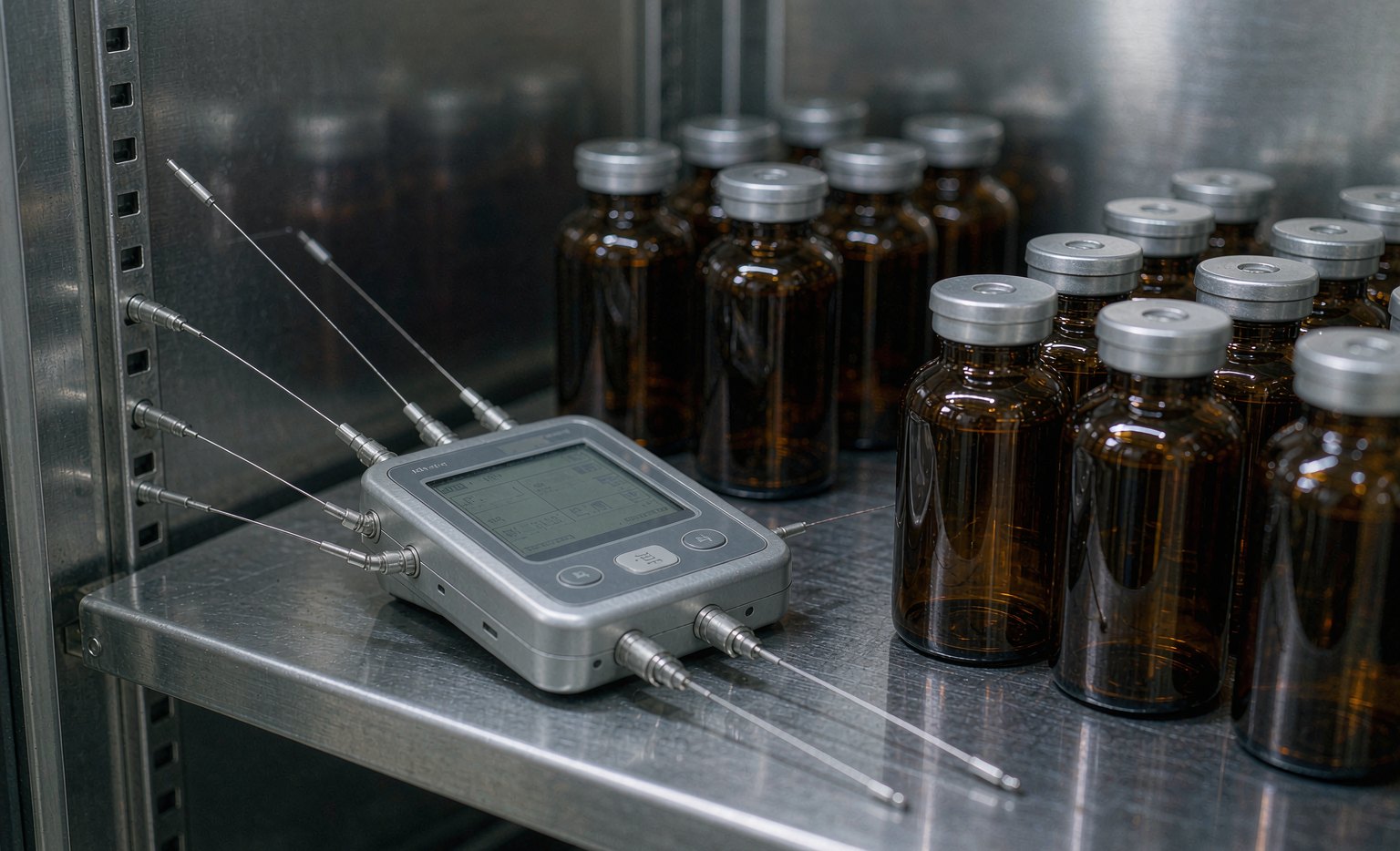
A defensible protocol covers the corners and centre of every shelf level, the area immediately inside the door, and the position closest to the air outlet and return. Justify the number of points by volume and risk — nine or more is common for a standard pharmaceutical chamber, but the justification matters more than the number. Run it empty and loaded, long enough to cover normal operating cycles including defrost.
Repeat mapping is not optional. Re-map after relocation, major repair, control-system change or shelving modification, and periodically per your SOP. Keep the raw data with the calibration certificates; an inspector can ask for a mapping report by date.
Data integrity: where most audits find something
Modern inspections rarely fail on hardware. They fail on records. The framework most teams work to is ALCOA+ — records must be attributable, legible, contemporaneous, original and accurate, plus complete, consistent, enduring and available. Electronic records in a GMP environment are governed by frameworks such as 21 CFR Part 11 in the United States and EU GMP Annex 11 in Europe.
For a stability chamber, that means:
- Audit trail. Every setpoint change, alarm acknowledgement and user action is recorded with who, when and the previous value, and cannot be edited by the person being audited.
- Role-based access. Named users with defined roles. No shared logins, no administrator account for routine operation.
- Secure records. Time-stamped, protected from overwriting, exportable, and backed up with a tested restore.
- Alarm history kept separate from process data. An excursion should stay visible after the condition returns to normal.
- Notification outside working hours. A local buzzer in an empty building is not an alarm system. Define who is contacted and within what time.
- Routine audit-trail review. Assign the review, define the frequency, document the outcome.
Add a documented contingency for power or control failure: how long the volume stays inside tolerance, who is called, and where samples go.
Qualification: DQ, IQ, OQ, PQ
The four-stage qualification model is the standard route from purchase to routine use, and the cheapest place to discover a specification error, because it happens before samples are at risk.
| Stage | Question it answers | Typical evidence |
|---|---|---|
| DQ — design qualification | Does the design meet the URS? | Specification, drawings, contact materials, control and alarm description |
| IQ — installation qualification | Was it delivered and installed as designed? | Utilities check, sensor list with serial numbers, calibration certificates, manuals |
| OQ — operational qualification | Does it operate correctly across its ranges? | Empty-chamber mapping, alarm challenge tests, power-failure test, access-control test |
| PQ — performance qualification | Does it hold the condition under real load and routine use? | Loaded mapping, worst-case load, door-opening recovery, seasonal data |
After qualification, the system is maintained by calibration, periodic re-mapping, preventive maintenance, change control and deviation management. Ask the supplier which documents they can support — IQ/OQ templates, sensor certificates and software documentation shipped with the unit save weeks during commissioning.
Choosing the right storage technology
"Stability chamber" is often used generically, which causes buying mistakes. Four equipment classes sit close together, and each is correct for a different job.
| Equipment class | What it controls | Best for | Not suitable for |
|---|---|---|---|
| Constant temperature & humidity chamber | Temperature and RH across the ICH bands | Formal stability studies, registration batches | Ultra-dry or oxygen-free storage |
| Low-humidity dry cabinet (YSM) | RH, typically 1–50 % RH at ambient temperature | Moisture-sensitive APIs, reference standards | 40 °C / 75 % RH protocols, heated runs |
| Nitrogen purge cabinet (YSN) | Very low oxygen plus low RH, ambient temperature | Oxidation-sensitive biologics, intermediates | Humid or elevated-temperature conditions |
| Heating oven (YSHG) | Elevated temperature, PID control | Drying, thermal treatment, materials testing | Stability studies that require humidity control |
Most biopharma sites need at least two of these. A YSM series moisture-proof cabinet is the practical answer for hygroscopic powders and reference standards that only need dry ambient storage, while a YSN series nitrogen cabinet covers oxygen-sensitive biologics and intermediates that must not see air — the material mechanisms are described in Nitrogen Cabinets for Oxidation-Sensitive Storage. The constant temperature and humidity chamber is then reserved for studies that generate registration data, keeping its capacity and qualification burden on the work that needs it.
Practical checks before you sign a purchase order
- Working volume, not external volume. Ask where uniformity is specified and at what load, and compare that between suppliers rather than the litre figure on the brochure.
- Door behaviour. Whether there is an inner glass door, whether the view window fogs at high humidity, and where the sensor port is.
- Low-temperature capability. If you need 5 °C or −20 °C, ask how humidity is handled there and what the defrost strategy is.
- Water and drainage. Feed quality, drain access, and what happens when the supply is interrupted.
- Service and metrology. Calibration support, sensor replacement lead time, and which qualification documents ship with the unit.
YanSyn builds constant temperature and humidity chambers to order, so ranges, tolerances, volume and shelving are specified against your protocol rather than chosen from a catalogue. Bring your URS and the configuration follows from it.
Frequently asked questions
Can a stability chamber be "GMP certified"?
No. There is no certificate that makes a chamber compliant. The manufacturer supports compliance with design documentation, calibration certificates and qualification templates; compliance itself comes from your qualification, procedures and records.
How often should sensors be calibrated?
Base it on risk, manufacturer recommendation and drift history; annual is common, but a sensor that drifted twice in a year earns a shorter interval. Justify it with data, not habit.
Do we have to map with the chamber loaded?
Yes. Empty-chamber mapping is an operational qualification activity. Performance qualification should use a representative load, because the load is what changes the airflow and thermal mass.
What should we do after an excursion?
Follow the deviation procedure: document the start, end and magnitude; retrieve the mapping data for the affected positions; assess the impact using mean kinetic temperature where temperature is the variable; and record the decision. A documented excursion is manageable. An undocumented one is a finding.
Bringing it together
A GMP-compliant stability chamber is defined long before the equipment arrives: a specification that states conditions, tolerances, load and alarm behaviour; mapping that proves the working volume; records that survive inspection; and calibration, re-qualification and change control to maintain it.
Planning a stability room or replacing an ageing chamber? Share your ICH conditions, tolerance band, load and alarm requirements, and YanSyn will map them against a chamber configuration — or against the YSM and YSN cabinet lines where dry or oxygen-free storage is the better answer.
Request a stability storage configuration and quotation from YanSyn
Related Posts
Automotive Electronics Reliability: Protecting ECUs and Sensors from Moisture
Automotive electronics are expected to survive fifteen years of vibration, thermal cycling, and humidity. The parts that fail earliest are rarely the ones with the heaviest workload. In field returns and line audits, a recurring…
How to Specify a High-Low Temperature Test Chamber for Your Lab
A high-low temperature test chamber is one of the most frequently mis-specified pieces of laboratory equipment. Two labs can order machines with the same nominal temperature range and still end up with completely different capabilities,…

Nitrogen Cabinets for Oxidation-Sensitive Storage: Pharmaceutical, Battery, and Precision-Alloy Use Cases
Most engineers think of a dry cabinet as a defense against moisture. For a large class of materials, however, water vapor is only half the threat, oxygen is the other. Active pharmaceutical ingredients, lithium-ion battery…