
Automotive electronics are expected to survive fifteen years of vibration, thermal cycling, and humidity. The parts that fail earliest are rarely the ones with the heaviest workload. In field returns and line audits, a recurring pattern appears: components that absorbed moisture during storage, sat on a shelf for weeks, and then went through reflow with that moisture still inside them.
Moisture control is therefore not a packaging detail. It is a process variable with a measurable effect on yield, warranty cost, and audit findings. This article explains how moisture damages ECUs, sensors, and boards, what humidity bands make sense for each part family, and how to specify a dry storage cabinet.
Why Moisture Is a Reliability Risk in Automotive Electronics
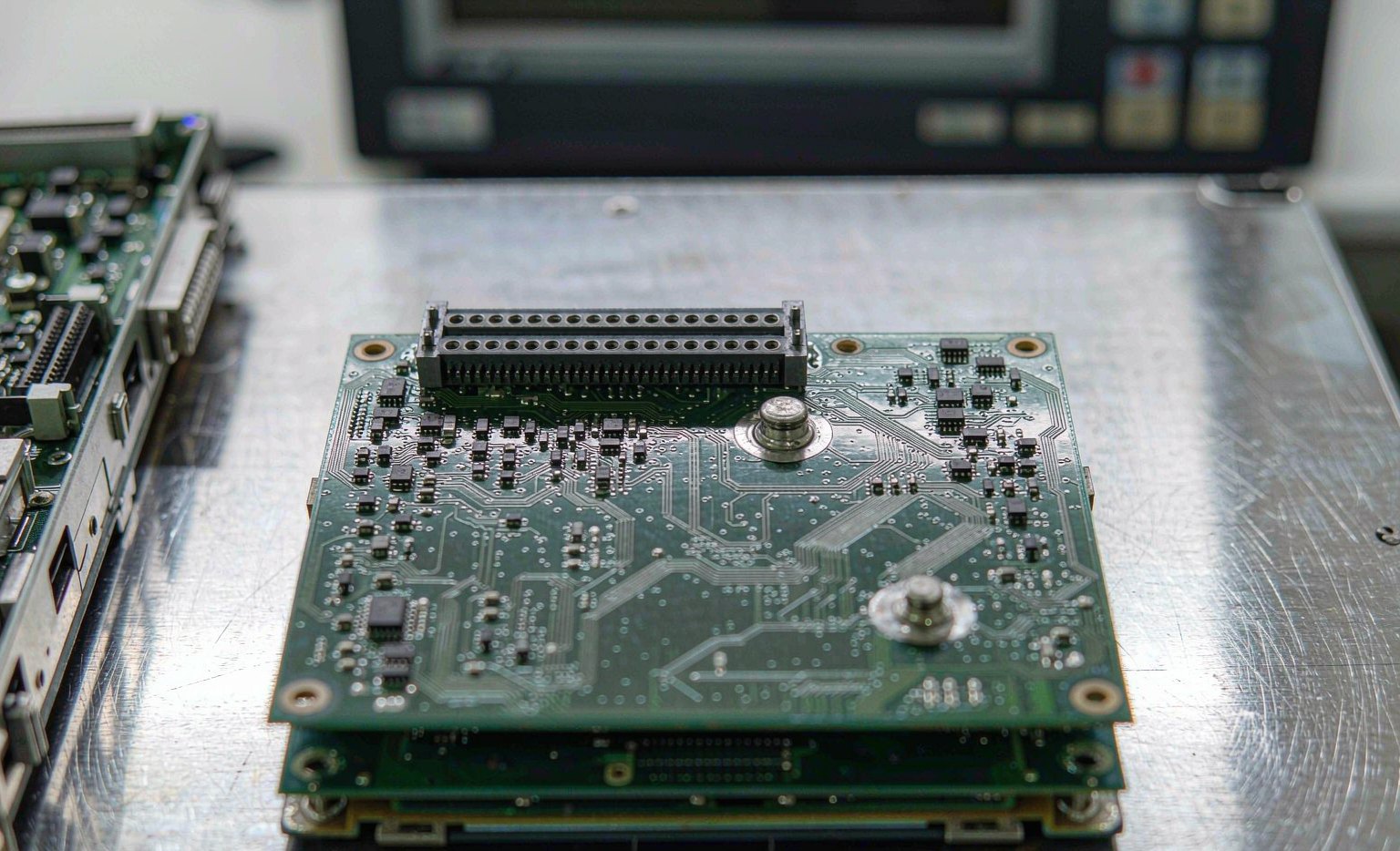
Plastic packaging materials used for integrated circuits and modules are hygroscopic. They absorb water vapour from ambient air in proportion to relative humidity and exposure time. That water then migrates during thermal excursions and changes both the mechanical and the electrical behaviour of the assembly.
Three failure mechanisms that dry storage addresses
- Moisture-induced stress and popcorn cracking. When a moisture-loaded component is heated quickly above 100 °C, trapped water vaporises. The internal pressure can delaminate the package, crack the mould compound, or break wire bonds. This is the mechanism behind the moisture sensitivity level (MSL) system in IPC/JEDEC J-STD-033.
- Corrosion and electrochemical migration. At elevated humidity, a thin water film forms on plated surfaces. With bias voltage present, metal ions migrate between closely spaced conductors. On fine-pitch connectors, sensor pins, and long-life ECUs, this produces leakage paths, dendrites, and intermittent faults.
- Condensation during temperature cycling. A part stored in warm, humid air and then moved into a cold chamber or a winter logistics leg can cross the dew point. Liquid water on a populated board acts immediately and is far more aggressive than humid air.
What automotive standards assume about humidity
Automotive qualification programs such as AEC-Q100 for ICs and AEC-Q200 for passive components include humidity-biased stress tests, typically in the 85 °C / 85 % RH region. Those tests describe what a part must survive, not how it should be stored. Quality systems such as IATF 16949 then require evidence that storage conditions were controlled and traceable — meaning humidity must be measured, logged, and bounded, not simply "kept in a dry room".
Where Moisture Enters the Automotive Electronics Supply Chain
Humidity exposure is a sequence of events, not a single one. The table below maps the usual risk points to a storage response.
| Process stage | Typical exposure | Main risk | Storage response |
|---|---|---|---|
| Incoming kitting | Packs opened, partial reels returned to stock | Floor-life clock restarts unnoticed | Low-RH cabinet with recorded entry and exit |
| Bare PCB storage | Packs punctured, panels staged for SMT | Copper pad oxidation, solderability loss | Moisture-proof storage below 20 % RH |
| SMT work in progress | Line stop, shift break, partial build | Reabsorption between reflow passes | Cabinet beside the line with fast recovery |
| Finished ECU buffer | Days to weeks of staging | Connector corrosion, coating cure defects | Controlled storage with RH history |
| Sensors and ADAS modules | Long shelf periods before fitting | Drift, seal ageing, condensation on optics | Stable low-RH, stable temperature |
Choosing Humidity Setpoints for Automotive Parts
There is no single correct setpoint for a plant. The right band depends on the part family, the packaging it arrives in, and the next thermal process it will see. The values below are indicative starting points for a specification discussion. Always confirm against the component datasheet, the J-STD-033 floor-life calculation, and your own qualification data before fixing a process window.
| Part family | Indicative RH band | Reason |
|---|---|---|
| Unpopulated rigid PCBs | 10 – 20 % RH | Slows copper oxide growth in a stable, static-safe range |
| MSD components, bulk or partial reels | Below 10 % RH | Extends floor life so reflow can proceed without a bake |
| Sensors, MEMS and optical modules | 15 – 30 % RH | Prevents condensation on optics and pressure ports |
| Connectors, terminals and plated hardware | Below 30 % RH | Limits electrochemical migration on close-pitch contacts |
| Finished ECUs awaiting shipment | 20 – 40 % RH | Protects seals and coatings without over-drying elastomers |
| Long-term reference samples | 20 – 30 % RH | Stable baseline, no corrosion or desiccation |
Two notes. First, a lower setpoint is not automatically better: many plastics, adhesives, and labels behave differently in very dry air, and static charge builds more easily below roughly 20 % RH. Review drying and ESD protection together. Second, the setpoint matters less than recovery behaviour — a cabinet that reads 5 % RH when closed but climbs to 40 % whenever a door opens is not delivering 5 % RH storage.
How to Specify a Dry Storage Cabinet for an Automotive Line
Automotive buyers often compare storage equipment on price per litre. That misses the parameters that decide whether a cabinet holds a process window across three shifts.
| Specification | What to ask for | Why it matters on a production line |
|---|---|---|
| Humidity range | Continuous control across roughly 1 – 50 % RH, adjustable | One cabinet type serves boards, MSD parts, and goods |
| Recovery time | Time to return to setpoint after a door cycle, with test conditions | Sets the real average exposure on a busy line |
| Uniformity across shelves | Measured at top, middle, and bottom, not only at the sensor | Stops the bottom shelf becoming an uncontrolled zone |
| ESD-safe construction | Dissipative shelves and grounding point; no ungrounded trays | Required for bare boards and sensitive devices |
| Monitoring and alarms | Independent display, high-limit alarm, door detection | Turns a silent drift into action before parts are scrapped |
| Data logging | Timestamped RH and temperature history, exportable | Provides the evidence an audit or 8D report asks for |
| Footprint and throughput | Shelf count and capacity matched to daily turnover | Avoids the commonest failure mode: cabinets too full to close |
A Practical Storage Workflow for Automotive Electronics
The equipment is only half of the control. The other half is a workflow that operators can follow without judgement calls:
- Classify by moisture sensitivity. Mark every incoming reel, tray, and module with its MSL or a plant storage class before it reaches the line.
- Store by class, not by convenience. Put MSD components and bare boards in the low-RH cabinet; keep finished modules in a separate zone so door traffic does not disturb critical parts.
- Record entry and exit. Log when a partial reel leaves the cabinet. The clock does not stop because the part is on a trolley.
- Bake only when the clock has expired. Baking is a recovery step, not a routine one. For profile selection, see our guide to IPC/JEDEC J-STD-033D MSD management.
- Return baked parts to dry storage. A part that is baked and then left in plant air reabsorbs moisture within hours, undoing the bake.
- Review the log monthly. Repeated high-limit alarms and shelves that consistently drift point to capacity problems, not operator problems.
Where YanSyn Fits in an Automotive Electronics Process
YanSyn builds temperature and humidity control equipment, with product lines that map onto the three jobs described above.
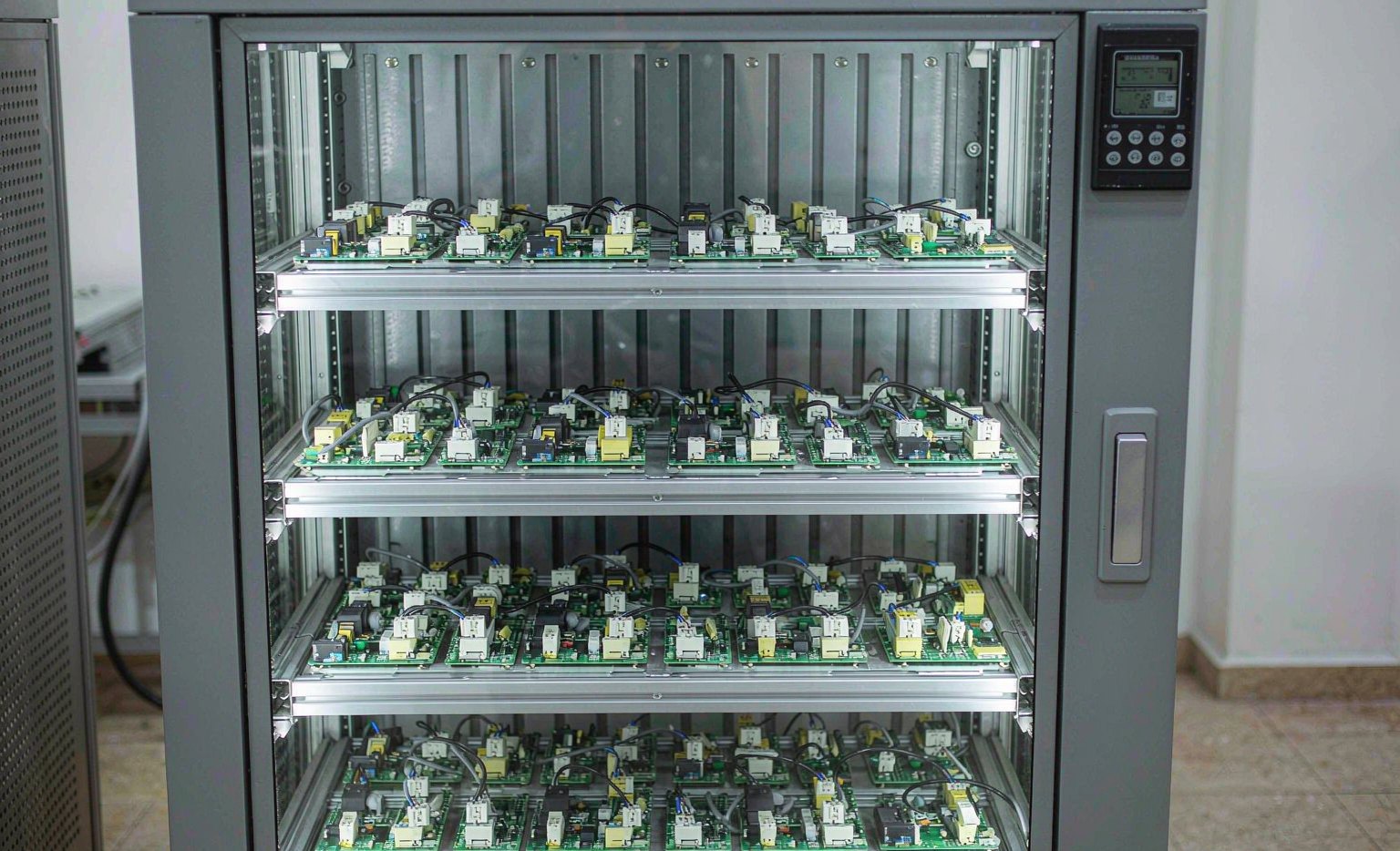
- YSM moisture-proof cabinets for humidity-controlled storage across roughly 1 – 50 % RH, used for bare boards, MSD components, sensors, and module buffers. See the YSM series moisture-proof cabinet range.
- YSN nitrogen cabinets where oxidation, not only humidity, is the concern — such as connector plating and oxidation-sensitive alloys. See the YSN series anti-oxidation nitrogen cabinets.
- YSHG electric heating ovens with PID control and uniformity of ±2 °C or better (customizable to ±1 °C) for baking and curing, with optional cleanroom, nitrogen, and IoT configurations. See the YSHG series electric heating oven.
If you are matching model numbers to a process, our YanSyn model code guide explains how the YSM, YSN, and YSHG designations are structured. For a wider view of humidity setpoints, the how-to-choose-humidity guide is a useful companion.
Common Mistakes in Automotive Moisture Control
- Treating dry storage as a warehouse function. If logistics owns storage instead of process engineering, setpoints drift and alarms get muted.
- Trusting a single sensor. The cabinet display reports one point. Without a reference or a logged record, there is no way to prove the setpoint held.
- Over-drying static-sensitive parts. Below roughly 20 % RH, charge retention on insulating surfaces grows. Manage drying and ESD together.
- Ignoring condensation during transfers. Moving parts from a cold store to a warm, humid hall creates the same water film as a rain event. Let parts equalise in sealed containers.
- Assuming nitrogen is always the answer. Nitrogen purge addresses oxidation; humidity control addresses moisture. Some parts need both, and some need only one.
Frequently Asked Questions
What humidity should automotive electronics be stored at?
It depends on the part. Moisture-sensitive components in opened packaging are typically held below 10 % RH to extend floor life; bare boards sit in the 10 – 20 % RH range; finished ECUs, sensors, and long-term samples are usually stored between 20 % and 40 % RH. Confirm the final value against the component datasheet and your process validation.
Is a dry cabinet required if components arrive in sealed dry packs?
Sealed packaging controls the part until the pack is opened. The storage problem begins the moment a reel or tray is opened and the remainder returns to stock. A cabinet makes a partial reel reusable without a bake.
How long can an MSD part stay outside the cabinet?
Floor life is defined by the component's MSL class and the ambient conditions of the assembly area, and is calculated according to IPC/JEDEC J-STD-033. Rather than tracking it mentally, log cabinet exit and return times so the accumulated exposure is visible.
Do we need nitrogen if we already control humidity?
Not always. Nitrogen purge reduces oxygen concentration, which slows oxidation of plated surfaces and oxygen-sensitive materials. If your failure modes are solderability loss, tarnish, or oxidation rather than moisture-induced cracking, purge storage is the relevant control.
How should dry cabinets be validated?
Validate the empty cabinet first — setpoint accuracy, recovery time after a door cycle, and uniformity across shelves — then validate the loaded condition, because a full cabinet behaves differently from an empty one.
Conclusion
Moisture damage in automotive electronics is predictable, which means it is preventable. Define a humidity band per part family, place storage where the parts actually are, log conditions continuously, and treat baking as an exception. Those four decisions remove one of the most common causes of latent field failures and SMT yield losses.
If you are specifying storage for an automotive electronics program, tell us your part families, current failure modes, and available footprint. We will propose a configuration from the YSM, YSN, and YSHG ranges and share the measurement data you need.
Request a storage specification review
YanSyn Intelligence (Shanghai) Co., Ltd. — Building 10, No. 568, Xueronghua Road, Pudong New Area, Shanghai, China. We manufacture moisture-proof cabinets, nitrogen cabinets, and industrial heating ovens for electronics, semiconductor, new energy, biopharma, automotive, and research applications.
Related Posts
How to Specify a Constant Temperature & Humidity Chamber: Buyer's Guide
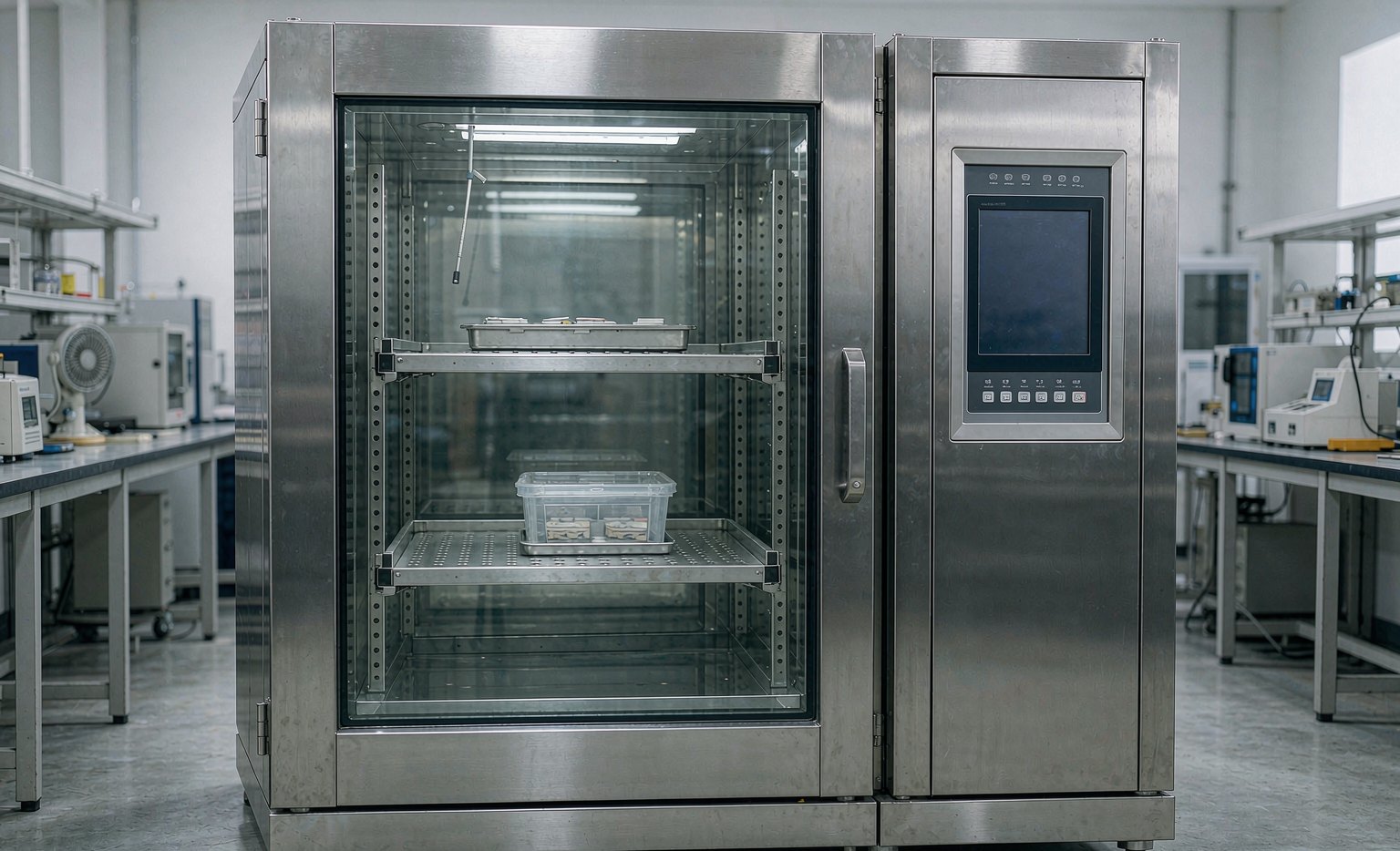
Specifying a heating oven means controlling one variable: temperature. Specifying a dry cabinet means controlling one variable: relative humidity. A constant temperature and humidity chamber looks like a simple combination of the two, but it…

Photovoltaic Module Manufacturing: Storage & Curing Solutions for Moisture, Oxidation, and Heat Control
Photovoltaic module manufacturing is a race against contamination. Between cell sorting and the final flash test, every layer — glass, encapsulant, cells, ribbons, backsheets, and adhesives — passes through multiple humidity, oxidation, and temperature windows.…
YanSyn Cabinet Manufacturing Process
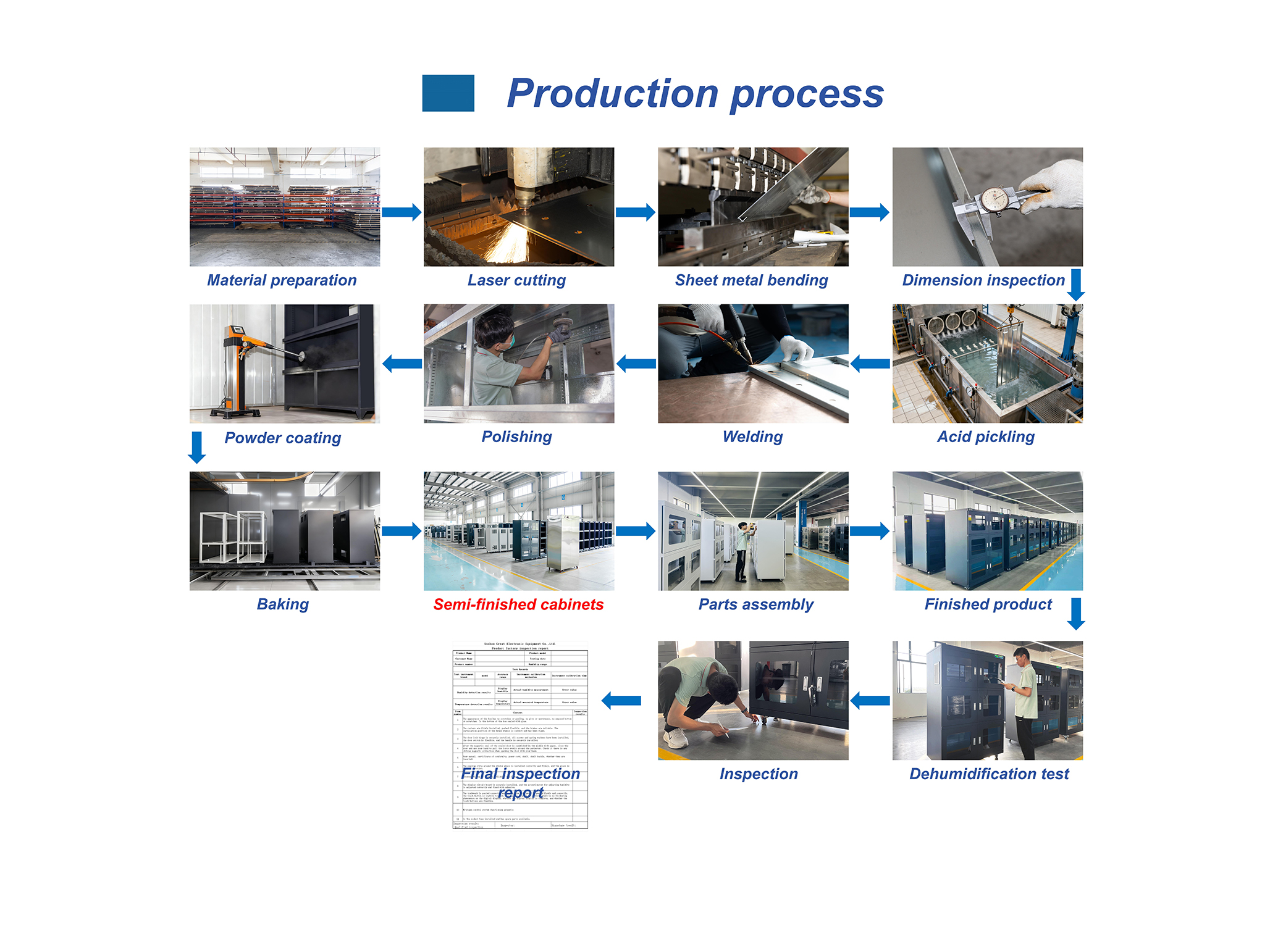
Sheet metal fabrication techniques: blanking, bending, stretching, forming, welding The cabinet body of YanSyn follows standard sheet metal processing methods, including blanking, bending, stretching, forming, and welding. The detailed manufacturing processes are as follows: 1.…