
A high-low temperature test chamber is one of the most frequently mis-specified pieces of laboratory equipment. Two labs can order machines with the same nominal temperature range and still end up with completely different capabilities, because the numbers that actually decide whether a test works — ramp rate, uniformity under load, recovery time, data integrity — are often left out of the request for quotation entirely.
This guide is written for university laboratories, research institutes, and industrial QA teams preparing to specify a high-low temperature test chamber. It explains what the machine really does, walks through the eight specification blocks you should define before contacting any supplier, and clarifies the boundary between a true test chamber and a heating oven such as the YanSyn YSHG electric heating oven series.
What a High-Low Temperature Test Chamber Actually Does
A high-low temperature test chamber creates controlled temperature excursions — both above and below ambient — and moves the test articles between them in a repeatable cycle. Typical jobs include:
- Temperature cycling and thermal stress screening. Repeated exposure to hot and cold extremes to precipitate latent defects in electronics, solder joints, adhesives, and composite materials before products reach the field.
- Cold-start and high-temperature operation testing. Verifying that a device powers up, measures correctly, and remains safe at the temperature extremes stated in its own specification.
- Storage and aging studies. Holding materials at elevated or reduced temperatures for days or weeks to observe drift, degradation, or phase changes.
- Pre-conditioning before other tests. For example, moisture sensitivity baking and dry storage are handled separately — see our guide to MSD baking profiles and the popcorn effect.
Internationally, this kind of testing is anchored by generic environmental test frameworks such as the IEC 60068 series (cold, dry heat, and change-of-temperature tests), automotive and electronics industry cycling standards, and customer-specific reliability programs. The exact standard matters less at the specification stage than one insight: the chamber must reproduce the profile your standard demands, inside your workspace, with your load installed. That last clause is where most specifications fall apart.
Eight Specification Blocks to Define Before You Request a Quote
1. Temperature range — and whether you need cooling at all
State the working range honestly. A chamber specified as -40 °C to +150 °C needs a mechanical refrigeration stage; a chamber specified as ambient +20 °C to +300 °C may not. Many labs order sub-zero capability they never use, paying for compressor capacity, higher power draw, and additional maintenance for the life of the machine.
If your testing only involves elevated temperatures — curing, drying, burn-in, annealing — a heating-only oven is often the better engineering and economic choice. The decision boundary is discussed later in this article.
2. Ramp rate — and whether it is specified empty or loaded
Ramp rate is how fast the chamber air temperature moves, usually expressed in °C per minute. Two details are routinely misunderstood:
- Average versus linear ramp. Averaged ramp rates are calculated across the full span and can look better than the achievable rate near the extremes, where heating or cooling authority is weakest.
- Empty chamber versus loaded chamber. A published ramp rate almost always describes an empty workspace. A full rack of aluminium fixtures or a dense stack of circuit boards changes the thermal picture completely. Ask the supplier to state ramp performance with your representative load.
3. Three different numbers: stability, uniformity, fluctuation
Suppliers quote temperature performance in several ways, and mixing them up is the single most common source of disappointment after installation:
- Stability (fluctuation) — how tightly the chamber holds a set point at one location over time, for example ±0.5 °C.
- Uniformity — how consistent temperature is across the workspace volume at the same moment, for example within ±2 °C between corners and centre.
- Deviation under load — how much the above values degrade when your product and fixtures are inside.
For orientation: the YanSyn YSHG industrial oven line is built with PID control and a temperature uniformity of within ±2 °C (customisable to ±1 °C by agreement), with working temperatures from room temperature up to 500 °C. Whatever numbers your application requires, write them into the purchase specification explicitly, including the load condition under which they must be met.
4. The load: mass, material, and thermal behaviour
Describe what goes inside the chamber. A specification is not complete without it:
- Total mass of product and fixtures per cycle, and the material (metal fixtures add large thermal mass).
- Whether the load dissipates heat itself (powered devices under test do).
- Whether the load can release moisture or volatiles, which affects both humidity control and, in extreme cases, heater sizing and exhaust design.
- Fixture design — shelves, racks, and how parts are suspended — because airflow around the load determines real uniformity.
5. Workspace geometry and airflow
Volume alone is a poor sizing metric. Compare the internal dimensions against your largest fixture, allow clearance for air circulation, and ask for a description of the airflow pattern (horizontal versus vertical flow, air change frequency). A chamber that technically fits your load but blocks its own airflow path will never meet its uniformity rating.
6. Humidity — usually a separate decision
Combined temperature-and-humidity testing is a different class of equipment with a water system, humidity sensor maintenance, and different failure modes. If your programme genuinely requires humid cycling, specify it as such and see our separate buyer's guide to the constant temperature and humidity chamber. If you only need dry temperature cycling, do not pay for the water system — but do specify maximum dryness where relevant, for example when testing moisture-sensitive components. For storage between test runs, dedicated dry cabinets such as the YSM moisture-proof cabinet series or nitrogen-purged YSN anti-oxidation cabinets keep parts within the moisture-sensitive-device floor-life rules far more economically than any test chamber.
7. Control, data recording, and compliance
For university research and regulated industry alike, the recorder is part of the product:
- Programmable profiles: number of segments, cycles, and dwell times; ramp-and-soak programming quality determines how faithfully a standard profile is reproduced.
- Independent data logging with exportable files and a timestamp that survives audits.
- For pharmaceutical or accredited laboratories, check whether electronic records need to support data-integrity expectations (user access control, audit trail, protected storage) before purchase, not after.
- Alarm and safety layers: independent over-temperature protection separate from the main controller, and defined behaviour on power failure.
8. Utilities, installation, and service
Finally, close the loop on site conditions: electrical supply and breaker sizing, heat rejected into the room (refrigerated chambers dump significant heat), clearance for condenser airflow, ambient limits of the lab itself, drainage if humidity is fitted, and the supplier's commissioning, calibration, and spare-parts support in your region. A chamber that cannot be calibrated locally is a specification failure regardless of its datasheet.
Specification Checklist Table
Use the following table as a minimum RFQ checklist. Fill the "your requirement" column before sending anything to a supplier.
| Specification block | What to define | Common omission |
|---|---|---|
| Temperature range | Working range actually used by your test standards; whether sub-ambient is genuinely required | Ordering refrigeration that will never be used |
| Ramp rate | Required °C per minute, and whether it must be met loaded or empty | Comparing an empty-chamber figure against a loaded requirement |
| Stability / uniformity | Both numbers separately, with the load condition stated | Accepting one blended "accuracy" figure |
| Load | Mass, material, heat dissipation, moisture release, fixtures | Specifying only the part, never the fixture |
| Workspace & airflow | Internal dimensions, clearance, airflow pattern | Sizing by volume instead of by fixture geometry |
| Humidity | Explicit yes/no; if yes, range and water-system maintenance plan | Assuming humidity comes "for free" with temperature |
| Control & data | Profile capability, logging export, data-integrity features, independent over-temperature protection | Discovering audit-trail gaps after an inspection |
| Site & service | Power, heat rejection, clearances, calibration and spares availability | Ignoring room heat load from refrigerated chambers |
Test Chamber or Heating Oven? Drawing the Boundary
Not every laboratory that searches for a "test chamber" actually needs one. The practical boundary is simple:
- If your range never goes below ambient, and your process is defined by holding or slowly ramping elevated temperatures, a heating oven is the correct tool. It delivers tighter high-temperature performance per unit of budget, with fewer moving parts and less maintenance. The YanSyn YSHG series covers room temperature to 500 °C with PID control and, where required, optional cleanroom-compatible construction, nitrogen atmosphere, and IoT monitoring — the same platform used for curing, drying, burn-in, and annealing work. For a structured comparison of two common oven types, see clean oven versus high-temperature oven.
- If your profile requires sub-ambient temperatures or fast cycling across a wide span, you need a true high-low temperature test chamber with refrigeration — specified according to the eight blocks above.
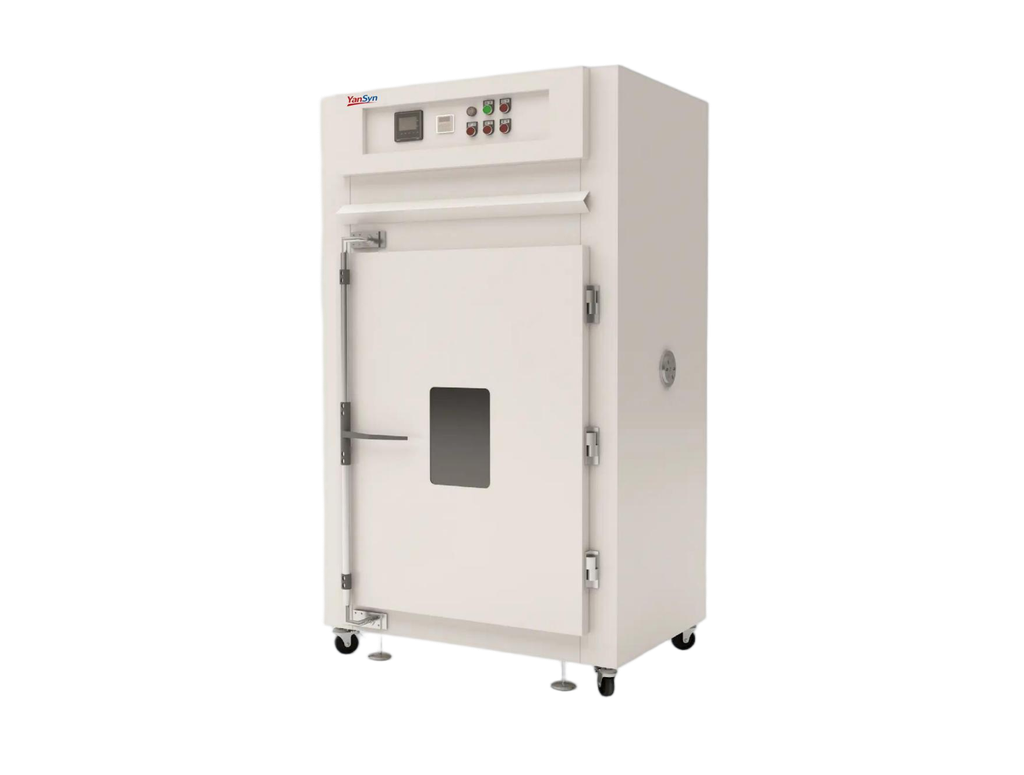
A frequent middle case deserves mention: labs that need dry, oxygen-controlled elevated-temperature processing — for example, curing adhesives or annealing oxidation-sensitive parts. That is solved not by a refrigerated chamber but by an oven with a nitrogen atmosphere option, combined with low-humidity storage from the YSM or YSN lines before and after processing.
Five Common Specification Mistakes
- Copying a competitor's datasheet. Their numbers reflect their load and airflow, not yours.
- Specifying only the extremes. Most test failures happen in the transitions and dwells, not at the endpoints.
- Forgetting the fixture. Racks and trays routinely outweigh the product and dominate thermal behaviour.
- Treating the recorder as an accessory. In accredited and regulated labs, data capability is a primary requirement.
- Ignoring installation reality. Doorway widths, floor loading, room heat gain, and power quality end more chamber projects than technical shortfalls do.
Frequently Asked Questions
What is the difference between a high-low temperature test chamber and an environmental chamber?
Usage varies by region. In most technical contexts, a high-low temperature test chamber covers temperature-only cycling, while "environmental chamber" is the broader family that may add humidity, altitude, vibration, or light. Always specify the actual variables you need rather than relying on the label.
Do I need humidity control in a temperature cycling chamber?
Only if your test standard calls for humid conditions. Temperature-only cycling is simpler, drier, and cheaper to maintain. If moisture sensitivity of components is the concern, control moisture through storage — dry cabinets or nitrogen purging — rather than by humidifying the test itself.
How much workspace margin should I allow?
As an indicative planning assumption to be validated with your supplier: keep at least 20 to 30 percent of the workspace free around the load so air can circulate, and treat published uniformity as a figure that applies to properly spaced loads, not packed ones.
Can an oven replace a test chamber for high-temperature-only testing?
Yes, and it is usually the better choice: better temperature ceiling per unit of cost, simpler maintenance, and options such as nitrogen atmosphere or clean construction. Choose a chamber only when sub-ambient temperatures or rapid cycling are genuine requirements.
Conclusion
A high-low temperature test chamber is a profile-reproduction machine, and a good specification describes the profile, the load, the numbers, and the records — in that order. Define the eight blocks above before you request a quote, decide honestly whether you need cooling at all, and draw the oven-versus-chamber boundary deliberately. If your requirement sits on the elevated-temperature side, the YanSyn YSHG heating oven series may be the more precise and more economical answer, and our team can help you specify it against your test standards.
Related Posts

The Development History of Electronic Dry Cabinets
Electronic dry cabinets have become indispensable storage and production equipment in many industries, including semiconductors, electronics manufacturing, biopharmaceuticals, and new energy. So, how did dry cabinets evolve, and what are the future development trends? In…
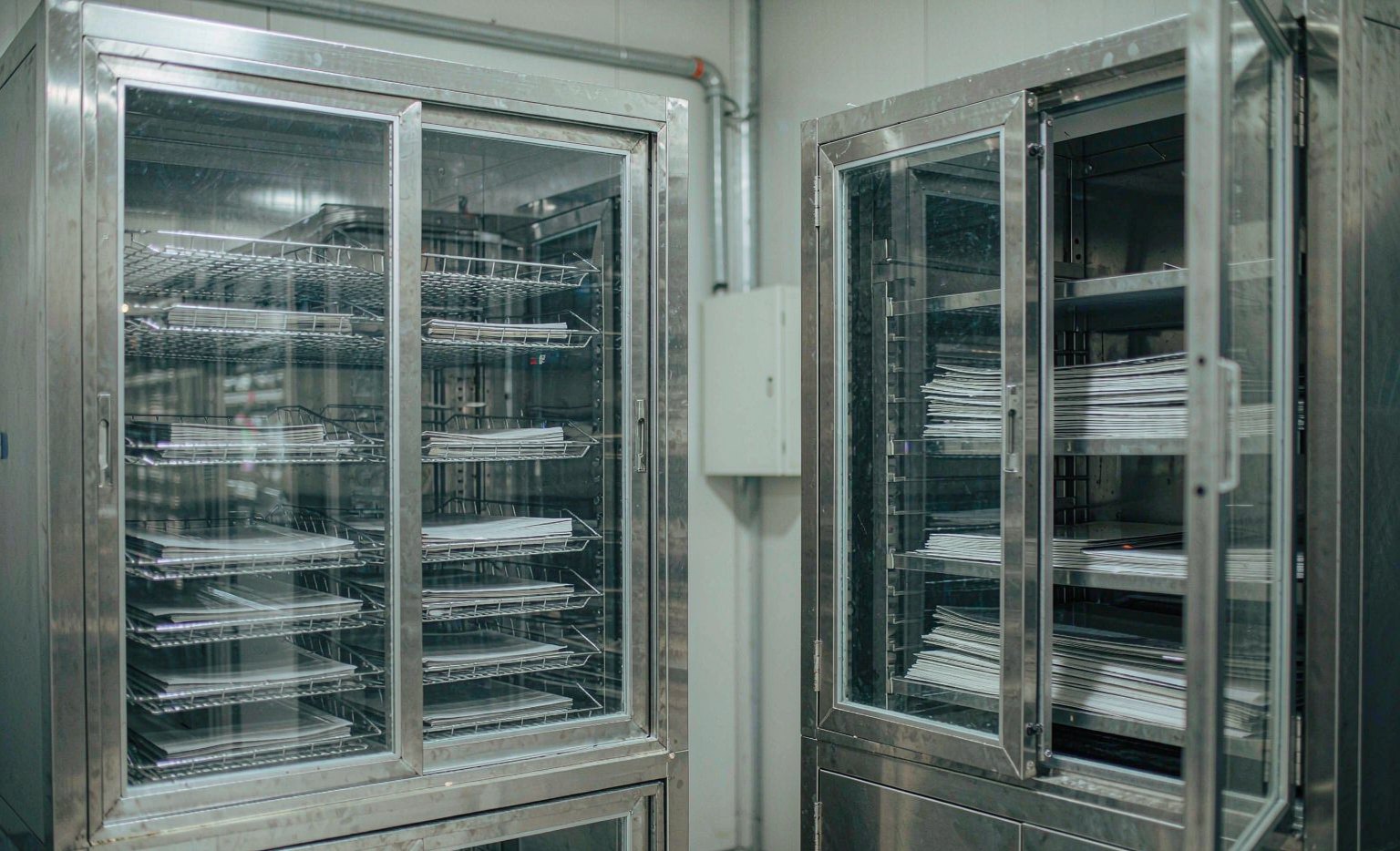
Nitrogen Purge Cabinet vs Desiccant Dry Cabinet: The 5-Year TCO Breakdown
Every procurement cycle starts the same way. Two quotes land on the same desk: one for a desiccant dry cabinet, one for a nitrogen purge cabinet holding the same number of trays. The desiccant unit…
MSD Management: Why IPC/JEDEC J-STD-033D Matters
Moisture-sensitive devices (MSDs) absorb moisture from the air. During reflow soldering, the rapid heating turns that moisture into steam, causing internal cracks—a defect known as the “popcorn effect.” This leads to latent failures or immediate…