
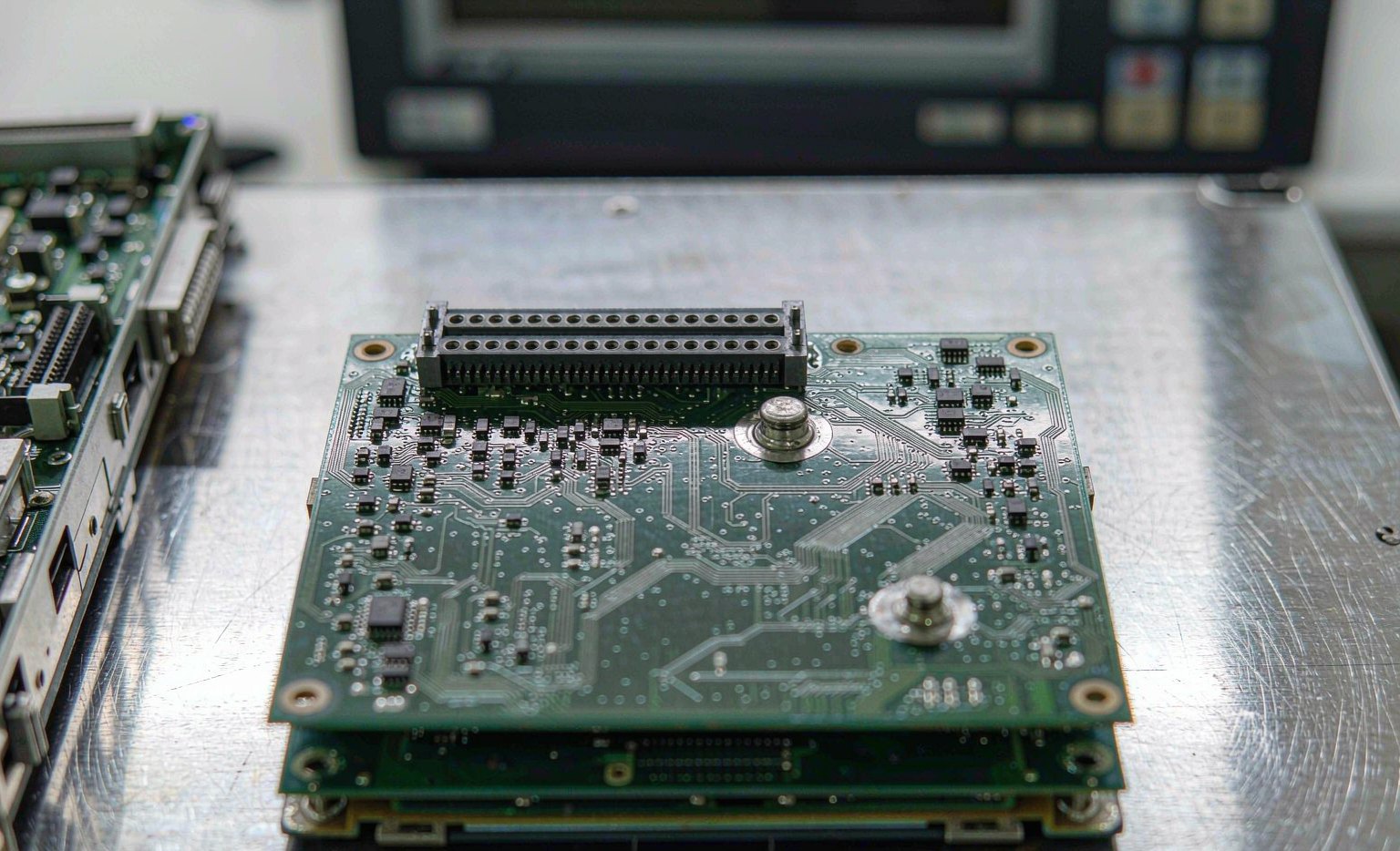
5G base stations, small cells, and radio units are packed with parts that are far more moisture-sensitive than their industrial appearance suggests. High-frequency RF printed circuit boards, gallium arsenide and gallium nitride MMICs, silver- and copper-plated connectors, cavity filters, and low-loss cable assemblies all degrade in measurable ways when they sit in humid ambient air — and most of that damage is invisible until the unit fails a PIM test, drifts out of frequency, or corrodes in the field.
This guide is written for telecom hardware manufacturers, base-station integrators, and maintenance teams that store RF and base-station parts between production, installation, and field service. It explains why 5G hardware is moisture-sensitive, which failure modes matter most, and how to specify dry-cabinet storage setpoints for each part family — using a moisture-proof dry cabinet such as the YanSyn YSM series moisture-proof cabinet as the reference storage environment.
Why 5G and RF Hardware Is More Moisture-Sensitive Than Older Telecom Equipment
Several trends in 5G hardware design push moisture sensitivity upward at the same time:
- Higher frequencies, tighter geometry. At mmWave frequencies, even a small change in the dielectric constant of a PCB laminate — which absorbed moisture directly causes — shifts impedance and insertion loss enough to fail specification. Sub-6 GHz designs tolerate more; 28 GHz and above tolerate very little.
- Fine-pitch, low-standoff packaging. ADFAs, QFNs, and chip-scale RF packages sit close to the board, so flux residues and absorbed moisture have less room to escape during reflow, making popcorning and voiding more likely.
- Dissimilar plated metals. RF connectors, jumpers, and filter tuners rely on silver, copper, gold-over-nickel, and tin platings. In humid air, these combinations drive galvanic corrosion and silver migration — both direct causes of intermittent contact resistance and passive intermodulation (PIM).
- Mass production economics. 5G rollouts move huge volumes of radios, antennas, and filters through the supply chain. Parts wait in warehouses, in transit, and on the line. Waiting time is where uncontrolled humidity does its damage.
Individually, none of these is exotic. Together, they mean that storage conditions — not just production conditions — decide whether assembled units meet their RF specifications.
The Four Failure Modes That Matter in Humid Storage
1. Laminate moisture absorption and RF parameter drift
Modern RF laminates and prepregs are engineered for low loss, but most polymer systems still absorb moisture from ambient air. Absorbed water raises the dielectric constant and dissipation factor, which shifts impedance, increases insertion loss, and detunes filters and antennas. The drift is often within specification when the part is fresh and out of specification after weeks of humid storage or a humid transit leg — a pattern that is very hard to debug after the fact.
2. MSD popcorning during reflow
Plastic-encapsulated RF and power components are classified for moisture sensitivity under IPC/JEDEC J-STD-033. Once a moisture-sensitive device (MSD) is exposed beyond its floor-life limit, trapped moisture vaporizes during reflow and cracks the package from the inside — the classic "popcorn" defect. We cover the baking curves in detail in our MSD baking profile deep-dive; the storage-side fix is to keep MSDs inside their floor-life window by holding them in a dry cabinet the moment their moisture-barrier bag is opened.
3. Galvanic corrosion and silver migration on plated interfaces
Silver-plated contacts and cavity tuner screws are the usual casualties. In the presence of moisture and ionic contamination, silver migrates along the surface and corrodes to resistive compounds; copper platings oxidize; tin whiskers grow faster in humid, thermally cycled storage. On an RF connector these defects appear as rising contact resistance, intermittent VSWR, and — in duplexers and filters — PIM products that only show up during a line sweep.
4. Condensation during transport and outdoor staging
Base-station parts routinely move between air-conditioned buildings, unheated trucks, and outdoor cabinets. Each transition can push the part below its dew point and condense water onto PCBs and inside connectors. Staging hardware in a controlled low-humidity environment before packing, and using desiccant and moisture-indicator cards inside the shipping packaging, reduces the amount of free water available for that cycle.
Where Moisture Control Fits in the Telecom Hardware Workflow
A practical deployment places dry storage at four points:
- Incoming and warehouse storage. RF modules, MMICs, connectors, and filters wait days or weeks before assembly. This is the largest and most neglected humidity exposure.
- Open-bag MSD staging at the SMT line. After the moisture-barrier bag is opened, the component clock starts. A dry cabinet at the line keeps floor-life from being consumed while the feeder is prepared.
- Post-process buffering. Boards awaiting conformal coating, final RF test, or calibration should not sit in open shop air, especially before the coating that will become their only moisture barrier.
- Spare parts and field-service inventory. Replacement RF modules and filters stored at a depot for years must come out of storage ready to install and pass a line sweep immediately.
Recommended Dry-Cabinet Setpoints by Part Family
The table below summarizes storage conditions commonly used in the electronics and telecom industry. Treat every value as a starting point to be confirmed against your component manufacturers' data sheets and your own quality procedures — it is an indicative reference, not a substitute for component-level specifications.
| Part family | Typical storage setpoint | Primary risk if stored in ambient air | Notes |
|---|---|---|---|
| MSD components (MSL 3–6, incl. RF ICs) | 1–5% RH, or below 10% RH for MSL 2a and better parts | Popcorning and delamination at reflow | Follow the J-STD-033 floor-life clock; dry storage pauses it for most part families |
| Assembled RF boards awaiting test or coating | Below 10% RH, ambient temperature | Dielectric drift, pre-coating contamination | Buffer time before conformal coating is the critical window |
| Plated RF connectors and adapters | Below 10% RH; nitrogen purge for silver-plated long-term storage | Tarnish, galvanic corrosion, contact resistance rise | Where oxidation control matters as much as humidity, a nitrogen cabinet such as the YanSyn YSN series is the better fit |
| Cavity filters and duplexers | Below 10% RH before final sealing | Resonator surface oxidation, tuning drift, PIM | Keep tuner hardware dry until the unit is sealed and verified |
| Cable assemblies and jumpers | Below 10% RH for long-term depot storage | Connector corrosion, jacket and dielectric moisture uptake | Store capped; dry storage protects the caps' sealing function |
| Antenna and radome assemblies | Below 20% RH, away from condensation cycles | Feed network corrosion, radome internal condensation | Large parts may need a walk-in or high-capacity configuration |
What to Specify in a Dry Cabinet for Telecom Parts
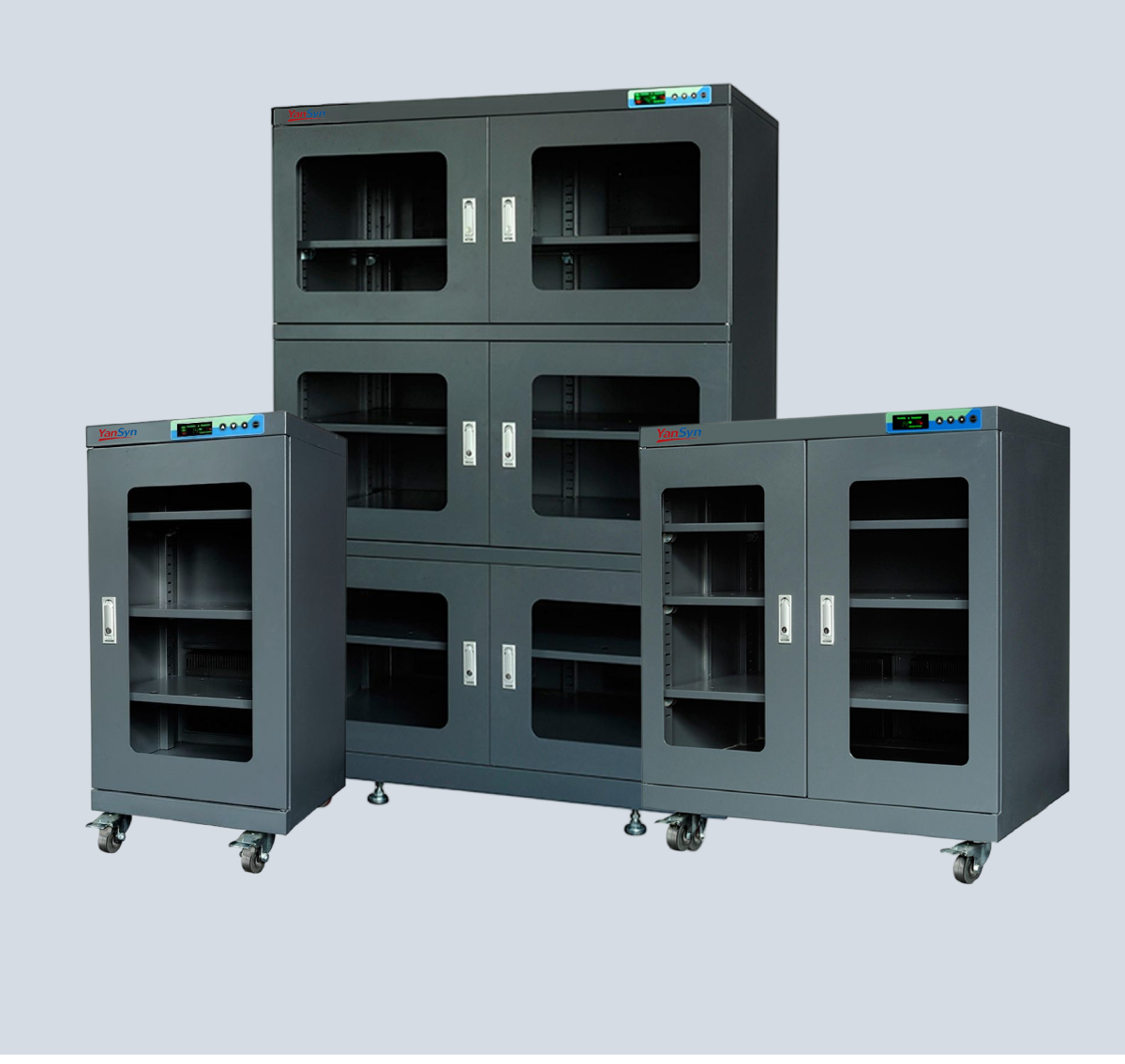
When you evaluate a moisture-proof cabinet for RF and base-station hardware, look past the RH number alone:
- Recovery speed. A cabinet that holds 5% RH when closed is not enough if it takes hours to recover after the door opens twenty times per shift. Ask for recovery-to-setpoint data with your actual door-opening pattern.
- Uniformity across shelves. A single sensor at the back can read well while the bottom shelf sits several points higher. Confirm the cabinet maintains its setpoint throughout the usable volume, not just at the sensor.
- Desiccant-core versus thermoelectric. Both technologies can reach ultra-low RH; desiccant-core designs generally recover faster after frequent door openings, which matters at a busy SMT line or kitting station.
- Data logging. Telecom quality audits increasingly ask for environmental records. Continuous logging with exportable history turns "we stored them dry" into evidence.
- Capacity planning. Size for your worst week, not your average one. Parts queue up before product launches and audits; a cabinet that is full precisely when you need it most quietly becomes ambient-air storage.
The YSM series moisture-proof cabinet is designed around exactly these parameters — adjustable setpoints from 1 to 50% RH, fast recovery, and uniformity suitable for MSD handling under IPC/JEDEC J-STD-033. For storage where oxidation of plated surfaces is the dominant risk, the YSN series nitrogen-purge cabinets add an inert-gas layer on top of humidity control.
Frequently Asked Questions
Do I need nitrogen for RF connectors, or is dry air enough?
For short-buffer storage of a few days to a few weeks, humidity control below 10% RH is normally sufficient to slow tarnishing to an acceptable rate. For long-term depot storage of silver-plated parts, or for parts that have already shown tarnish in your climate, nitrogen purge adds oxidation protection that humidity control alone cannot provide. The right answer depends on your plating stack, your climate, and your dwell time — verify with your plating supplier before committing either way.
How fast does a component consume its floor life in ambient air?
It depends on the moisture sensitivity level and the local climate. An MSL 3 part typically has 168 hours of floor life once the bag is opened under controlled conditions; in a hot, humid warehouse the effective window can be shorter. The safe practice is to move opened MSDs into a dry cabinet immediately and reset the clock according to the J-STD-033 procedure for the part family.
Is a dry cabinet enough, or do we also need baking?
They solve different problems. Dry storage prevents moisture uptake; baking removes moisture that has already been absorbed. If parts arrive with unknown or exceeded exposure history, follow the J-STD-033 baking profile before reflow, then keep them dry afterward. Our article on MSD baking curves covers the baking side in detail.
What about finished base-station units in outdoor cabinets?
Finished units are designed to survive the field, but the storage rule still applies before deployment: keep spares and pre-staged units out of condensing conditions. The most common field complaint in humid regions — water inside connectors after commissioning — usually traces back to a staging period, not to the installed environment.
Conclusion
Moisture damage in 5G and telecom hardware rarely announces itself. It appears later as a shifted filter, a marginal PIM sweep, or a reflow defect that survives to the field. Because the exposure happens mostly during waiting — in warehouses, at open feeders, in depot storage — storage humidity is one of the highest-leverage, lowest-cost controls available to a telecom hardware operation.
Start by mapping where your RF parts wait, assign a setpoint to each part family using the table above as a starting point, and verify every value against your component suppliers' data. If you are building or upgrading a storage environment for RF modules, plated connectors, or base-station assemblies, contact YanSyn for a storage specification review — our team helps telecom manufacturers match YSM and YSN cabinet configurations to their part mix, climate, and throughput.
Related Posts
The Popcorn Effect Deep-Dive: MSD Baking Curves That Save Yield
A single cracked package can scrap an entire assembled board. In many cases the crack did not start on the line. It started days earlier, when a tray of plastic-encapsulated devices sat open in ordinary…

Photovoltaic Module Manufacturing: Storage & Curing Solutions for Moisture, Oxidation, and Heat Control
Photovoltaic module manufacturing is a race against contamination. Between cell sorting and the final flash test, every layer — glass, encapsulant, cells, ribbons, backsheets, and adhesives — passes through multiple humidity, oxidation, and temperature windows.…
Oxygen-Free Ovens Demystified: When You Need Below 1 ppm O₂
Search for an industrial oven and you will quickly meet two very different promises. One is precise temperature. The other is an oxygen-free atmosphere, sometimes quoted as "below 1 ppm O₂". The difference is not…