
A single cracked package can scrap an entire assembled board. In many cases the crack did not start on the line. It started days earlier, when a tray of plastic-encapsulated devices sat open in ordinary room air and quietly absorbed water vapour. By the time the board reaches reflow, the damage is already sealed inside the package.
This article explains the popcorn effect in practical terms, shows how to read the moisture sensitivity level (MSL) floor-life clock, and describes the two baking routes defined by the IPC/JEDEC J-STD-033 handling standard. It is written for process engineers and quality teams who need a repeatable MSD baking profile instead of a guess. For the standard itself, see MSD Management: Why IPC/JEDEC J-STD-033D Matters.
What the popcorn effect actually is
Most integrated circuits are sealed in an epoxy moulding compound. That compound is not hermetic. It absorbs moisture from the air until it reaches equilibrium with the surrounding humidity. Under a microscope, the absorbed water sits at the interfaces between the moulding compound, the die paddle, the lead frame, and the die surface.
During reflow soldering the board is heated to a peak temperature. Lead-free profiles typically peak between 245 °C and 260 °C, well above the 220 °C to 235 °C range common with tin-lead profiles. Water at that temperature flashes to steam and expands roughly a thousandfold. The pressure concentrates at the weakest interface, the package delaminates, and if it rises further the steam bursts through the moulding compound. The result is an internal crack, a lifted die, or a visible bulge. The name comes from the audible crack some packages produce.
Two characteristics make this failure expensive. It is often latent: a partially delaminated package can pass electrical test and fail months later in the field. It is also a batch failure: every device in the same exposed tray carries a similar moisture load, so one storage mistake can affect hundreds of boards.
Reading the floor-life clock
JEDEC J-STD-020 defines how packages are classified into moisture sensitivity levels, and J-STD-033 defines how classified parts must be handled, packed, and dried. The classification tells you how long a part may remain exposed to ambient air before it must be baked. That period is the floor life.
| MSL | Floor life | Ambient condition | Practical meaning |
|---|---|---|---|
| MSL 1 | Unlimited | ≤30 °C / 85% RH | No baking needed |
| MSL 2 | 12 months | ≤30 °C / 60% RH | Rarely a problem in normal stores |
| MSL 2a | 4 weeks | ≤30 °C / 60% RH | Track by lot, not by memory |
| MSL 3 | 168 hours | ≤30 °C / 60% RH | One working week of exposure |
| MSL 4 | 72 hours | ≤30 °C / 60% RH | Three days, including weekends |
| MSL 5 | 48 hours | ≤30 °C / 60% RH | Two days. Needs a real control system |
| MSL 5a | 24 hours | ≤30 °C / 60% RH | One day. Dry storage is mandatory |
| MSL 6 | Mandatory bake | Time on label | Bake before every use |
Exposure is cumulative: every hour outside dry storage adds to the total for that part. Heat and humidity accelerate absorption, so a humid summer week consumes floor life faster than a dry winter week. The supplier's own manufacturing exposure time is counted by the classification, so the clock does not start at zero when you receive the reel.
Bake or not: the decision path
Baking is not free. It costs oven time and labour, and a high-temperature bake can degrade some packages and most plastic trays. The first question is therefore not how long to bake, but whether a bake is needed at all.
- Keep the part dry from the start. If floor life has not expired, no bake is required.
- Pause the clock in dry storage. Placing exposed parts in an active low-humidity cabinet is treated in the standard as stopping the floor-life clock. Confirm acceptance with your customer.
- Bake when the clock has expired or the label says so. MSL 6 devices always require a bake before reflow.
- Record every exposure. Without a record you cannot prove whether a bake was necessary, and you will bake everything.
The two baking routes
J-STD-033 defines two standard bake conditions. They are not interchangeable: they suit different packages, different trays, and different production rhythms.
| Parameter | High-temperature bake | Low-temperature bake |
|---|---|---|
| Set point | 125 °C (+5 / −0 °C) | 40 °C (+5 / −0 °C) |
| Humidity requirement | Not critical | ≤5% RH, mandatory |
| Typical duration | Hours. Exact time depends on package thickness and MSL | Days, commonly around 8 days for thick packages |
| Best for | Fast recovery, high-mix lines | Parts in trays that cannot withstand 125 °C |
| Main risk | Lead oxidation, intermetallic growth, tray deformation | Ineffective if humidity is not held below 5% RH |
| Operational cost | Low per batch, needs oven capacity | Low energy, high inventory waiting time |
The duration for each route is read from the bake table in the standard, using package body thickness and MSL as inputs. Work from the revision your customer requires, and use the conservative value when a lot mixes thicknesses.
What a good baking curve needs from the oven
The set point is the easy part. The curve features that decide the outcome are less obvious:
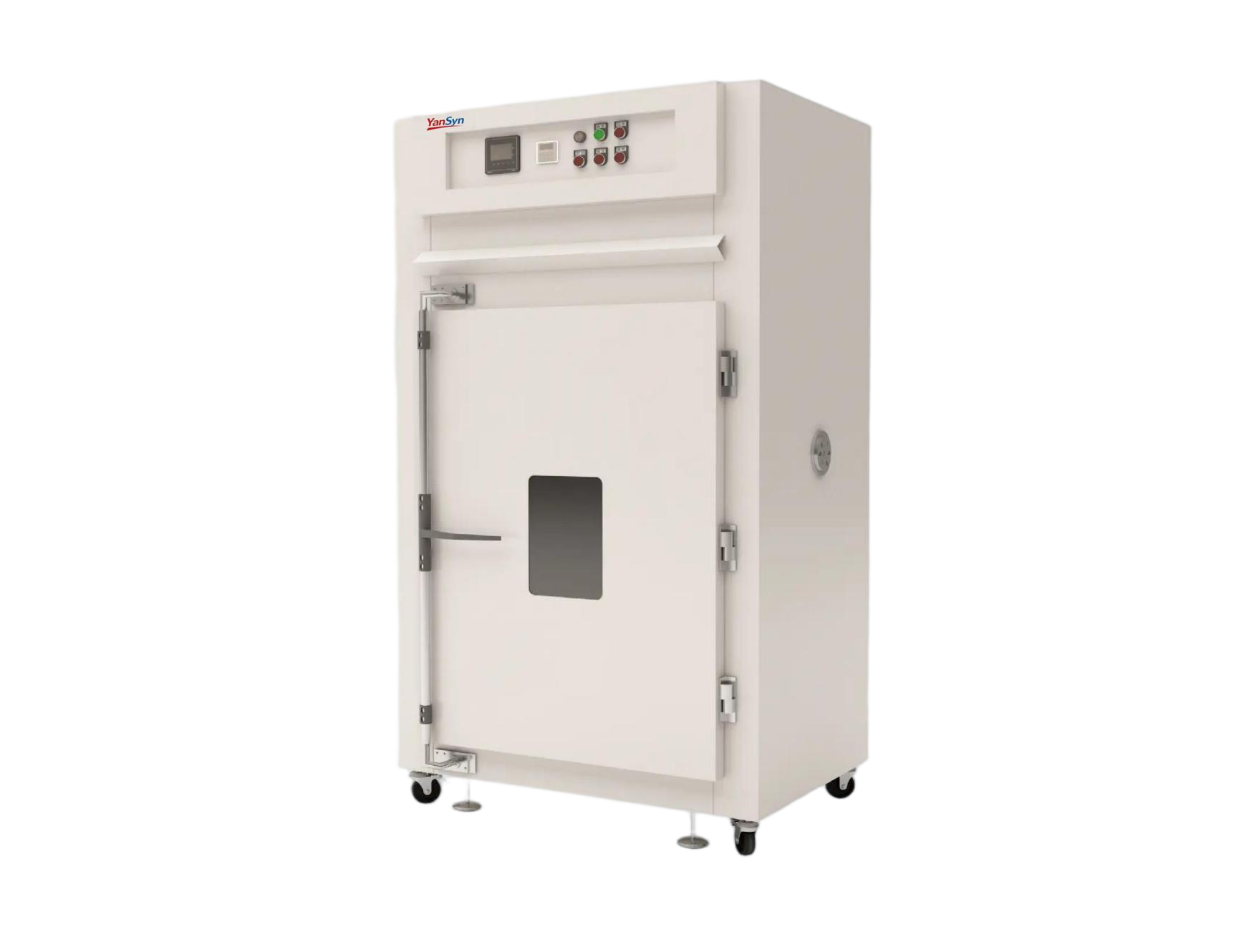
- Temperature uniformity across the load. A chamber that reads 125 °C at the sensor but 118 °C at the corner under-dries part of the batch. YanSyn YSHG ovens use PID control with ±1 °C control accuracy and chamber uniformity of ±2 °C or better, with ±1 °C available as a custom option.
- Recovery time after door opening. Loading a cold tray drops the chamber temperature; fast recovery keeps the effective soak time close to the specified value.
- Airflow distribution. Forced-air circulation removes the moisture leaving the packages; stagnant pockets slow drying.
- Atmosphere options. When lead oxidation is a concern, a nitrogen-purged chamber reduces oxide growth.
- Cleanliness. Class 100 filtration is worth specifying when the oven also serves optical or medical assemblies.
- Traceability. A recorder that logs chamber temperature per batch turns a bake from a claim into evidence.
The YSHG series covers room temperature to 500 °C, so one chamber can serve a 125 °C MSD bake, a 40 °C soak, and higher-temperature curing. Details are on the YSHG electric heating oven page.
After the bake: cooling, reflow window, and dry storage
Baking removes moisture. It does not protect the part afterwards. A freshly baked device left on an open bench absorbs water immediately, and the rate is highest in the first hours. Three habits close that gap:
- Cool in a dry environment. Let the load come down inside the oven with dry purge, or move it straight into a low-humidity cabinet.
- Respect the reflow window. If the board build is delayed, return baked parts to dry storage rather than assuming the bake still holds.
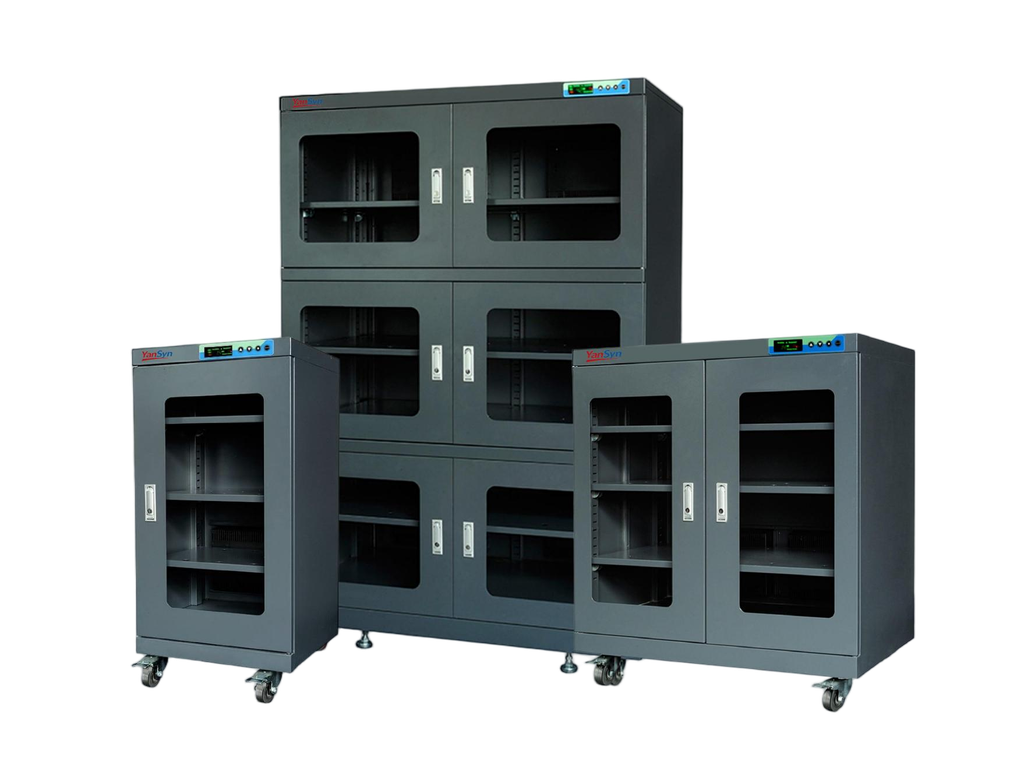
- Store at a low, stable humidity. An active dry cabinet held at or below 5% RH keeps devices ready and removes most emergency bakes. Our YSM series moisture-proof cabinet covers the 1% to 50% RH range used across semiconductor and PCB stores.
Choosing the right humidity set point is a separate question; see How to Choose the Humidity for an Electronic Dry Cabinet and Active Humidity Control for PCB & Semiconductor for the reasoning.
Mistakes that quietly cost yield
- Baking in a dirty or shared oven. Adhesive or flux residue can outgas onto leads and hurt solderability.
- Baking parts in trays that cannot take the temperature. Warped trays jam feeders and damage leads; check the tray rating, or use the 40 °C route.
- Stacking trays so tightly that airflow is blocked. The centre of the stack never reaches the intended condition.
- Counting only the soak time. The clock starts when the whole load reaches temperature, not when the door closes.
- Treating a bake as a permanent repair. Baking restores the moisture state; it does not change the MSL classification.
- Ignoring ultra-low humidity static risk. Below about 10% RH, electrostatic discharge becomes easier to generate; see ESD & Humidity: Why <10% RH Destroys Semiconductors.
A short checklist for line operators
- Read the MSL from the bag label and the humidity indicator card before opening.
- Start the exposure record at the moment of opening.
- Move unused devices into dry storage the same shift.
- Schedule the bake before the lot is needed, not after.
- Verify set point and uniformity for the batch, and keep the log.
- Reflow within the allowed window, or return the parts to dry storage.
Frequently asked questions
Does baking change the moisture sensitivity level of a part?
No. Baking removes absorbed moisture so the part can be reflowed safely. The MSL classification describes how quickly a package absorbs moisture, which is a property of the package construction and does not change.
Can every device be baked at 125 °C?
No. Some devices, including certain sensors and modules with embedded batteries, must not see 125 °C. The 40 °C bake with humidity below 5% RH exists for these cases. Follow the component data sheet when in doubt.
Why is humidity control required for the 40 °C bake but not the 125 °C bake?
At 125 °C the vapour pressure of water inside the package drives moisture out on its own. At 40 °C the driving force is weaker, so the surrounding air must be very dry. If chamber humidity is not held low, a 40 °C bake does not work.
How often should oven uniformity be verified?
Most quality systems check once or twice a year, plus after any repair or relocation. A multi-point survey with independent thermocouples is the usual method.
Is dry storage cheaper than baking?
In most high-mix lines, yes. Baking consumes oven capacity, operator time, and schedule slack. Dry storage removes the exposure that makes baking necessary.
Building a process that does not depend on luck
The popcorn effect is a storage problem that appears as a soldering problem. So the fix belongs at the storage step. A controlled low-humidity cabinet keeps the floor-life clock paused, and a properly specified baking oven gives a reliable recovery path when a lot does slip.
YanSyn builds both halves of that pair: the YSHG series of PID-controlled industrial ovens for baking and curing, and the YSM series of moisture-proof cabinets for controlled storage. Share your package mix, MSL range, and throughput, and we will size the equipment to the process.
Discuss your MSD baking and storage requirements with YanSyn
Related Posts
Nitrogen Purge Cabinet vs Desiccant Dry Cabinet: The 5-Year TCO Breakdown
Every procurement cycle starts the same way. Two quotes land on the same desk: one for a desiccant dry cabinet, one for a nitrogen purge cabinet holding the same number of trays. The desiccant unit…
ESD & Humidity: Why Sub-10% RH Risks Wafers and ICs
Electrostatic discharge (ESD) is a sudden flow of electricity between two objects with different electrical potentials. It can be as low as a few volts—undetectable to human touch—yet it carries enough energy to permanently destroy sensitive…
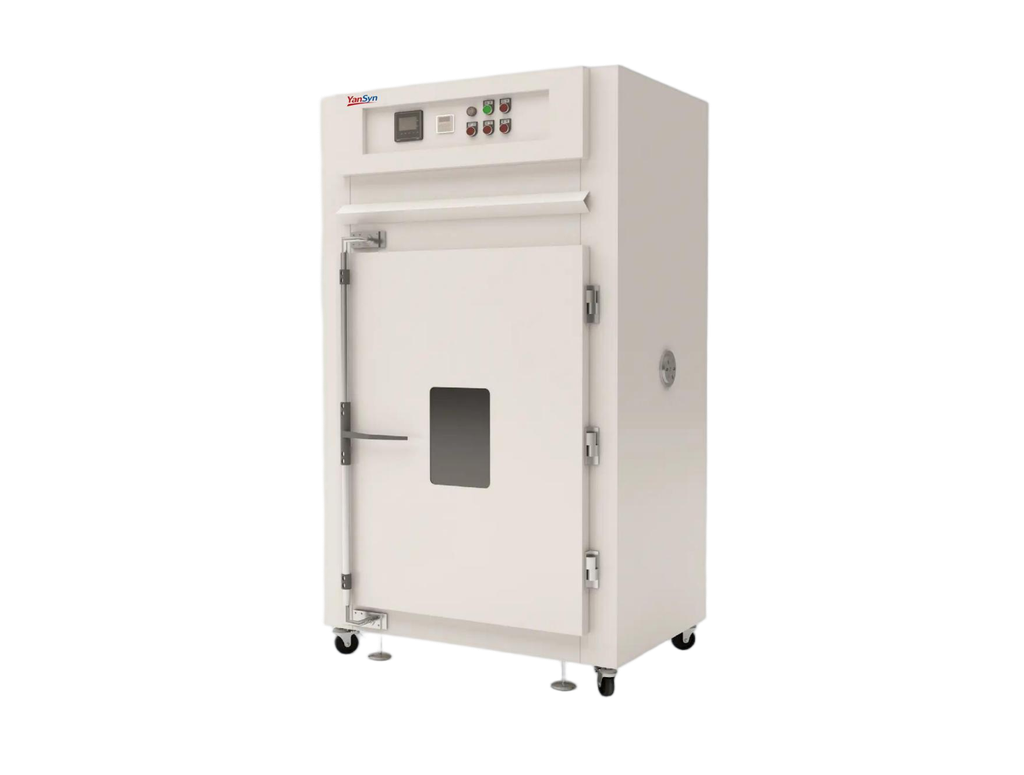
YSHG series electric heating blower oven
Selling Points Product Overview The YSHG series electric heating constant-temperature blower oven from YanSyn integrates precise temperature control and efficient, uniform heating. It adopts an intelligent PID control system to ensure precise and stable temperature.…