
A small specification change in vacuum drying can produce a large change in yield. Two ovens can look identical and still differ by a factor of three in drying time, or leave a thin oxide film on a surface that must stay bright. This guide explains the seven specifications that decide the result.
Why vacuum drying, and when you need it
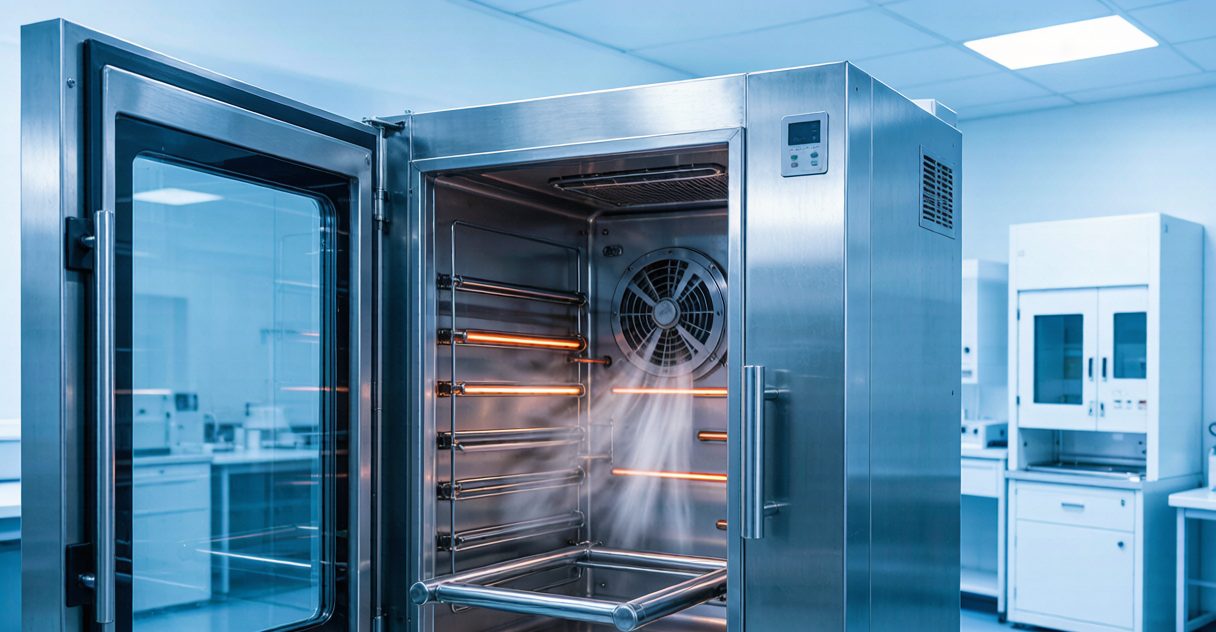
Water boils when its vapour pressure equals the pressure around it. Lower the pressure and the boiling point falls: at about 30 mbar water boils near 24 °C, and at about 100 mbar it boils near 46 °C. This is the core advantage of a vacuum oven. Moisture leaves the product at a temperature far below 100 °C, so heat-sensitive materials dry quickly without thermal damage.
The second advantage is the absence of oxygen. In a chamber that has been evacuated, oxidation and discolouration are largely suppressed. That matters for copper lead frames, silver paste, lithium battery electrodes, precision alloys, and any part that must leave the oven with a clean, bright surface.
There is a trade-off. With almost no gas inside the chamber, convective heat transfer nearly disappears. Heat reaches the load by conduction through the shelves and by radiation from the walls. Heat-up is therefore slower than in a forced-air oven, and shelf design becomes critical.
The seven specifications that matter
Most purchasing mistakes come from buying on chamber volume and maximum temperature alone. The seven items below are what determine drying quality, cycle time, and repeatability.
1. Ultimate vacuum level and working pressure range
These are two different numbers and you need both. Ultimate vacuum is the lowest pressure the empty, clean, dry chamber can reach. Working pressure is the pressure the oven holds while the load is releasing moisture. A datasheet that quotes only ultimate vacuum tells you very little about production behaviour.
For general electronics drying, working pressures of roughly 10 to 1000 Pa are common. Processes such as advanced packaging or certain pharmaceutical steps may require below 1 Pa. Ask the supplier for the pump-down curve: pressure versus time with a defined load and moisture content.
2. Leak rate and vacuum integrity
A chamber that cannot hold vacuum forces the pump to run continuously, which increases oil consumption, raises maintenance cost, and makes the pressure unstable. Ask for a leak rate expressed as a pressure rise over a fixed period after the chamber is isolated from the pump, for example pascals per hour.
Integrity depends on details that are easy to overlook: the door gasket material and its temperature rating, whether the chamber seams are welded or mechanically joined, and the quality of the feedthroughs. A gasket that hardens at 200 °C will leak long before the heater fails.
3. Temperature range and uniformity
Uniformity is the most frequently misunderstood specification. Ask three follow-up questions: at what temperature was it measured, was the chamber empty or loaded, and how many measurement points were used. A uniformity figure measured empty at 100 °C is not the same as one measured with six loaded shelves at 150 °C.
For reference, YanSyn specifies its YSHG series electric heating ovens with PID control at ±1 °C, temperature uniformity of ±2 °C or better, customizable to ±1 °C, and a working range from room temperature to 500 °C. When you compare vacuum ovens, request the same level of detail.
4. Heating method and shelf design
Because convection is weak under vacuum, the way heat enters the load dominates cycle time. There are two common arrangements. Heated shelves transfer heat by direct contact and are efficient for trays, jars, and flat parts. Jacketed or wall-heated chambers radiate from the walls and give a more even environment for irregular loads, but heat-up is usually slower.
Check the number of independently controlled shelf zones, the flatness and thickness of each shelf, and the maximum permissible load per shelf. Also confirm that shelves can be removed or re-positioned, because that determines how easily the oven can be re-qualified for a different product.
5. Chamber material, surface finish, and outgassing
Stainless steel is standard; 316L is preferred where corrosion resistance or cleanliness is critical. Surface finish matters because rough surfaces hold moisture and release it slowly, which lengthens every pump-down. Electropolished interiors and welded seams reduce this effect.
Outgassing is the release of trapped vapour from non-metallic parts inside the chamber: gaskets, heater insulation, cable jackets, and adhesives. It contaminates the product and slows the pressure drop. Ask which internal materials are used, and whether a Class 100 configuration is available for cleanroom lines.
6. Vacuum pumping system and backstreaming control
An oil-sealed rotary vane pump is economical and reaches good vacuum, but oil vapour can migrate back into the chamber and deposit a thin film on the product. Dry scroll or diaphragm pumps avoid this risk at a higher purchase price and generally higher maintenance cost. The right choice depends on how sensitive your surface is.
Whichever pump you choose, size it against the chamber volume and the required pump-down time. A trap or condenser between chamber and pump protects the pump from solvent and water vapour and is recommended whenever the process removes meaningful quantities of liquid.
7. Control, data logging, and safety
Modern processes need repeatability more than manual flexibility. Look for recipe storage, multi-step ramp and soak profiles, and automatic vacuum and purge cycles. Time-stamped logging of pressure and temperature supports traceability when a batch fails.
On safety, confirm an independent over-temperature cut-off, a pressure relief path, a door interlock that prevents opening under vacuum, and a controlled venting sequence. If the process releases flammable solvent, the electrical classification of the oven and pump set must be considered before purchase.
Specification reference table
| Specification | What to ask the supplier | Typical industrial range | Why it matters |
|---|---|---|---|
| Working pressure | Pump-down curve with a defined load | 10–1000 Pa; below 1 Pa for high-end processes | Sets the drying temperature and the cycle time |
| Leak rate | Pressure rise per hour after isolation | Low and stable rise over a defined test period | Stable pressure, lower pump wear, lower cost |
| Temperature uniformity | Loaded or empty, number of points, test temperature | ±2 °C typical; ±1 °C on request | Decides batch consistency across all shelves |
| Heating method | Heated shelves or heated walls; zone count | 2–8 shelf zones on production units | Main heat path under vacuum; drives heat-up time |
| Chamber material | Steel grade, finish, seam type, low-outgassing build | 304 or 316L stainless steel, welded seams | Cleanliness, corrosion life, pump-down speed |
| Pump type | Oil-sealed or dry; trap included; sizing basis | Rotary vane, scroll, or diaphragm | Risk of oil backstreaming onto the product |
| Control and safety | Recipes, logging, purge cycles, interlocks | PLC or PID controller with data export | Repeatability, traceability, operator protection |
Matching the oven to your process
The same list produces different priorities by industry:
| Process | Main risk | Priority specifications |
|---|---|---|
| PCB and component drying | Popcorning during reflow; hidden moisture in packages | Uniformity, shelf capacity, logged bake profile |
| Lithium-ion electrode drying | Residual water reacting with electrolyte | Working pressure under load, solvent trap, dry pump |
| Semiconductor packaging | Outgassing contamination and surface oxidation | Low-outgassing build, cleanroom option, leak rate |
| Pharmaceutical and laboratory | Batch records that cannot be reconstructed | Data logging, recipe control, calibration access |
| Precision parts and alloys | Discolouration and surface oxide | Oxygen-free operation, inert purge, clean interior |
Vacuum oven or hot-air oven?
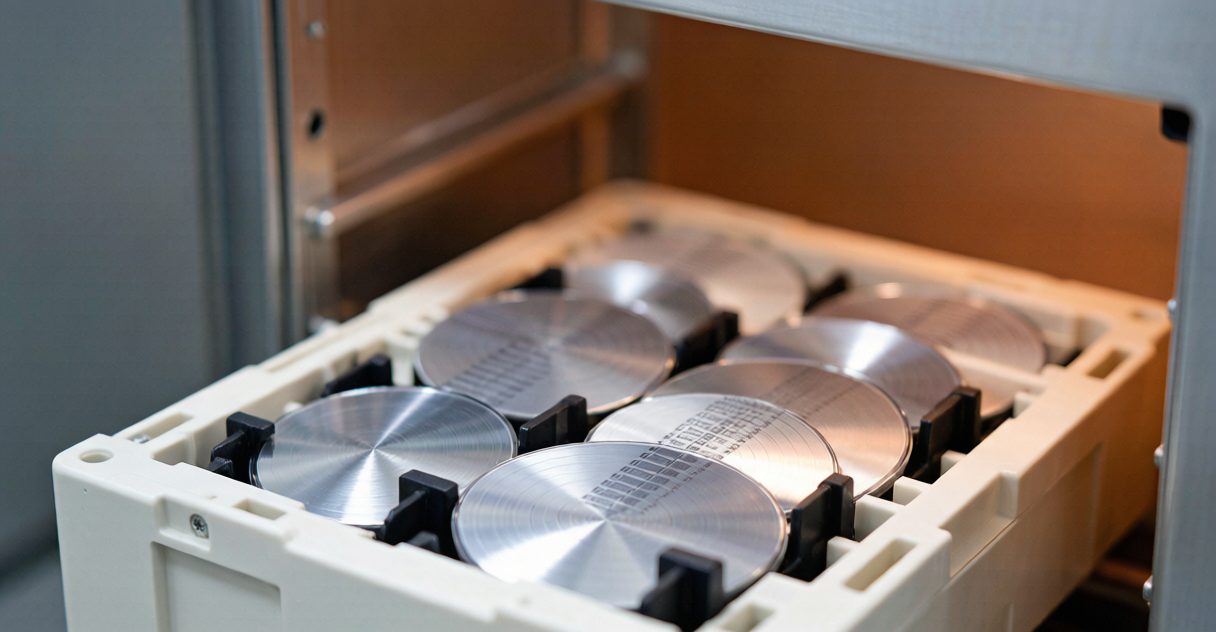
Choose vacuum when the product is temperature-sensitive, when oxidation must be avoided, or when moisture is trapped inside a sealed or dense structure. Choose a hot-air oven when you need fast throughput, high-temperature curing, or strong forced convection across a large, open load.
The two are often used together in the same line: a vacuum step removes the last traces of moisture at low temperature, and a forced-air step completes curing or annealing at higher temperature. For the atmospheric step, YanSyn’s YSHG series offers PID control at ±1 °C, uniformity of ±2 °C or better, a range from room temperature to 500 °C, and options for Class 100 clean operation, nitrogen atmosphere, and IoT monitoring. See also our article on ovens and thermal processing at the 3 nm node.
Drying is only half of the moisture problem. Once a part leaves the oven it re-absorbs water from the room. Storing dried components at low humidity, for example in the YSM series moisture-proof cabinet with adjustable humidity from about 1 to 50 % RH, keeps the benefit of the drying step. Where moisture and oxygen must both be excluded, the YSN series nitrogen cabinets provide an ultra-low-oxygen environment. Our article on MSD management and IPC/JEDEC J-STD-033D explains how drying and storage form one procedure.
Frequently asked questions
What vacuum level do I need for low-temperature drying?
It depends on the temperature ceiling of your product. Because water boils near 24 °C at about 30 mbar, holding the chamber at or below that pressure allows drying at close to room temperature. Always confirm the working pressure with a loaded chamber, not the ultimate vacuum of an empty one.
Is vacuum drying faster than hot-air drying?
Not always. Vacuum removes moisture at a lower temperature, protecting the product, but heat reaches the load more slowly because convection is weak. Cycle time depends on shelf contact and load configuration, so ask for a trial run with your own product.
Can I backfill with nitrogen instead of air?
Yes, and it is common practice. An inert backfill after the drying step prevents oxidation and moisture re-adsorption while the chamber returns to atmospheric pressure. Confirm that the controller supports an automatic vacuum and purge sequence.
Do I need a dry pump?
If your product surface is sensitive to hydrocarbon film, a dry scroll or diaphragm pump removes the risk of oil backstreaming. If you choose an oil-sealed pump for cost reasons, fit a trap and maintain the oil on a strict schedule.
What routine maintenance should I plan for?
Replace the door gasket on a fixed interval, check the leak rate on a schedule, service the pump as specified, and re-verify temperature uniformity yearly or after any heater or sensor replacement.
Choosing with confidence
A vacuum oven is a long-lived asset, and the specification you set at purchase defines your process window for years. Focus on working pressure under load, leak rate, loaded uniformity, shelf heating, chamber finish, pump type, and control and safety. Ask for test data rather than catalogue claims, and validate with your own product before you commit.
YanSyn Intelligence Technology (Shanghai) Co., Ltd. designs and manufactures temperature- and humidity-control equipment, including vacuum ovens, the YSHG electric heating oven, the YSM moisture-proof cabinet, and the YSN nitrogen cabinet. Tell us your product, your temperature limit, and your target residual moisture, and our engineers will recommend a configuration.
Related Posts
Clean Oven vs High-Temperature Oven: How to Choose
Not every thermal process needs a clean oven. Not every clean process needs 500 °C. Buying the wrong one costs money in two ways: you pay for capability you never use, or you pay again…
The Popcorn Effect Deep-Dive: MSD Baking Curves That Save Yield
A single cracked package can scrap an entire assembled board. In many cases the crack did not start on the line. It started days earlier, when a tray of plastic-encapsulated devices sat open in ordinary…
The Development History of Electronic Dry Cabinets
Electronic dry cabinets have become indispensable storage and production equipment in many industries, including semiconductors, electronics manufacturing, biopharmaceuticals, and new energy. So, how did dry cabinets evolve, and what are the future development trends? In…