
Lithium-ion cells are built from materials that react with water and oxygen at levels far below what a normal factory floor would call dry. A cell plant can invest in a large dry room and still lose yield in the small gaps: an electrode roll waiting for calendering, a stack waiting for welding, a tray of cells queued for electrolyte filling. This guide maps those contamination windows and shows which control technology belongs at each point.
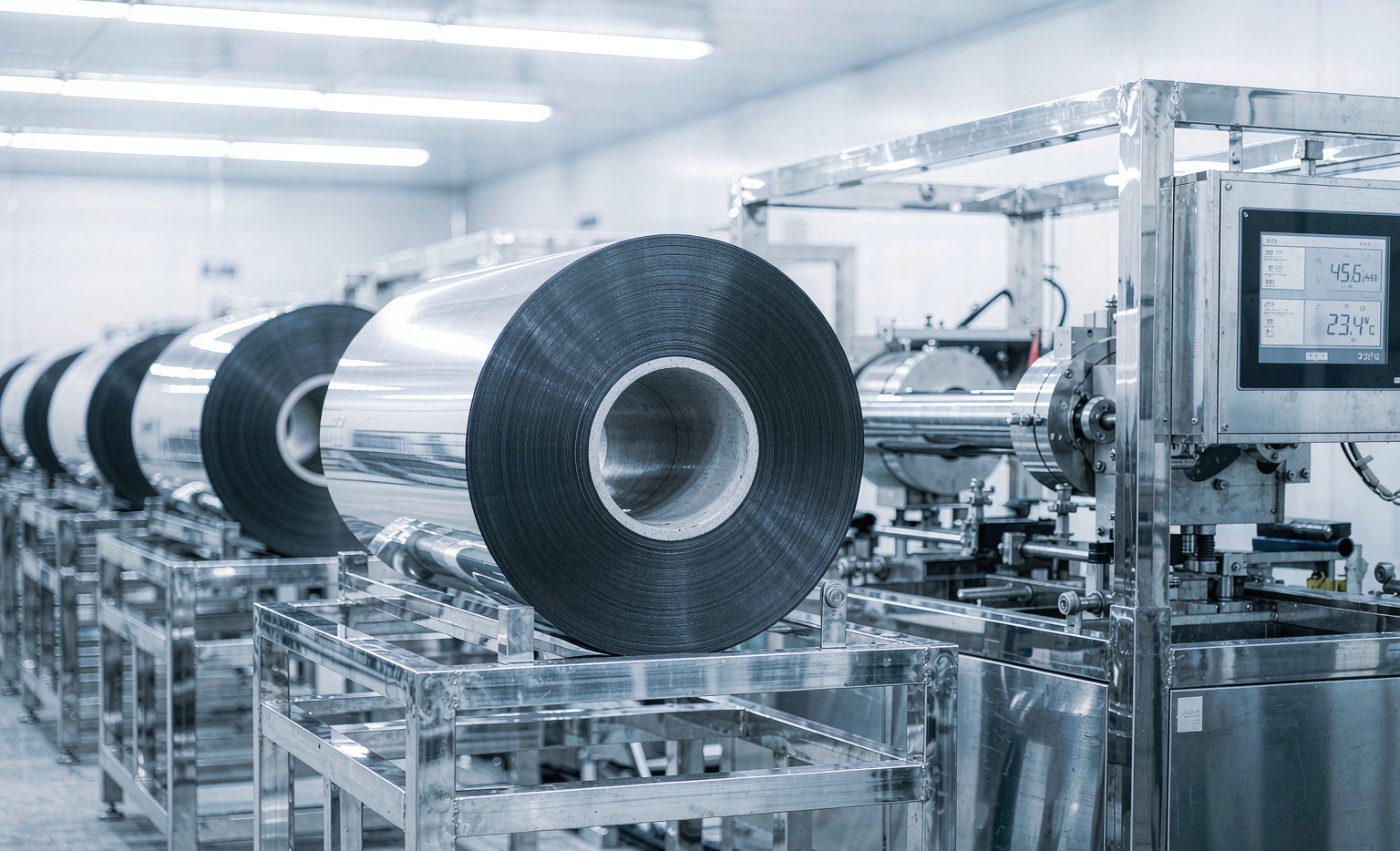
YanSyn Intelligence Technology (Shanghai) Co., Ltd. designs and manufactures temperature- and humidity-control equipment for exactly these points of use. The recommendations below come from the two cabinet families and the oven family we build, and from the way production teams actually deploy them.
Why Moisture Is the Quiet Enemy of Cell Quality
The electrolyte salt LiPF6 hydrolyses on contact with water and produces hydrofluoric acid (HF). HF attacks the cathode lattice, dissolves transition metals, degrades the solid-electrolyte interphase (SEI) on the anode, and generates gas that swells the cell. The practical results are familiar to every cell engineer: lower initial capacity, faster capacity fade, higher internal resistance, and in severe cases venting or thermal events.
The reaction is catalytic and cumulative. Damage is often invisible at incoming inspection and only appears during formation or later in the field. For this reason, moisture control is a process discipline rather than a single equipment purchase. Teams that treat it as a layout problem, and place protection where material actually waits, recover far more yield than teams that only tighten the dry-room setpoint.
Where Oxygen Does Its Damage
Moisture receives most of the attention, but oxygen is the second half of the problem. Lithiated anode surfaces, freshly cut electrode edges, and several cathode chemistries oxidise rapidly in ambient air. Oxidation increases surface film resistance, consumes active lithium, and reduces first-cycle efficiency. For high-nickel cathodes and silicon-bearing anodes, oxygen exposure during storage and transfer measurably shortens cycle life.
Two different control strategies follow from this. Where water is the dominant threat, aggressive dehumidification is the answer. Where oxygen is the threat, an inert atmosphere is required. Most cell lines need both, in different places.
The Contamination Map: From Coating to Formation
It is not economical to treat the entire line as one controlled space. The better method is to identify the specific windows where material is vulnerable and protect those points. The table below maps a conventional lithium-ion cell line stage by stage.
| Process stage | Primary threat | Typical control target | Recommended equipment |
|---|---|---|---|
| Electrode coating and drying | Residual solvent, water pickup | Controlled oven atmosphere | Heating oven / vacuum oven |
| Calendering and slitting | Moisture re-absorption on cut edges | Low RH buffer storage | Moisture-proof cabinet |
| Electrode and separator storage | Moisture absorption over dwell time | 1–5% RH, stable | Moisture-proof cabinet |
| Stacking and winding | Moisture plus oxygen on active surfaces | Low RH, inert gas | Nitrogen cabinet |
| Electrolyte filling and sealing | Oxygen and moisture ingress | Inert, dry atmosphere | Nitrogen cabinet / glovebox |
| Formation and ageing | Gas generation from residual water | Temperature-controlled, monitored | Controlled environment |
The pattern is consistent. Water risk dominates wherever material sits in queue. Oxygen risk appears wherever a fresh, reactive surface is created or exposed. Equipment selection follows directly from which of the two is present.
Dry Room or Point-of-Use Cabinets?
A dry room is the correct foundation for electrode processing, and it is usually specified by dew point rather than by relative humidity. A dry room does not follow the material, however. Every transfer trolley, every queue before a bottleneck tool, and every door opening on a large chamber is an exposure event.
Point-of-use cabinets close those gaps. They sit next to the tool they serve, they recover quickly after access, and they cost a small fraction of expanding dry-room capacity. Production teams typically deploy both: a dry room for the bulk environment, and cabinets at the specific points where material waits or where operators work.
| Approach | Best for | Main limitation |
|---|---|---|
| Dry room | Coating, calendering, large open processing areas | High capital and energy cost; slow to change setpoint |
| Moisture-proof cabinet | Buffer storage, electrode and separator stock, WIP holds | Controls humidity only, not oxygen |
| Nitrogen cabinet | Stacking, winding, sealing, oxidation-sensitive surfaces | Requires a nitrogen supply; gas cost matters |
| Heating oven | Electrode drying, component degassing, laboratory trials | Batch process; needs the correct atmosphere option |
Dry Cabinet or Nitrogen Cabinet?
Moisture-proof cabinets
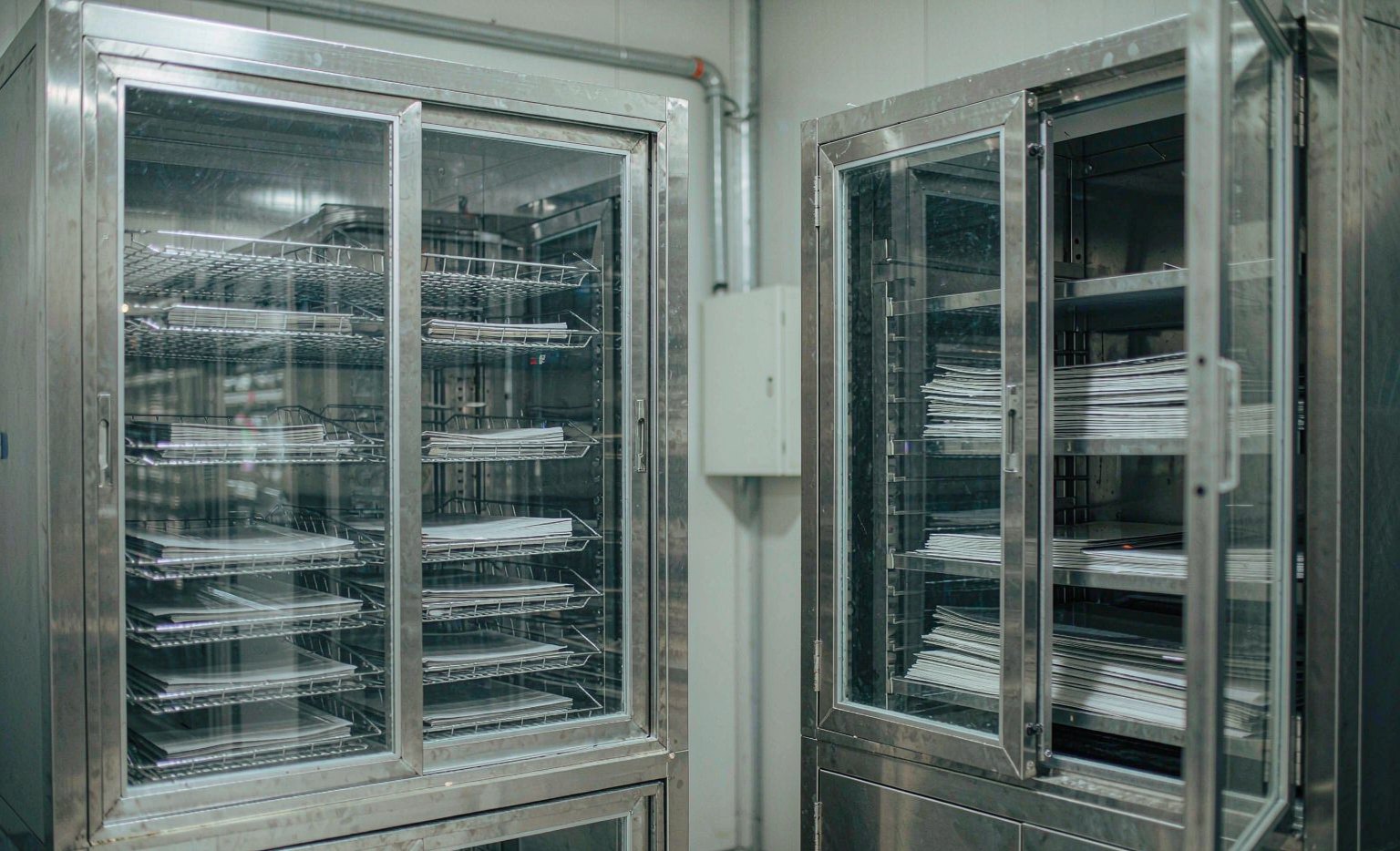
A moisture-proof cabinet uses active dehumidification to pull relative humidity down and hold it there. The YanSyn YSM series applies a dual dehumidification system with chip-based microcomputer control and Honeywell temperature and humidity sensors, and holds an adjustable range from 1% RH to 60% RH. The dual design combines molecular physical dehumidification with PTC circulation for rapid pull-down, which matters on lines with frequent door openings.
This is the right tool for electrode rolls, separator stock, and any material waiting in queue where water, not oxygen, is the dominant risk. An anti-static version is available with a conductive coating of 106–109 Ω, which is useful when electrode dust and electrostatic discharge are both concerns. For a related discussion of static behaviour at low humidity, see our article on ESD and low-humidity protection.
Nitrogen cabinets
A nitrogen cabinet floods the chamber with inert gas and displaces both oxygen and moisture. The YanSyn YSN series uses a dual-flowmeter control system that automates nitrogen filling and lets users adjust flow and pressure. Once the humidity setpoint is reached, the unit enters a semi-sleep state, cutting nitrogen consumption by more than 50% compared with continuous-purge designs.
This is the right tool at stacking, winding, and sealing, where oxidation of active surfaces directly reduces yield. For a deeper discussion of oxidation-sensitive storage across pharmaceutical, battery, and precision-alloy applications, see our companion article on nitrogen cabinets for oxidation-sensitive storage.
Where Ovens Fit in the Battery Line
Thermal processing is the third leg of the control strategy. Electrode coatings must be dried to a residual-solvent specification, cell components are degassed before assembly, and pilot lines run small coating and drying trials continuously. Temperature uniformity across the working chamber is the specification that decides whether every part of a batch is treated alike.
The YanSyn YSHG electric heating oven uses PID control and operates from room temperature to 500 °C, with chamber uniformity of ±2 °C or better, customizable to ±1 °C for tighter processes. Options include a Class 100 clean configuration, a nitrogen atmosphere, and IoT monitoring for data capture. When a drying step must also be an oxygen-free step, specify the inert-atmosphere option rather than assuming a standard chamber will be sufficient.
Five Specifications to Check Before You Buy
- Humidity floor, not just range. Confirm the cabinet sustains its target RH under full load, not only when empty.
- Recovery time. Measure how quickly the chamber returns to target after a door opening. Short recovery protects material during frequent access.
- Uniformity across shelves. Sensor placement and airflow design determine whether every shelf is genuinely in spec.
- Oxygen control on nitrogen models. Ask how the system regulates flow, and what the actual gas consumption is per hour.
- Data logging and traceability. Automotive and energy-storage customers increasingly require recorded environmental history for every batch.
Monitoring, Logging and Traceability
Control without records is difficult to defend during a customer audit. A practical logging setup captures temperature and humidity at a defined interval, stores the record against a batch or lot identifier, and raises an alarm when a limit is exceeded. The alarm should be actionable: the operator needs to know which cabinet, which shelf, and how long the excursion lasted.
Traceability also changes behaviour on the floor. When a team can see that a specific buffer cabinet drifts every time it is loaded, it changes the loading practice or adds capacity instead of blaming downstream formation results.
Frequently Asked Questions
What relative humidity should we use for electrode storage?
Most electrode and separator stock is held in the low single-digit RH range. The correct setpoint depends on the chemistry and the dwell time, so validate it against your own moisture measurements rather than copying a value from a datasheet.
Can a desiccant cabinet replace an active dry cabinet?
No. Desiccant cabinets have no active control and no indication of state. They are acceptable only for short, low-value holds. For electrode stock or any material with a defined floor life, active control with logging is the safer choice.
Is a dry room enough on its own?
A dry room sets a baseline, but it does not protect material during transfer, queueing, or door-open events. Point-of-use cabinets close those gaps, and they do it at a fraction of the operating cost of expanding dry-room capacity.
Do we need nitrogen at every stage?
No. Nitrogen is justified where oxygen causes measurable harm, typically stacking, winding, and sealing. Storage and buffering points usually need only aggressive dehumidification.
How often should sensors be calibrated?
Follow your quality system, and treat any reading that drifts from a reference probe as a calibration event. Annual verification is common; high-volume lines often check critical cabinets more frequently.
Can one cabinet serve both drying and storage?
A heating oven and a dry cabinet solve different problems. Drying removes water from the material; storage prevents the material from re-absorbing it. Running a drying step inside a storage cabinet also loads the storage environment with the released moisture.
Conclusion
Moisture and oxidation control in battery manufacturing is a layout decision, not a single purchase. Map the vulnerable windows, place dehumidifying cabinets where material waits, place nitrogen cabinets where material is exposed, and specify ovens where water must be driven out of the material itself. YanSyn's YSM, YSN, and YSHG families cover the three windows with logged, production-grade control.
Discuss your cell line layout with our engineers: request a storage and drying recommendation. Explore the YSM moisture-proof cabinet, the YSN nitrogen cabinet, and the YSHG electric heating oven.
Related Posts

FAQ: Frequently Asked Questions by clients
1. What kind of services do you provide: Orignal manufacturer in China, OEM & customization are available as well. 2.Transportation: Defaulted by sea freight, can also through other ways according to your request. 3.After-sales service Free-maintenance & spare parts for…
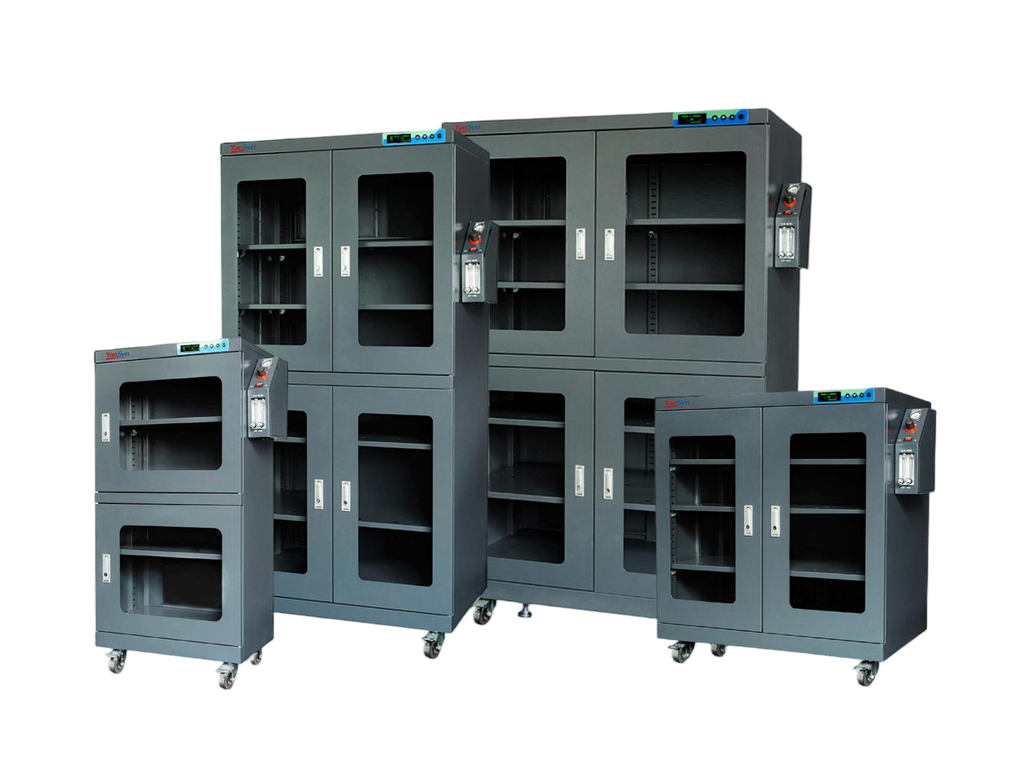
YSN series anti-oxidation nitrogen cabinets
Selling Points Intelligent DehumidificationEnergy SavingAnti-StaticAnti-OxidationSilent OperationMoisture-proof & mold-proof Product Overview The YSN series anti-oxidation nitrogen cabinets adopt the new generation of microcomputer sensor control system to achieve fully automatic nitrogen filling. Users can flexibly adjust…
MSD Management: Why IPC/JEDEC J-STD-033D Matters
Moisture-sensitive devices (MSDs) absorb moisture from the air. During reflow soldering, the rapid heating turns that moisture into steam, causing internal cracks—a defect known as the “popcorn effect.” This leads to latent failures or immediate…