
Nitrogen is one of the cheapest ways to protect oxidation-sensitive parts. It is also one of the easiest operating costs to lose control of. A purge cabinet running at a fixed flow rate around the clock consumes the same gas whether it holds three trays or thirty, whether the door was opened twice today or forty times. Nobody notices, because nobody stands at the generator watching the meter.
This article asks one narrow question: how much nitrogen should a cabinet actually use, and how quickly can better flow control pay for itself? It is not a comparison of cabinet types — we covered that in our five-year total cost of ownership breakdown — and not a catalogue of applications.
Every number below is an indicative assumption, not a measured result. Gas prices, cabinet counts and leakage rates vary enormously between sites. Use the method, then replace the figures with your own data.
Where the nitrogen actually goes: four loss paths
You need to know which of four paths dominates in your plant. They have different symptoms and different fixes.
| Loss path | Typical symptom | Control lever | What to measure |
|---|---|---|---|
| Over-provisioned setpoint | Flow set "high just to be safe"; oxygen far lower than the process requires | Rotameter plus needle valve; documented setpoint per cabinet | Actual litres per minute at the inlet, and the oxygen level the process truly needs |
| Continuous purge | Gas flows twenty-four hours a day at the same rate, loaded or empty | Closed-loop control: purge to setpoint, then hold; scheduled idle when empty | Duty cycle of the inlet valve; hours per day at full flow versus holding flow |
| Leakage and seal ageing | Oxygen creeps up even with the door closed; recovery after closing is slow | Gasket replacement, feedthrough inspection, pressure-decay leak test | Pressure decay over a fixed interval; time to return to setpoint after a door cycle |
| Door-open exchange | Frequent short openings; long re-purge each time; operators hold the door open | Load planning, staging shelves, door-open limits, auto re-purge profile | Openings per shift and seconds per opening; gas used per recovery cycle |
In most plants, the first two paths dominate. Leakage is often blamed because it is visible, but a sound seal with a badly chosen setpoint still wastes more gas than a slightly leaky cabinet on a smart control loop.
Why constant-flow cabinets waste gas
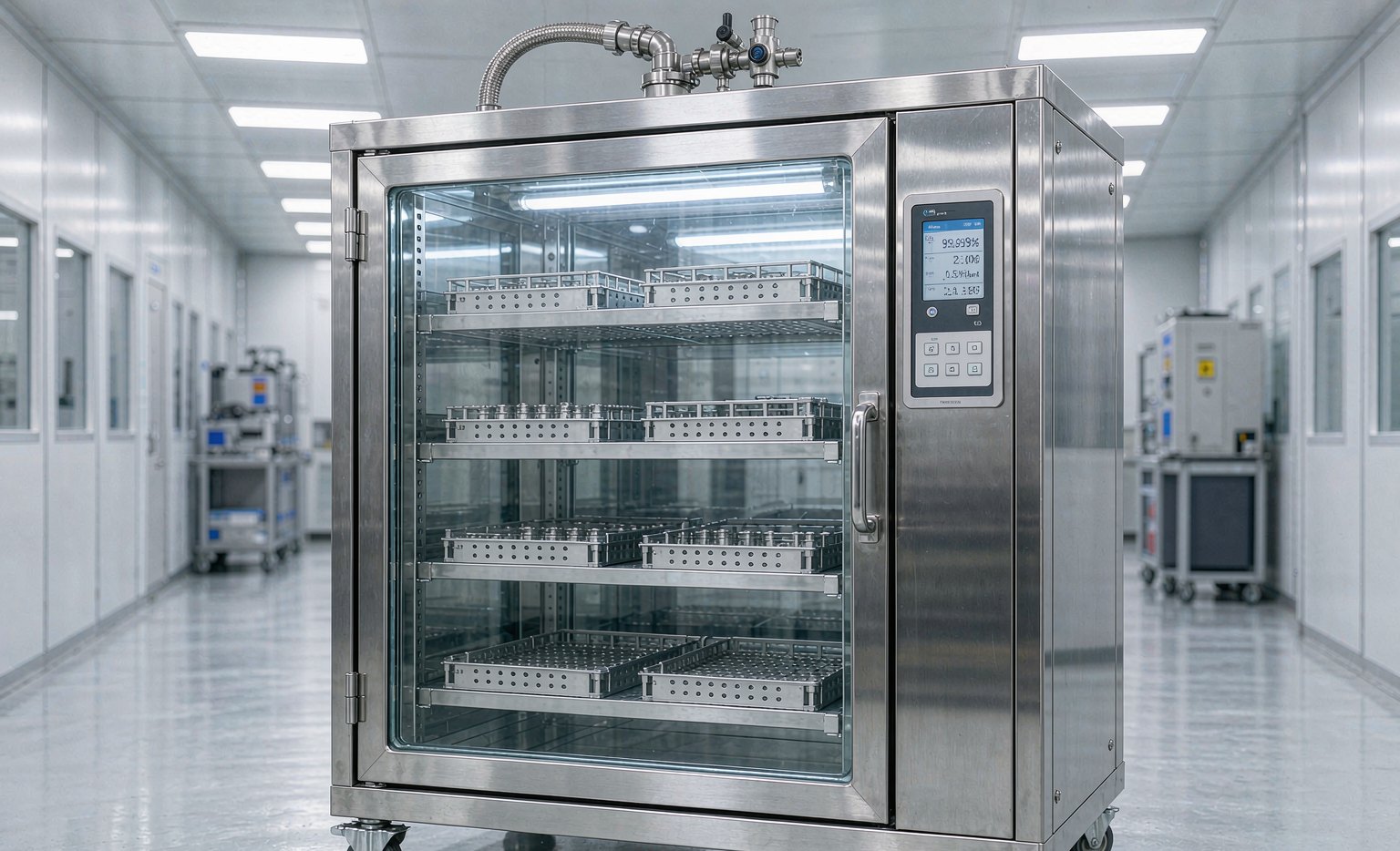
A nitrogen purge cabinet maintains a low-oxygen, low-humidity environment. The engineering is straightforward: displace the air, keep it displaced. The operating habit is where the money leaks out.
When a cabinet has no flow indication and no oxygen feedback, the only way an operator can be confident is to open the valve further. The setpoint drifts upward over months. A cabinet that needs eight litres per minute ends up at twenty, because twenty made the oxygen reading look good during commissioning — and nobody has touched it since.
Worse, the flow is constant. A cabinet at thirty percent loading is purged as aggressively as a fully loaded one. Nitrogen is spent on empty shelf space, every hour of every day, including weekends and shutdowns.
The fix is not exotic instrumentation. It is three things: know your flow, know your oxygen, and let the cabinet stop purging when it has already won.
Four control levers that cut consumption
1. Right-size the flow at the cabinet inlet
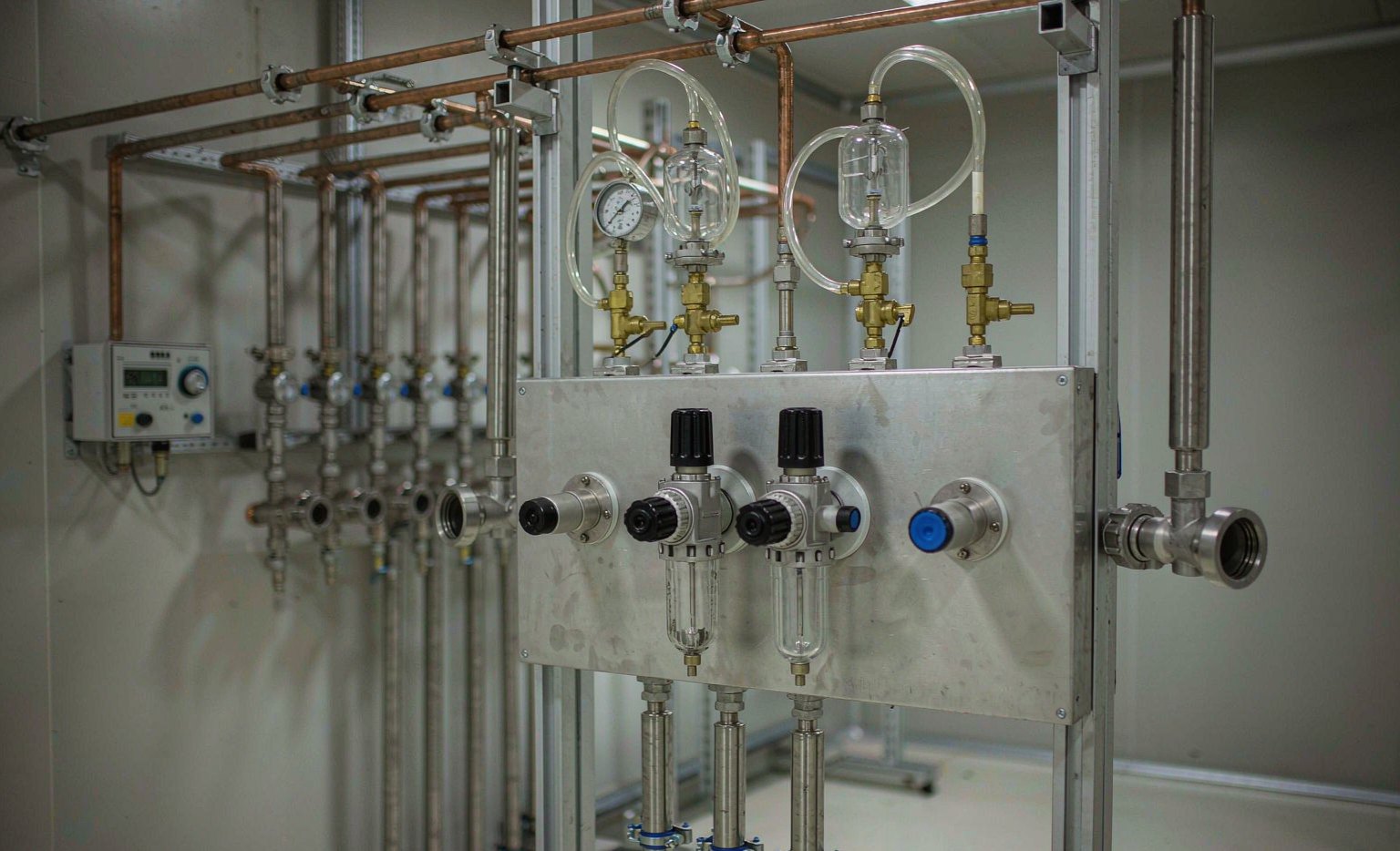
Install a rotameter and a needle valve at each cabinet, then calibrate the setpoint to the oxygen level the process actually requires. This is not a "set it low" exercise: it is a documented, repeatable setting you can audit later. Write the number on the cabinet and record it in the maintenance system.
2. Replace constant purge with closed-loop control
An oxygen analyser paired with a solenoid inlet valve turns nitrogen from a continuous flow into a controlled dose. The cabinet purges at high flow after loading, then switches to a low holding flow once the setpoint is reached. Because the controller reads the actual condition inside the chamber, it also compensates for leakage and door openings automatically — instead of relying on a human to open a valve wider.
This is where the largest savings come from, and where the payback calculation is easiest to defend, because the duty cycle of the inlet valve is measurable. If your cabinets do not already support this, ask your supplier which options are available for your model. YanSyn YSN series cabinets are built for dry nitrogen purge with ultra-low oxygen and low humidity; the instrumentation depends on the configuration, so confirm the exact arrangement for your process.
3. Fix the physical losses
Seals, gaskets, cable feedthroughs and sample ports are the quiet consumers. Run a simple pressure-decay test: close the inlet, record the pressure, and watch it over a fixed interval. Then measure how long the cabinet takes to return to setpoint after a standard door cycle. If recovery time has drifted upward over the past year, you are paying for that drift every day.
Replacing a hardened gasket costs a fraction of what one year of excess purge costs.
4. Manage the door, not just the gas
Door openings are the largest single-event nitrogen loss. Each opening exchanges chamber gas with room air, and the cabinet must rebuild the atmosphere. Three low-cost habits reduce this measurably: stage parts before the door opens, restrict the open duration, and group transfers into scheduled windows rather than continuous access across a shift.
A payback method you can run on your own numbers
The arithmetic is simple enough to do on one page. Use this sequence.
Step 2. Baseline volume = flow per cabinet (L/min) × number of cabinets × 43 m³.
Step 3. Baseline gas cost = baseline volume × your point-of-use nitrogen price per m³.
Step 4. Monthly saving = baseline gas cost × the reduction percentage you realistically expect.
Step 5. Payback in months = retrofit capital cost ÷ monthly saving.
Now a worked example. Every figure is an indicative assumption and should be replaced with your own invoice data, measured flows and quoted capital costs.
- Six cabinets, average measured constant flow of 15 L/min each = 90 L/min total.
- Baseline volume: 90 × 43 m³ ≈ 3,890 m³ per month.
- Indicative point-of-use nitrogen price: $0.85 per m³. This is the most site-dependent input — on-site generation, liquid supply and cylinder supply differ widely, and the price depends on contract volume and electricity rates.
- Baseline gas cost: approximately $3,300 per month.
- Retrofit capital cost, indicative: $3,000 to $7,000 for flow meters, oxygen analysers, solenoid control and commissioning across the fleet.
The sensitivity table below shows how the payback window moves with the reduction you actually achieve.
| Nitrogen reduction achieved | Monthly saving (indicative) | Payback at $3,000 capex | Payback at $4,500 capex | Payback at $7,000 capex |
|---|---|---|---|---|
| 15% — setpoint discipline only | ≈ $496 | 6.0 months | 9.1 months | 14.1 months |
| 25% — setpoint plus seal repair | ≈ $827 | 3.6 months | 5.4 months | 8.5 months |
| 35% — closed-loop oxygen control | ≈ $1,157 | 2.6 months | 3.9 months | 6.0 months |
| 50% — full programme, well-sealed fleet | ≈ $1,654 | 1.8 months | 2.7 months | 4.2 months |
The eight-month headline in this article's title corresponds to a mid-range scenario: roughly a quarter of the bill removed on a fleet that needs a fuller instrumentation package. It is a conservative planning figure, not a best case.
What "50% less nitrogen" really requires
Halving consumption is achievable, but not through one change. It comes from stacking levers.
- Measurement first. Without a flow reading you cannot prove anything. Install totalisers or take regular readings.
- Control second. Closed-loop oxygen control does the heavy lifting, because it removes the human tendency to over-purge.
- Maintenance third. Seals and gaskets degrade quietly. Put recovery time on a periodic checklist.
- Behaviour last, but permanently. Door discipline only holds if it is written into the standard work instruction.
Be sceptical of any supplier who promises a specific percentage without measuring your baseline. The honest answer is a range, and the range narrows only after the first month of data.
When a desiccant dry cabinet is the better answer
Not every application needs nitrogen. If your parts need a dry environment but not a low-oxygen one — for example, many moisture-sensitive devices covered by IPC/JEDEC handling practice — an active desiccant or compressor-driven dry cabinet such as the YanSyn YSM series moisture-proof cabinet may hold specification at a lower operating cost, with no gas supply at all. The decision turns on whether oxygen itself is the enemy, or only humidity. Our review of nitrogen cabinet applications across pharma, battery and precision alloy work sets out where each approach earns its place.
Frequently asked questions
How do I know if my nitrogen cabinets are over-purged?
Compare the oxygen and humidity inside the chamber with the specification your process requires. If the measured values sit well inside the limit while the flow meter reads high, you are paying for margin you do not need. The gap between "meets specification" and "uses the least gas to meet it" is where the savings live.
Will reducing flow put my parts at risk?
Only if the reduction is untested. The safe sequence is to measure, change one setpoint at a time, and verify against the process specification and your quality records. Closed-loop control is safer than manual reduction, because the cabinet responds to real conditions rather than a fixed guess.
How long does a retrofit take?
For a small fleet, flow meters and analysers are usually fitted during scheduled maintenance windows. Sequence the work cabinet by cabinet so production is never without storage capacity.
Can I just switch off cabinets that are not in use?
Idling an empty cabinet is a legitimate saving, provided the restart purge is adequate before the next load. Document the restart procedure so the saving does not become a contamination event.
What is a realistic reduction target for the first year?
Plants starting with no flow measurement usually find the largest early gains through setpoint discipline and seal maintenance. Deeper reductions require closed-loop control. Treat any figure above fifty percent as a claim needing site-specific evidence.
Conclusion
Nitrogen consumption is a controllable operating cost, not a fixed one. The programme is unglamorous: measure flow, set oxygen targets deliberately, add closed-loop control, maintain seals, and manage door discipline. Each step is cheap relative to the gas it saves.
If you want to work through the numbers for your own fleet — cabinet count, target oxygen and humidity levels, loading patterns, and available control options — our engineers can help you size it. Send us your baseline data and we will tell you honestly whether the payback is measured in months or in years.
Request a nitrogen consumption review
YanSyn Intelligence (Shanghai) Co., Ltd. — Building10, No.568, Xueronghua Road, Pudong New Area, Shanghai, China.
Related Posts
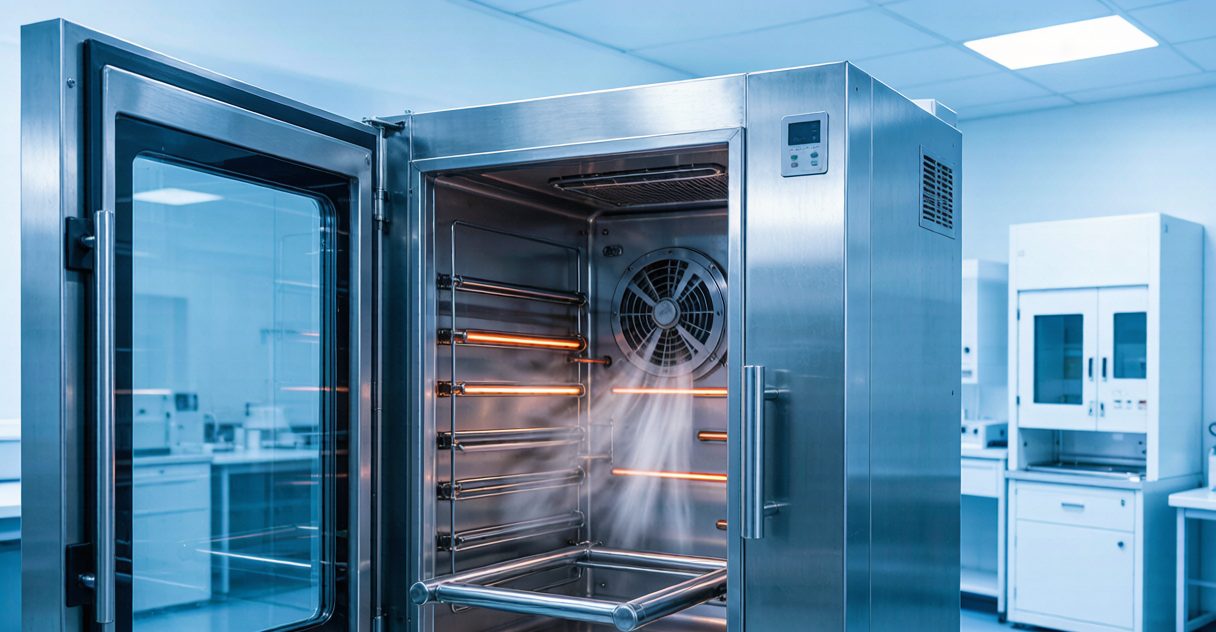
Ovens and Thermal Processing at the 3 nm Node: What Advanced Chip Manufacturing Demands, and How YanSyn YSHG Delivers
At the 3 nm node and beyond, the margin for error in thermal processing has all but disappeared. Roughly 18 to 22 percent of front-end-of-line and middle-of-line process modules in modern 3 nm and sub-2…

The Development History of Electronic Dry Cabinets
Electronic dry cabinets have become indispensable storage and production equipment in many industries, including semiconductors, electronics manufacturing, biopharmaceuticals, and new energy. So, how did dry cabinets evolve, and what are the future development trends? In…

Photovoltaic Module Manufacturing: Storage & Curing Solutions for Moisture, Oxidation, and Heat Control
Photovoltaic module manufacturing is a race against contamination. Between cell sorting and the final flash test, every layer — glass, encapsulant, cells, ribbons, backsheets, and adhesives — passes through multiple humidity, oxidation, and temperature windows.…