How a Dry Cabinet Works: Dehumidification Modules, RH Recovery and Maintenance
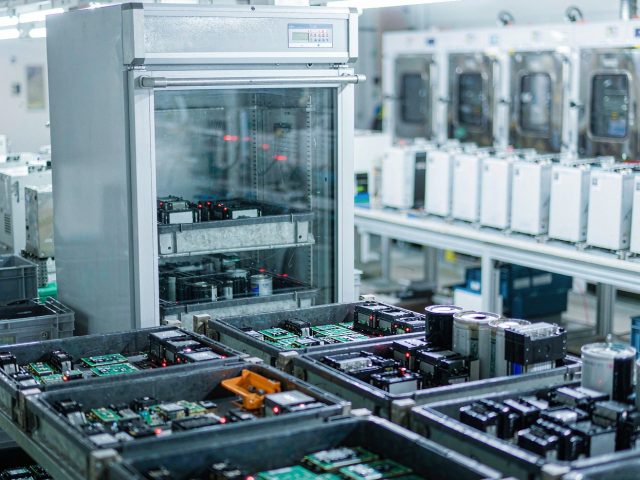
Walk through any electronics, semiconductor or precision-instrument factory and you will see rows of stainless-steel cabinets glowing with green digits: 3% RH, 2% RH, 5% RH. Dry cabinets have become default equipment wherever moisture-sensitive parts are stored, yet many buyers still treat them as a metal box with a display. Understanding what actually happens inside the cabinet — especially the dehumidification module and the way relative humidity (RH) recovers after a door opening — is the fastest way to separate a cabinet that protects yield from one that just looks the part.
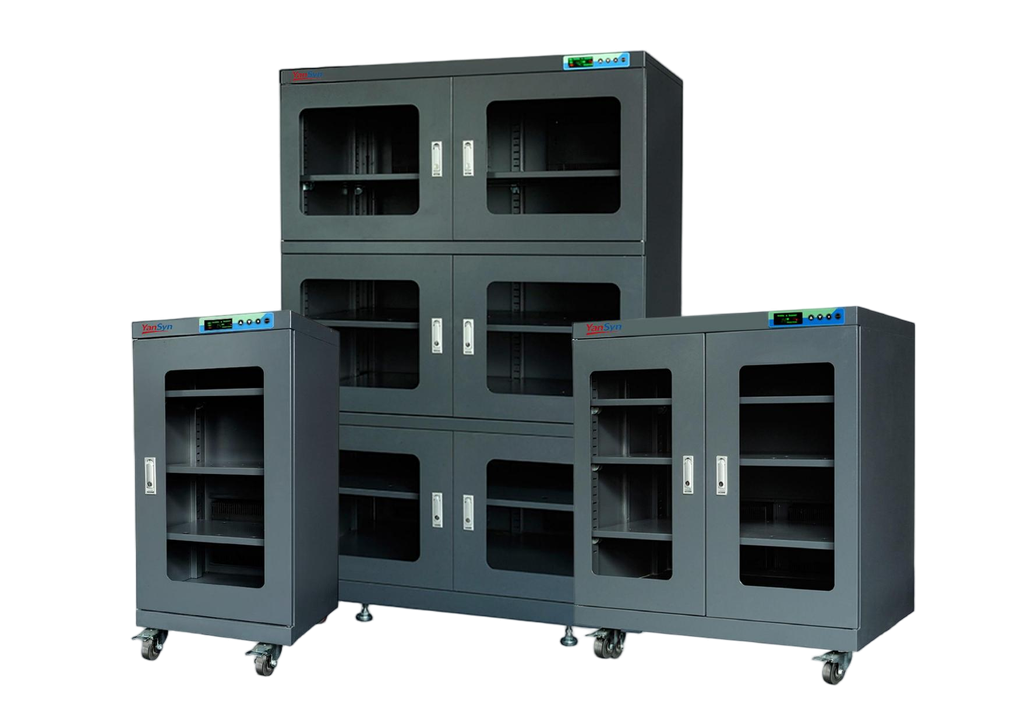
This article explains the working principle of a modern electronic dry cabinet, how the desiccant module pulls RH down to 1–5%, what happens to recovery time when operators open doors all day, and the maintenance routine that keeps performance stable for years. If you are comparing models right now, you can use it as a technical checklist alongside the YanSyn YSM series moisture-proof cabinets.
What a Dry Cabinet Actually Does
A dry cabinet is a sealed storage enclosure that actively removes water vapor from the air inside it, holding a user-selected RH setpoint indefinitely — without consuming desiccant bags or needing compressed air. Unlike a nitrogen purge cabinet, which displaces moist air with nitrogen gas, a dry cabinet circulates the internal air through a solid desiccant material and returns it dried. The result is an extremely economical way to maintain ultra-low humidity: once the target is reached, the module only runs intermittently to hold it.
Three subsystems determine whether the cabinet meets its number on the display:
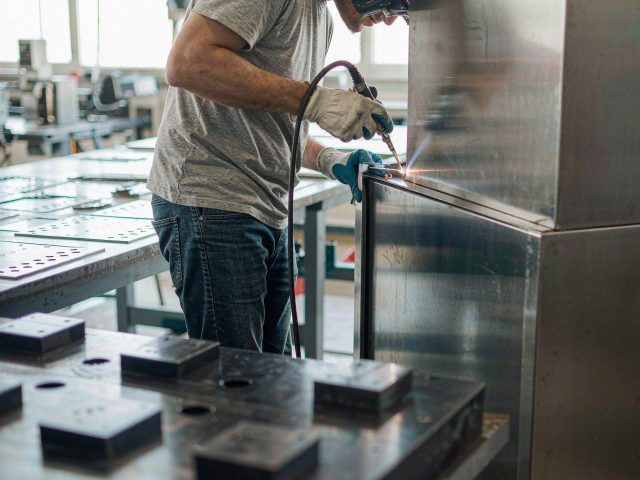
- The enclosure. Steel panels with proper coating and full-perimeter welding, a magnetic sealing strip around the door, and tempered glass that does not leak. A leaky enclosure forces the module to run continuously and shortens its life.
- The dehumidification module. The heart of the machine — a renewable desiccant core that alternates between drying the cabinet air and regenerating itself.
- The control system. A humidity sensor, a controller, and usually an HMI panel that lets you set the RH target and log conditions.
Inside the Dehumidification Module
The module used in virtually all modern dry cabinets is a renewable desiccant rotor or twin-core design. The principle is simple and has no consumables: a hygroscopic material (silica gel family) adsorbs water vapor when cool and releases it when heated.
The Adsorb–Regenerate Cycle
At any moment, the module splits the internal air stream into two paths:
- Process air. A fan draws air from the cabinet volume, pushes it through the cool desiccant bed, and returns dried air to the cabinet. Water molecules stick to the desiccant surface; the air leaving the bed can be far drier than the cabinet itself.
- Regeneration air. A small heater warms a separate section of the desiccant, driving the adsorbed moisture out as vapor. This wet air is vented to the room, not into the cabinet.
In rotor designs the wheel rotates continuously between the two zones; in twin-core designs the modules alternate on a timed cycle. Either way the desiccant is “recharged” by electricity alone. This is why a quality cabinet needs no refill packs: the same desiccant works for years, and the only running cost is a modest amount of power.
Why Module Sizing Matters More Than the Spec Sheet Suggests
Two cabinets can both claim “1–5% RH” yet behave completely differently in production. The difference is how much drying capacity the module delivers per hour relative to the cabinet volume and the moisture load that walks in through the door. An undersized module will hold the setpoint in an idle lab but never recover during a busy shift; an oversized one holds margin for door traffic, power interruptions, and humid-season loading. When comparing suppliers, ask for the dehumidification capacity at low RH rather than only the ultimate setpoint — reaching 2% RH once in an empty cabinet is easy; holding it with twelve trays of MSL-3 components inside is the real test.
Sensors, Control and Recovery Time
The humidity sensor feeds a closed-loop controller. When RH drifts above setpoint, the module runs; when it reaches target, the module idles. On a well-built cabinet you can watch this cycle on the HMI panel — long idle periods with short bursts of activity mean the enclosure is tight and the module is correctly sized.
What Happens When the Door Opens
Every door opening exchanges a large fraction of the cabinet air with room air. At 60% RH and 25°C, room air carries roughly fifteen grams of water per cubic meter — several hundred times more than air at 2% RH. The cabinet must re-adsorb all of that through the module. Recovery time therefore depends on four factors:
- Door-open duration. Five seconds of browsing is trivial; a thirty-second rummage for one reel is not.
- Opening frequency. A line-side cabinet opened fifty times per shift lives in a permanently wet regime compared with a lab cabinet opened twice a day.
- Internal thermal mass. Cold parts pulled from an air-conditioned store into a humid room can condense moisture on their surfaces before the air even dries.
- Module capacity versus volume. The same module dries a 100 L benchtop unit far faster than a walk-in bank of cabinets.
Two practical rules follow. First, for high-traffic locations, prefer multiple smaller cabinets staged at the point of use over one large shared cabinet — fewer door openings per unit of stored material. Second, treat the recovery curve, not the idle setpoint, as the acceptance criterion when you qualify a cabinet: log RH continuously for a week of normal production before signing off.
Choosing an RH Setpoint by Application
Lower is not always better. The right setpoint depends on the failure mode you are preventing, and for some materials ultra-dry air brings its own side effects (for example, increased ESD risk or drying out of non-metallic materials). The ranges below are commonly used starting points across the industry — always defer to your own process specification or customer requirements.
| Application | Commonly Used RH Target | Why This Range |
|---|---|---|
| Moisture-sensitive devices (MSD), SMT reels and trays | 1–5% RH | Pauses floor-life clock per IPC/JEDEC practice; prevents popcorn effect in reflow |
| Semiconductor wafers, ICs, MEMS | 1–5% RH | Prevents surface oxidation and micro-corrosion of bond pads |
| General electronic components, PCBs in WIP | 10–20% RH | Well below the moisture uptake threshold of most laminates, lower energy cost |
| Precision optics, lenses, camera modules | 30–50% RH | Stops fungus growth (needs >60% RH) without over-drying adhesives and coatings |
| Metal precision parts, tooling, samples | 20–40% RH | Suppresses corrosion while avoiding brittle behavior in some non-metallic materials |
Note the optics row: this is where the “drier is better” instinct fails. Storing coated lenses at 1% RH provides no additional benefit over 40% RH and can stress organic adhesives over long periods. Set the number the application needs, not the lowest number the cabinet can reach.
A Practical Maintenance Checklist
Renewable-desiccant cabinets are deliberately low-maintenance, but a short routine keeps the displayed RH trustworthy:
| Interval | Task | What It Protects |
|---|---|---|
| Weekly | Glance-check displayed RH against setpoint; confirm the module cycles (not running flat-out) | Early warning of door leaks or sensor drift |
| Monthly | Wipe the door seal and mating surface; check shelves and trays for items blocking airflow paths | Seal integrity and uniform airflow |
| Quarterly | Verify sensor with an independent calibrated hygrometer placed mid-cabinet; clean or replace inlet filters if fitted | Accuracy of the number everyone trusts |
| Annually | Run a full door-opening recovery test and record it; inspect hinges, latch and casters | Documented qualification evidence for audits |
The quarterly sensor check deserves emphasis. Every decision in your MSD program — whether a reel needs rebaking, whether a tray is still within floor life — is made against the cabinet display. A sensor that reads 3% when the true value is 12% quietly invalidates all of them.
When Nitrogen Purge Beats Desiccant Drying
A dry cabinet removes water; it does not remove oxygen. If your parts are oxidation-sensitive — bare copper leads, silver-alloyed contacts, reactive metal powders, solder paste stocks — you need an oxygen-lean atmosphere, and that is the job of a nitrogen purge cabinet such as the YanSyn YSN series. The two technologies also combine well: many lines run dry cabinets for general MSL storage and a smaller nitrogen-purged bank for oxidation-critical parts, with flow control on the nitrogen side to keep gas consumption sane.
The Takeaway
A dry cabinet is a closed-loop moisture machine: a tight welded enclosure, a self-regenerating desiccant module, and a sensor-driven controller working together. When you evaluate one, look past the setpoint on the display and check the three things that actually predict performance — dehumidification capacity relative to cabinet volume, recovery behavior under realistic door traffic, and sensor accuracy you can verify with your own hygrometer. Those three checks take an afternoon and will tell you more than any datasheet.
If you are building or upgrading an ultra-low-humidity storage area, the YanSyn YSM series moisture-proof cabinets cover benchtop to large-capacity volumes with renewable desiccant modules and HMI control — and the team can help you match module capacity to your door-traffic profile before you order.