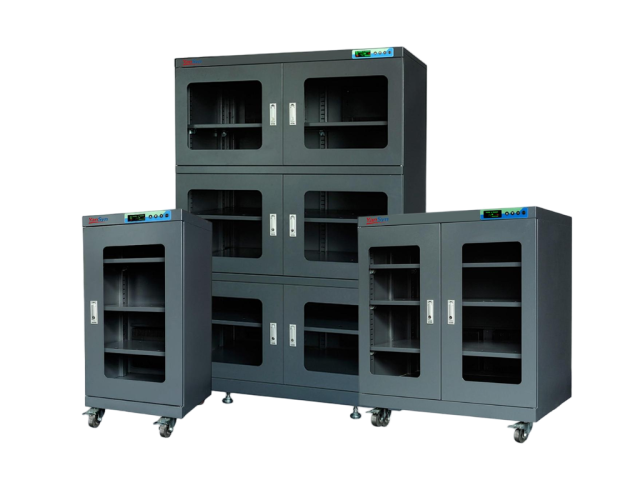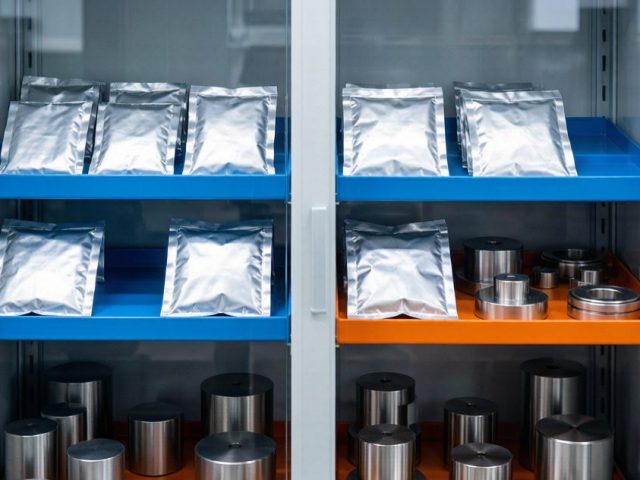
Dry Cabinet Build Quality: How Sheet Metal and Welding Decide Humidity Stability and Yield
When buyers compare a dry cabinet, a nitrogen cabinet or an industrial oven, the conversation usually starts with the control numbers: a 1–50% RH control range, an ultra-low oxygen environment, or temperature uniformity of ±2 °C. Those numbers describe the control system. They do not describe the enclosure that has to hold the environment in place.
That enclosure — the sheet metal, the welds, the door seal, the insulation — is the first layer of environmental control. If it leaks, sags, warps or loses compression, the control system spends its capacity fighting the room instead of protecting your product. This article explains how build quality turns into measurable performance, and gives you a checklist you can send to any supplier before you sign a purchase order.

A controlled cabinet is an enclosure problem first
Every humidity-controlled cabinet is a moisture-balance machine. A desiccant module or a dry nitrogen purge removes water vapour from the internal volume; the room outside is constantly trying to put it back. The rate at which it comes back is governed by two things: the humidity gradient between inside and outside, and the size of the leak paths connecting them.
The control unit can only remove moisture at a finite rate. A cabinet with generous leak paths forces the dryer to run continuously, shortens desiccant service life, and makes recovery after every door opening slower. A cabinet with tight seams and a well-compressed gasket lets the same control unit hold setpoint with a fraction of the duty cycle.
The same logic applies to the other two product families. In a nitrogen cabinet, the leaked-in species is oxygen rather than water vapour, and the consequence is oxidation of sensitive surfaces — plus continuously rising nitrogen consumption. In a heating oven, the enclosure governs heat loss, and uneven loss at the door or at thin-insulated edges shows up directly as poor temperature uniformity across the working volume.
Put simply: the specification sheet tells you what the control system is capable of. The build quality decides whether you ever get to use that capability.
From build feature to performance metric
The table below maps seven ordinary construction details to the performance metric they actually influence. This is the most useful way to read a datasheet, because it converts a vague phrase like "robust construction" into a question you can ask and a test you can run.
| Build feature | What it governs | Typical failure mode | How to verify |
|---|---|---|---|
| Panel flatness and bend geometry | Whether the door meets the gasket evenly | Warped door, uneven compression, persistent leak on one side | Straightedge check; inspect the gasket imprint after closing |
| Weld seam continuity | Leak-tightness of the shell | Intermittent or porous welds leave capillary leak paths | Visual weld inspection; pressure-decay or tracer test |
| Door gasket / magnetic sealing strip | Recovery time after every door opening | Compression set, cracking, hardening at high temperature | Door-open recovery test logged over a fixed period |
| Insulation and wall construction (ovens) | Uniformity, ramp time, energy use, skin temperature | Cold edges near the door, long ramp, hot outer skin | Multi-point uniformity survey at operating temperature |
| Penetrations (sensors, cables, gas ports) | Local leak points that bypass the main seal | Unsealed feedthroughs, loose bulkhead fittings | Itemised visual and leak check at each penetration |
| Shelf and rack rigidity | Airflow distribution and usable load | Sagging shelves, blocked circulation, dead zones | Rated-load test; uniformity survey under load |
| Surface finish and cleanability | Cleanroom and GMP suitability | Particle traps in crevices, difficult wipe-down | Wipe-down trial; review of internal corner construction |
Sheet metal: why flatness and bend radius matter
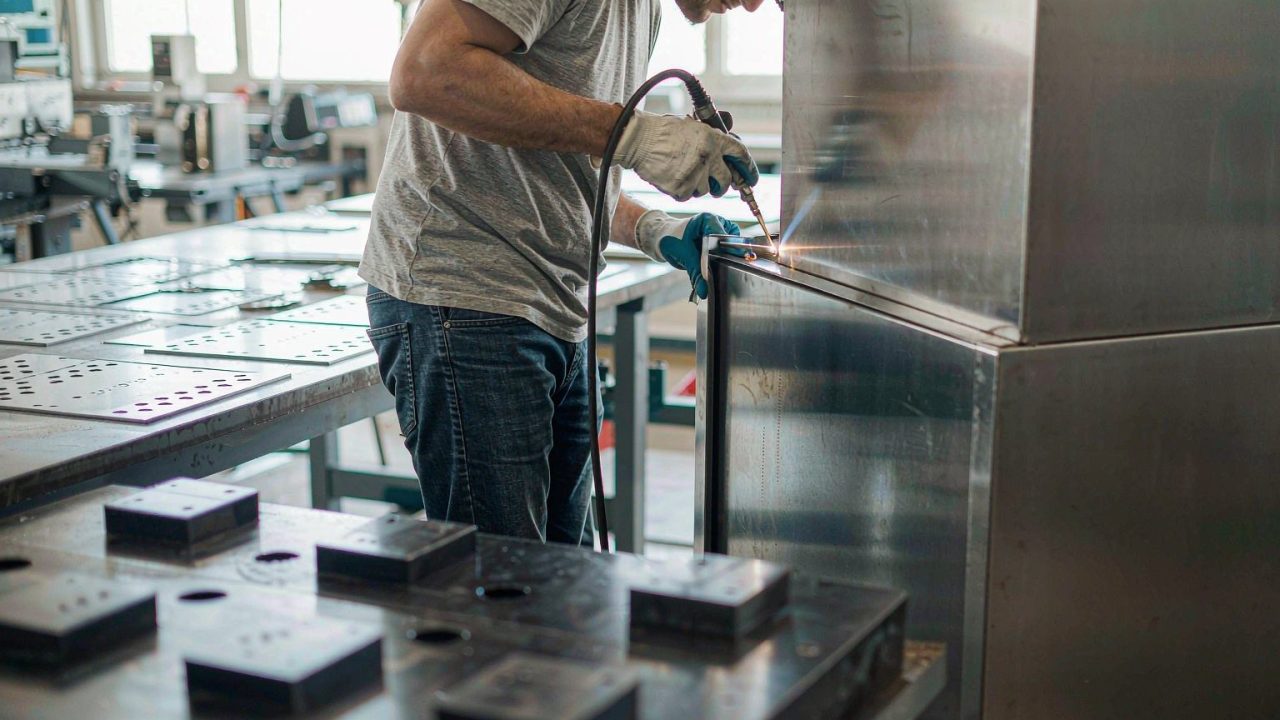
Cabinet bodies follow the standard sheet metal route: blanking, bending, stretching or forming, and welding. Two details from that route have outsized influence on the finished enclosure.
First, bend geometry. When sheet metal is bent, the outer layer of the bend is stretched and the inner layer is compressed. For a given material thickness, a smaller inner radius makes that stretching more severe; if the tensile stress on the outer surface exceeds the material's strength, the bend cracks. A practical design rule is to keep the inner radius larger than the sheet thickness, and for drawn features to work in the range of roughly three to five times the sheet thickness. This is a strength rule, but it is also a dimensional rule: a panel that has been stressed near its limit is a panel that will relax and move over time.
Second, rigidity. Flat panels are stiffened with formed features rather than with extra material thickness — embossed ribs increase rigidity, and louvers provide ventilation where heat has to escape. Stiffened panels hold their shape under load and through thermal cycles, and a door that holds its shape keeps its gasket in contact.

Welding and seam continuity: the nitrogen cabinet's critical path
Weld quality matters for every controlled enclosure, but it is decisive for nitrogen cabinets. A desiccant dry cabinet has to exclude water vapour; a nitrogen cabinet has to exclude oxygen while maintaining a positive internal pressure of dry gas. Every leak path is a direct oxygen ingress route and a direct nitrogen cost.
This is why seam construction deserves explicit attention in a specification:
- Continuous versus intermittent welds. Intermittent or stitch welds leave open intervals between weld beads. Those intervals are capillary paths — they may be invisible to the eye and still pass gas.
- Weld finish. Ground and cleaned welds are easier to inspect, easier to clean, and do not trap particles or moisture in slag and spatter.
- Penetrations and corners. Corners, sensor feedthroughs and gas ports are statistically the most likely leak locations, because they interrupt a continuous seam.
If you are running a nitrogen cabinet, the practical test is a decay test: bring the cabinet to its low-oxygen setpoint, isolate the gas supply, and log how fast oxygen rises. The shape of that curve tells you more about enclosure integrity than any marketing description. Operating practices that reduce gas consumption are covered in more detail in our article on cutting nitrogen use with smart flow control, and the longer-term economics of nitrogen versus desiccant are set out in our five-year TCO comparison.
Door sealing: where most real-world leakage happens
In day-to-day operation, the dominant moisture load on a dry cabinet is not steady-state leakage at all. It is the door opening. Every time an operator removes a tray, the cabinet exchanges its internal volume with room air, and the control system has to pull the humidity back down before the setpoint is meaningful again.
Recovery time is therefore the single most user-visible consequence of build quality. It depends on two things: how much air is exchanged during the opening, and how tightly the cabinet re-seals afterwards. A gasket that has taken a compression set — permanently flattened from years of pressure — will not restore its original profile, and the cabinet quietly becomes slower every year.
Two practical habits help. First, log recovery time quarterly under the same conditions and watch for drift rather than waiting for a failure. Second, treat gaskets as consumables with a documented part number and replacement interval, not as a mystery part to be sourced when something goes wrong.
Ovens: insulation, air path and uniformity
For a heating oven, the enclosure governs where heat goes. YanSyn YSHG ovens use PID control with temperature uniformity of ±2 °C, customisable to ±1 °C, over a working range from ambient to 500 °C, with options for Class 100 clean configuration, nitrogen atmosphere and IoT monitoring. Those are control-side and configuration-side capabilities; reaching them in your process depends on the chamber construction.
Three construction factors dominate:
- Insulation continuity. Any thin spot — typically around the door frame and at corners — becomes a cold edge, and cold edges are what a uniformity survey detects first.
- Air path. Circulation has to reach every shelf position. Shelf design, baffle placement and load distribution all interact; a uniformity result obtained on an empty chamber is not the same as a result obtained at rated load.
- Seal temperature rating. A gasket that is correct at 80 °C may harden at 250 °C. The seal material has to be specified against the maximum operating temperature, not against the average one.
If your process runs in a clean environment, two further construction questions apply — HEPA filtration and material outgassing — which we covered in how to specify a clean oven.

A build-quality checklist for your next RFQ
The checklist below is written as questions to put in a request for quotation. Asking for evidence rather than adjectives is what separates a comparable bid from a marketing claim.
| Item | What to ask | Evidence to request |
|---|---|---|
| Material traceability | Which sheet and frame materials, from which source | Mill certificate or material declaration |
| Weld method and finish | Continuous or intermittent; ground, cleaned, passivated | Weld map or build photographs with the finish spec |
| Leak-tightness test | Which method is used, and against what acceptance limit | Test report with the method and measured value |
| Gasket specification | Material, temperature rating, replaceability | Datasheet plus spare part number and price |
| Door geometry | Flatness tolerance, hinge adjustability, latch points | Drawing with tolerances; inspection record |
| Insulation (ovens) | Type, thickness, maximum external skin temperature | Construction drawing; measured skin temperature |
| Uniformity (ovens) | Number of survey points, tolerance, empty or loaded | Uniformity survey report with the load condition stated |
| Spare parts and service | Availability of gaskets, sensors, heaters, controllers | Spare parts list with lead times |
Four tests to run at acceptance
Specifications describe intent; acceptance tests describe reality. These four are inexpensive and can be run on site with the instruments you already have.
- Pull-down test. From ambient, close the door and log the time to reach setpoint. Compare against the value recorded at commissioning, not against a supplier's generic figure.
- Door-open recovery test. Open the door for a fixed period under normal operating conditions, close it, and log the time to return to setpoint. Repeat quarterly; a rising trend is a sealing or dryer-capacity signal.
- Decay or hold test (nitrogen cabinets). Reach the low-oxygen setpoint, isolate the gas supply, and log oxygen rise over a fixed period. The slope is your enclosure integrity indicator.
- Uniformity survey (ovens). Map multiple points across the working volume at operating temperature, both empty and at rated load. Record sensor positions so the survey is repeatable next year.
Treat any numbers you record as your own baseline rather than as a pass or fail against a published figure. Ambient conditions, load and door-opening frequency all shift the result, so what matters is the trend for your cabinet in your room. Any thresholds quoted in a supplier document should be confirmed against your own process requirements before they are written into an acceptance criterion.
Frequently asked questions
Does build quality really change humidity performance, or only appearance?
It changes performance. Humidity control is a balance between moisture removal and moisture ingress, and ingress is governed by leak area. A cabinet with poor seams or a tired gasket forces the drying system to run continuously and lengthens recovery after every door opening.
How often should a door gasket be replaced?
There is no universal interval, because it depends on opening frequency, operating temperature and material. The practical approach is to log recovery time quarterly and replace the gasket when the trend degrades, rather than on a fixed calendar date.
Can sealing on an existing cabinet be upgraded?
Often yes. Gasket replacement, hinge and latch adjustment, and sealing of unused penetrations are the three highest-value interventions and usually do not require replacing the cabinet. Ask for the spare part number for your specific model.
What is the single most useful acceptance test?
For dry and nitrogen cabinets, the door-open recovery test, because it combines sealing performance with control capacity in the condition you actually operate in. For ovens, the loaded uniformity survey, because an empty-chamber result hides most real problems.
Does build quality matter more for a clean oven?
Yes. In addition to everything above, a clean configuration adds filtration and outgassing requirements, and internal construction — corner radii, weld finish, material selection — determines whether the chamber can be cleaned to the level your process needs.
Where to go from here
If build quality is the first layer of environmental control, the second layer is choosing the right control principle for your material, and the third is operating it consistently. Our product pages describe the control side of each family: the YSM series moisture-proof cabinet for humidity-controlled storage in the 1–50% RH range, the YSN series nitrogen cabinets for oxidation-sensitive storage, and the YSHG series electric heating oven for controlled thermal processing. For the underlying fabrication steps, see YanSyn cabinet manufacturing process.
Tell us your material, your target setpoint and your throughput, and we will tell you which enclosure specification you actually need — and which checklist items we can evidence for it.