New Energy Beyond Batteries: Humidity Control for Solar Inverter and Module Lines
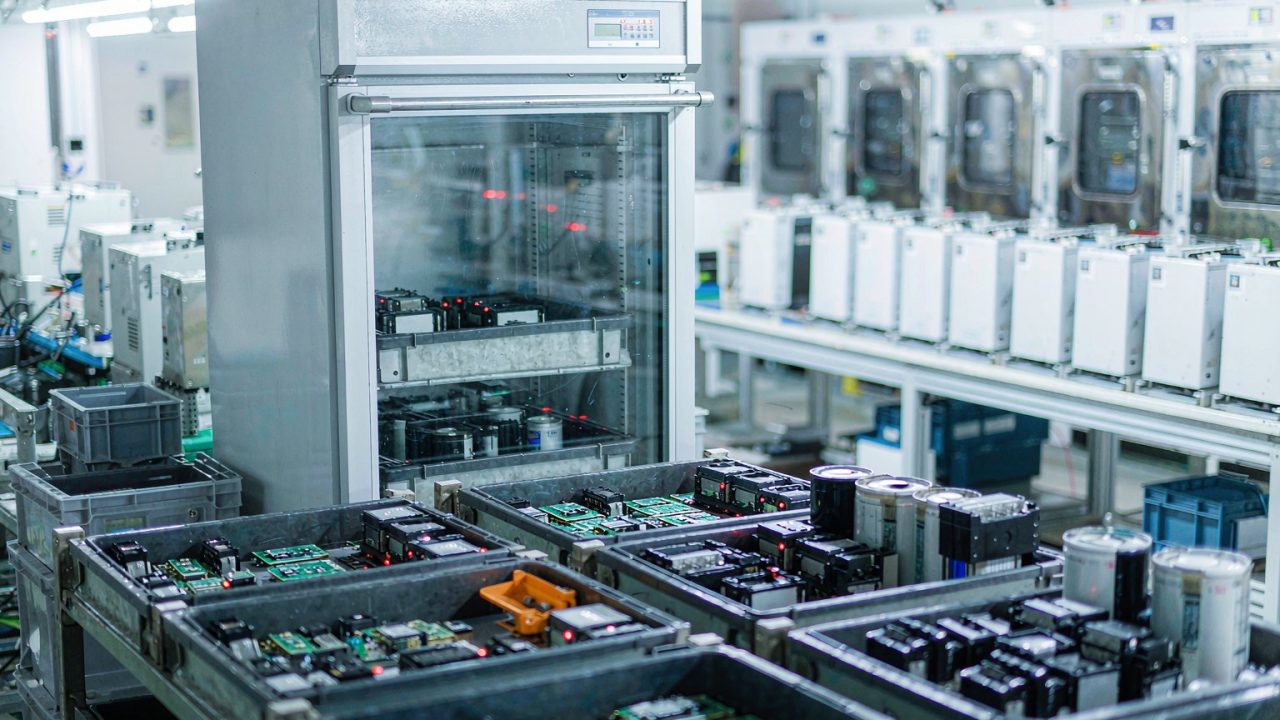
Batteries get most of the attention in new energy manufacturing, but they are not the only moisture-sensitive products on the line. A grid-tied solar inverter is essentially a power-electronics assembly: insulated-gate bipolar transistor (IGBT) modules, film capacitors, multi-layer PCBAs, magnetics and connectors, all protected by coatings and housings that depend on clean, dry upstream processes. The module line next door adds its own humidity risks in encapsulant films, backsheets, ribbons and junction boxes.
This article looks at storage and heat treatment for these two product families — what actually absorbs moisture, what fails as a result, and how dry cabinets and industrial ovens fit into a workable flow from goods-in to line-side.
Why Inverter Lines Have Their Own Moisture Problem
An inverter converts DC from the array into grid-compliant AC. The components that make this possible are exactly the ones that humidity attacks:
- IGBT and SiC power modules. Their internal die attach and wire bonds are vulnerable to moisture-driven degradation, and the module package itself absorbs water like any molded semiconductor device. Soldering a saturated module can trigger the same delamination failures known from chip components.
- DC-link film capacitors. Metallized film capacitor ends and terminations are sensitive to oxidation before soldering; long uncontrolled storage degrades solderability and can raise equivalent series resistance over the product's life.
- Inverter PCBAs. These boards carry fine-pitch controllers, gate drivers and communication interfaces. Like any printed circuit board assembly, the laminate and the bare board are moisture-barrier-bag items with a defined floor life once the bag is opened.
- Magnetics and busbars. Transformer cores, inductor windings and bare copper busbars discolor and oxidize in humid air. Oxide on a contact or a termination point means higher resistance and more heat in service.
- Connectors and contacts. Plated contacts lose solderability and contact reliability when corrosion films form during storage.
The common thread: none of these parts are dangerous on the shelf in a sealed bag. The risk starts when packaging is opened, exposure clock starts running, and the part sits in ambient air longer than its classification allows.
| Component family | Main humidity / oxidation risk | Typical storage control |
|---|---|---|
| IGBT / SiC power modules | Moisture absorption in the molded package; delamination and popcorning during reflow | MSL-based floor-life tracking; dry storage at low RH once bags are opened |
| DC-link film capacitors | Termination oxidation; degraded solderability | Dry cabinet storage below the RH level your soldering spec requires |
| Inverter PCBAs and bare boards | Laminate moisture uptake; microcracks and voiding at reflow | J-STD-033 floor-life management plus low-RH storage |
| Magnetics and busbars | Copper oxidation and discoloration; higher contact resistance | Low-RH dry cabinet; nitrogen purge for long-term buffer stock |
| Connectors and plated contacts | Corrosion films on plating; contact reliability loss | Dry storage; keep sealed until kitting |

Floor Life Still Applies on the Inverter Line
Power electronics assemblers sometimes assume that moisture rules are an SMT-only concern, or that large modules are exempt because they are physically big. Neither is true. Molded semiconductor packages — including IGBT and SiC modules — are classified for moisture sensitivity in the same framework as small SMDs, and a floor-life violation behaves the same way: absorbed water flashes to vapor during soldering and damages the package from the inside.
In practice, an inverter line needs the same discipline as any electronics line:
- Record the exposure clock. When a moisture barrier bag is opened, log the date, time, humidity class and remaining allowable exposure.
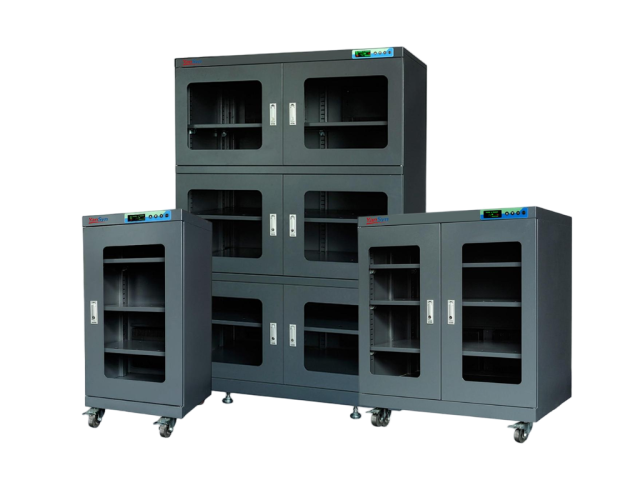
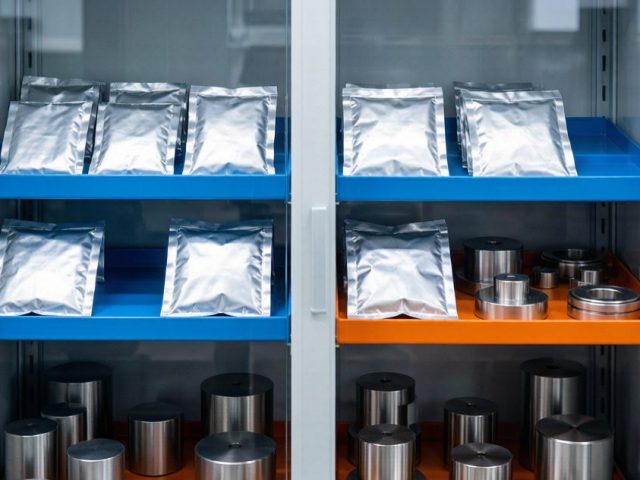
- Store open bags at low RH. A YSM series moisture-proof cabinet holds opened MSDs in a controlled low-humidity environment so the clock stops accumulating risk while parts wait for their next process step.
- Bake only when the clock has run out. If exposure exceeds the allowed time, follow the standard's baking profile before reflow. The decision logic and typical profiles are covered in our article on MSD baking profiles and the popcorn effect, and the per-level exposure limits are summarized in the IPC/JEDEC floor-life cheat sheet.
Treating inverter modules as first-class MSDs costs almost nothing to organize and removes one of the more reliable ways to ruin an expensive power stage during production.
The Module Line Side: Films, Ribbons and Junction Boxes
Photovoltaic module manufacturing has its own set of materials that quietly absorb moisture between deliveries and lamination. Our earlier article on photovoltaic module storage and curing covers the full production chain; here the focus is the storage decisions that matter most in daily operation.
- Encapsulant films (EVA and POE). These sheets are hygroscopic, and uncontrolled uptake shows up later as bubbles, delamination or elevated leakage current in finished modules. Film rolls and cut sheets belong in low-humidity storage until loading.
- Backsheets. Layered polymer backsheets can take up moisture at the edges; storage control protects both handling quality and long-term insulation performance.
- Solder ribbons and busbars. Copper-based interconnects oxidize like any other copper product. Dry storage keeps surfaces solderable and keeps lamination voids down.
- Junction boxes and potted components. Potting compounds and adhesives often require controlled storage and, in some cases, conditioning before use — check the manufacturer's data sheet rather than guessing.
Where film or component manufacturers specify a maximum RH for storage, the practical question is which cabinet maintains it across a full shift of door openings. That is what the YSM series is designed for: fast humidity recovery after access, with continuous display and logging.

Storage and Curing Setpoints That Hold Up
Every material supplier publishes its own storage limits, so the numbers below are indicative assumptions to illustrate the structure of a policy — replace each one with the value printed on your actual data sheets and in your customer specifications.
| Material class | Illustrative control target | Equipment role |
|---|---|---|
| Opened MSDs (modules, ICs, PCBAs) | Low RH per J-STD-033 storage guidance (indicative assumption: below 10% RH) | YSM moisture-proof cabinet |
| EVA / POE encapsulant, backsheets | Low RH per film maker's limit (indicative assumption: below 30% RH) | YSM cabinet sized for rolls and cut sheets |
| Ribbons, busbars, unplated copper parts | Low RH; nitrogen purge for long buffer times | YSM cabinet; YSN nitrogen cabinet where oxidation history is critical |
| Over-exposed MSDs needing bake-out | Time / temperature per the standard's baking profiles (indicative assumption) | YSHG electric heating oven |
| Potting and adhesive curing | Profile defined by the compound supplier | YSHG oven with PID control; uniformity within ±2 °C (customizable to ±1 °C) |
Two points deserve emphasis. First, storage and baking solve different problems: a cabinet slows moisture uptake, an oven removes it or cures a polymer — they are not interchangeable. Second, oven uniformity matters more than peak temperature for polymer curing. A chamber that holds every shelf within a tight band produces repeatable cure; a hot-spot-heavy chamber produces parts that pass today's test and drift for years in the field.
Cabinet, Oven or Both?
Plants asking "which one do we buy" are usually asking the wrong question. Use this quick decision view:
| Your situation | What fits | Why |
|---|---|---|
| Open MSDs and films waiting for the next process step | YSM dry cabinet | Stops the moisture clock; parts stay ready without rework |
| Copper parts or alloys with visible oxidation history | YSM, or YSN where needed | Low RH protects surfaces; nitrogen removes oxygen entirely when required |
| Exposure clock already expired | YSHG oven bake per profile | Drives absorbed moisture back out before reflow |
| Potting, adhesive or coating cure step | YSHG oven | Controlled, uniform heat for repeatable polymer cure |
A Practical Flow from Goods-In to Line-Side
Equipment only pays off inside a simple, enforced workflow. The version that survives real production looks like this:
- Goods-in checks. Verify MSL labels, bag seals and humidity indicators; quarantine anything with a broken seal.
- Sealed storage. Keep unopened bags in normal warehouse conditions; no need to open early.
- Controlled issue. Open bags only at the point of use, log the exposure start, and place anything not consumed immediately into the YSM cabinet.
- Clock tracking. Use your MES or even laminated cards per reel: level, remaining exposure, due-for-bake date.
- Bake-back loop. When a clock expires, bake per the standard profile in the YSHG oven, then reset the record and return the parts to low-RH storage.
- Module-line parallel track. Same pattern for encapsulants and ribbons: supplier limit in, low-RH storage, first-in-first-out issue.
None of this requires new IT systems on day one. It requires that every opened bag has a home and a rule — and that the home is a cabinet that actually holds its RH through a busy shift.
Frequently Asked Questions
Do large IGBT modules really follow the same moisture rules as small SMDs?
The physics is the same: molded polymer packages absorb moisture and damage occurs when it vaporizes during soldering. Size changes exposure times, not the principle. Follow the classification printed by the module manufacturer and treat the part as an MSD.
Can I just bake everything instead of using dry cabinets?
No. Repeated baking is slow, consumes oven capacity, and can degrade some materials when over-applied. Storage in a low-RH cabinet prevents uptake in the first place and is far cheaper per part than a bake loop that exists only to fix preventable exposure.
What RH should I set for encapsulant films?
Use the film manufacturer's storage specification — it is the binding requirement. As an indicative assumption only, many plants hold films well below 30% RH; your supplier's data sheet replaces that number.
Do we need nitrogen purge for inverter components?
Usually not for routine flow, where low RH in a YSM cabinet is sufficient. Nitrogen storage in a YSN cabinet earns its place for high-value buffer stock or parts with a demonstrated oxidation history, such as copper interconnects held for long periods.
What oven features matter most for potting cure?
Uniformity and control stability, not just maximum temperature. The YSHG series uses PID control with chamber uniformity within ±2 °C (customizable to ±1 °C), which is what makes a cure profile repeatable across shelves and batches.
Conclusion
Behind every warranty claim on a solar inverter or a fielded PV module is a chain of small upstream decisions — how a reel was stored, how long a module sat open, whether a cure actually reached every shelf. Moisture and oxidation control is one of the few cost categories where the equipment pays for itself through avoided scrap and field failures rather than through throughput. A dry cabinet for everything opened, a nitrogen cabinet where oxidation history demands it, and a PID-controlled oven for bakes and cures cover nearly every situation on an inverter and module line.
If you are mapping storage and heat treatment for a new energy production line, tell us your materials and throughput — we will help you size the right combination of cabinets and ovens.