Hot-Air Circulation vs Vacuum Oven: Drying Mechanisms Compared
Drying looks simple from the outside. You put wet parts into a warm box, wait, and take out dry parts. In practice, drying is one of the most specification-sensitive steps in electronics, materials and laboratory work. The mechanism you choose decides not only how fast water leaves the part, but also whether the part survives, whether the surface stays clean, and whether the result is repeatable shift after shift.
Two mechanisms dominate industrial drying: hot-air circulation, where heated gas is forced across the load and carries vapour away, and vacuum drying, where chamber pressure is reduced so that moisture boils off at a much lower temperature. They are often treated as interchangeable. They are not. They remove moisture through different physical paths, they fail in different ways, and they suit different materials.
This article explains both mechanisms in plain engineering terms, compares them side by side, and gives a practical decision path for choosing between them. It is written for process engineers, laboratory managers and buyers who need to justify a purchase or rewrite a drying specification.

Why the mechanism matters more than the setpoint
Most drying problems are not caused by the wrong temperature. They are caused by choosing a mechanism that cannot reach the water, or that reaches it in a way the material cannot tolerate.
Consider three common failure patterns:
- Dry outside, wet inside. A dense part reaches its target weight loss at the surface while the core is still holding moisture. Later, in reflow or in service, that trapped moisture expands and cracks the package.
- Dried, but damaged. The temperature needed to drive moisture out at atmospheric pressure is higher than the material can survive. The part comes out dry and degraded: discoloured, oxidised, or dimensionally changed.
- Dry, but re-contaminated. Moisture leaves, but the drying gas carries particles or oxygen onto a surface that must stay clean or oxide-free.
Each of these three failures maps to a different mechanism choice. That is why the question "what temperature?" should come after the question "what mechanism?".
Mechanism 1: hot-air circulation (forced convection)
How it works
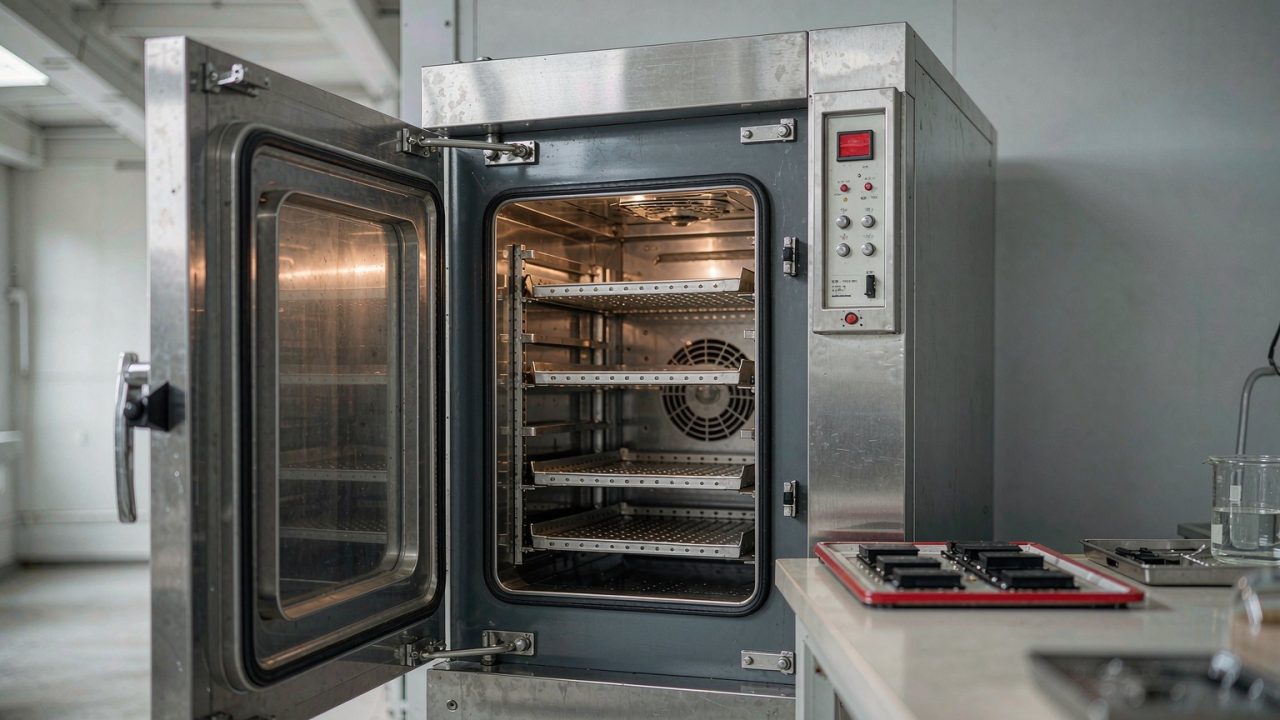
A hot-air circulation oven — the category that a YanSyn YSHG electric heating blower oven belongs to — heats a stream of process air and drives it through the chamber with a fan. Three things happen at once:
- Heat transfer. Moving air transfers heat to the load far more effectively than still air. This is why circulation, not just heating, is the core design feature.
- Evaporation. Energy arriving at the surface turns liquid water into vapour.
- Carriage. The same moving air picks up the vapour and carries it out of the chamber through exhaust, so the local humidity around the part never saturates.
Step three is the one people forget. A chamber with a heater but no air exchange becomes a humidity bath. The load stops drying even though the readout says the temperature is correct.
What it does well
- Thermal uniformity across many parts. A well-designed circulation loop holds temperature spread across the working volume within a tight band. YanSyn YSHG ovens use PID control with chamber uniformity of ±2 °C or better, with ±1 °C available as a customised configuration, across a working range from room temperature to about 500 °C.
- Throughput. Air reaches every shelf at once. Large batches dry in parallel without racking constraints.
- Simplicity and cost. No vacuum pump, no seal maintenance, no pump-down time.
- Compatibility with clean configurations. Circulation air can be filtered with HEPA to keep the load particle-free, which turns a drying oven into a clean-process tool.
Where it struggles
- Temperature ceiling of the material. At atmospheric pressure, water boils at 100 °C. Removing absorbed moisture from a dense or hygroscopic part usually needs substantially more energy than that, which can push the required temperature above what the material tolerates.
- Oxygen exposure. Hot air is roughly 21 % oxygen, and oxidation rate rises sharply with temperature. Parts with bare copper, silver, or reactive metal surfaces can come out discoloured.
- Geometry sensitivity. Deep cavities, tightly stacked trays and blind holes see much less airflow than exposed surfaces, producing uneven results within the same batch.
Hot-air circulation is the correct default whenever the material tolerates the required temperature and the batch is large. It is the backbone of moisture-sensitive device baking, which we covered in detail in our article on MSD baking profiles and the popcorn effect.
Mechanism 2: vacuum drying
How it works
A vacuum oven does the opposite to a convection oven. Instead of adding energy, it removes pressure. Water's boiling point follows the saturation curve: as absolute pressure falls, the temperature at which water turns to vapour falls with it. Reduce chamber pressure sufficiently and moisture leaves the part as vapour at temperatures far below 100 °C.
Because the vapour is generated inside the material and must travel out, a vacuum oven is not purely about pressure. Most vacuum processes still apply gentle shelf heating to supply the latent heat of vaporisation. The pump then removes the vapour so the pressure stays low and the driving force stays intact.
What it does well
- Low-temperature drying of heat-sensitive materials. Pharmaceuticals, some polymers, and certain battery electrode coatings can be dried without the thermal stress that convection would impose.
- Oxygen-free environment by default. Once air is pumped out, there is very little oxygen left to react with the surface.
- Reaching enclosed geometries. Pressure reduction acts throughout the volume rather than only on surfaces swept by air, which helps with powders, porous parts and tightly packed loads.
- Solvent recovery. Vapour can be captured in a condenser instead of being vented.
Where it struggles
- Uniformity is harder. Without a gas to carry heat, thermal transfer depends on radiation and shelf contact. Shelf-to-shelf and tray-to-tray temperature spread is generally worse than in a circulation oven.
- Batch size and cycle time. Pump-down adds time, and usable chamber volume is typically smaller for a given footprint.
- Maintenance burden. Pumps, seals, gauges and oil or dry-pump consumables add a service schedule that a convection oven does not have.
- Outgassing contamination. Volatile species released under vacuum can condense on cooler surfaces inside the chamber, including on the load itself.
Side-by-side comparison
| Dimension | Hot-air circulation oven | Vacuum oven |
|---|---|---|
| Driving force | Temperature difference plus continuous air exchange | Reduced absolute pressure lowers the boiling point |
| Typical temperature | Above 100 °C for most moisture removal; up to about 500 °C on YanSyn YSHG | Can run well below 100 °C for the same moisture load |
| Temperature uniformity | Strong, when the circulation loop is well designed (±2 °C standard, ±1 °C custom on YSHG) | Weaker; depends on shelf contact and radiation |
| Batch size | Large, multi-shelf, parallel drying | Smaller usable volume per footprint |
| Oxygen exposure | High, unless inerted with nitrogen | Low by default |
| Moving parts | Fan and heater | Vacuum pump, seals, gauges |
| Clean / particle control | Straightforward with HEPA filtration on the circulation loop | Possible, but air is not the transport medium |
| Operating cost driver | Electricity for heat and fan; optional nitrogen | Pump electricity, pump maintenance, longer cycles |
The third axis: atmosphere, not just mechanism
A frequent mistake is to treat "hot air versus vacuum" as a two-way choice when the real decision has three axes: how heat arrives, how vapour leaves, and what gas surrounds the part.
The third axis often decides the outcome. A part that survives 150 °C perfectly well in air may still fail because the surface oxidises at 150 °C. Conversely, a part that cannot survive 120 °C at atmospheric pressure may dry perfectly at 60 °C under vacuum.
There are two ways to control atmosphere in a convection oven:
- Nitrogen inerting. Purging the chamber with dry nitrogen reduces oxygen partial pressure while keeping convective heat transfer. This is the usual answer when you need both good uniformity and a low-oxygen surface.
- Fully oxygen-free configurations. When the specification calls for sub-ppm oxygen, standard inerting is not enough; sealing, purging strategy and oxygen monitoring all have to be designed in. We covered that boundary in our article on oxygen-free ovens and sub-ppm oxygen requirements.
For long-term storage rather than active drying, the same logic applies at room temperature: a YSM moisture-proof cabinet controls humidity, while a YSN nitrogen cabinet controls oxygen.

Decision path: which mechanism for which job
The table below is a starting point, not a standard. Every figure shown as a temperature or duration is an indicative assumption to be replaced by your own qualification data. Use it to frame the conversation, then validate on your own parts.
| Situation | Mechanism that usually fits | Reason |
|---|---|---|
| MSD baking before reflow | Hot-air circulation | Standards define temperature and time; uniformity across a full tray matters more than speed |
| Heat-sensitive API or excipient | Vacuum | Moisture must leave below the degradation threshold |
| Bare copper or silver surfaces | Vacuum, or nitrogen-inerted convection | Oxygen, not heat, is the damaging agent |
| Powders and porous parts | Vacuum | Pressure reduction acts throughout the volume, not only on swept surfaces |
| Large batches of similar parts | Hot-air circulation | Parallel drying on many shelves keeps unit cost low |
| Solvent with recovery value | Vacuum with condenser | Vapour can be captured rather than vented |
| Particle-critical drying | Hot-air circulation with HEPA | Filtration is straightforward when air is the transport medium |
| Curing and annealing | Hot-air circulation | The goal is a thermal profile, not moisture removal |
How to write a specification that a vendor can quote against
Whether you end up specifying convection or vacuum, the same information is needed. Vague requests produce vague quotations and, worse, equipment that passes acceptance testing but fails in production.
| Specify this | Why it matters |
|---|---|
| Maximum material temperature | Decides whether convection is even viable |
| Target end-point | Weight loss, moisture content, or a time-at-temperature rule; "dry" is not a specification |
| Uniformity requirement and how it is measured | State the number of sensors, their positions, and whether the load is empty or full |
| Atmosphere | Ambient air, filtered air, nitrogen, or sub-ppm oxygen |
| Load geometry and mass | Airflow and heat-up time are driven by the load, not by the chamber volume |
| Cycle time and throughput | Includes heat-up, soak, and for vacuum also pump-down |
| Monitoring and records | Regulated industries need traceable profiles, not just a setpoint display |
The last row is worth emphasising. In regulated and qualification-driven environments, the ability to produce a traceable temperature record is often the difference between an oven that passes an audit and one that does not. How to Specify a Clean Oven: HEPA, Uniformity and Outgassing goes deeper on the wording that makes uniformity clauses enforceable.
Practical notes for convection drying
If you land on hot-air circulation, three operational habits produce most of the available benefit:
- Do not overload the shelves. Circulation needs a path. Leave space between trays and avoid blocking return-air paths at the back and sides of the chamber.
- Verify uniformity with a real load. An empty-chamber uniformity figure and a full-chamber figure are different numbers. Ask for the loaded condition if that is how you will run.
- Confirm there is genuine air exchange. Exhaust should be measurable. A sealed chamber with a hot element dries slowly and unevenly.
Frequently asked questions
Is vacuum drying always faster?
No. Vacuum removes the temperature constraint, not the heat-transfer constraint. Under vacuum there is no gas to carry heat, so energy reaches the load mainly by radiation and shelf contact. For a large, dense batch, a circulation oven can finish sooner even though it runs hotter.
Can I dry moisture-sensitive devices under vacuum instead of baking?
Be careful. Industry moisture-sensitive device standards specify baking in terms of temperature and time at ambient pressure. Changing the mechanism changes the physics, and the standard's floor-life credit does not automatically transfer. Confirm with your quality function before substituting.
Does a nitrogen-purged convection oven perform like a vacuum oven?
Not exactly. Inerting solves the oxygen problem and keeps good convective uniformity, but it does not lower the boiling point. If your material cannot tolerate the temperature, inerting alone will not help.
Which mechanism gives better temperature uniformity?
Generally hot-air circulation, and by a wide margin where the chamber has a properly designed loop and fan. This is the main reason convection remains the default for processes where every part in a batch must see the same profile.
What should I ask a supplier first?
Ask for the uniformity figure under loaded conditions, the atmosphere options, and a reference profile from a comparable application. Those three answers will usually tell you whether the proposal is credible before you get into price. If you are evaluating vacuum equipment specifically, our vacuum oven selection guide lists the seven specifications that actually matter.

Choosing with confidence
The decision reduces to three questions. Can your material survive the temperature that atmospheric-pressure drying needs? If not, vacuum is the answer. Does oxygen damage your surface at that temperature? If so, use vacuum or inerted convection. Is uniformity across a large batch more important than cycle time or low-temperature operation? If so, circulation wins.
For most electronics, curing, annealing and general laboratory drying, hot-air circulation gives the best combination of uniformity, throughput and operating simplicity. Vacuum earns its place when the material is heat-sensitive, oxygen-sensitive, or porous in a way that airflow cannot reach. YanSyn builds convection equipment in the YSHG line and can advise on clean, inerted and monitored configurations when your process needs them.
Tell us your material, load geometry and end-point definition, and we will help you choose the mechanism before you choose the machine. Contact the YanSyn engineering team.