ESD at Ultra-Low Humidity: Managing Static Risk Below 5% RH
Why Ultra-Dry Storage Creates a Static Problem
Engineers who move a moisture-sensitive production line to very low humidity usually expect one problem to disappear and quietly create another. Moisture-related failures fall. Then ESD audit findings on the line begin to drift upward.
The reason is straightforward physics. Surface moisture forms an extremely thin conductive film on most materials. At ordinary factory humidity, that film bleeds static charge away fast enough that a technician handling a board rarely accumulates a damaging voltage. When you push a dry cabinet down to a few percent relative humidity, the film disappears. Polymer trays, tape, carrier bodies and packing foam become genuinely insulating, and charge has nowhere to go.
This article is a practical guide for lines that already run below 5% RH, or are planning to. It covers how static behaviour changes in that range, where the real risk sits, and how to design a workflow that protects moisture-sensitive and static-sensitive devices at the same time.
For the underlying moisture reasoning, the companion article on ESD and humidity in wafer and IC handling sets out the physical mechanism in more detail. This article takes that as a starting point and focuses on the operating practice.
What Changes Below 5% RH
Surface resistivity of ordinary materials rises
Most general-purpose plastics sit in the dissipative or mildly insulating band when they hold a normal amount of adsorbed moisture. Once they dry out, surface resistivity can climb by several orders of magnitude. A tray measured as marginally dissipative at 45% RH may behave as a plain insulator inside a cabinet held at 3% RH.
This matters because the tray, tape reel and foam cushion are all part of the ESD path. If they stop conducting, the only remaining discharge route is the device itself.
Charge generation does not stop, but charge decay does
Charge is generated by contact and separation, which means any movement of parts, lids, tape or film keeps producing it. What changes is the decay rate. In dry air, a charge that would bleed away in under a second at 50% RH can persist for minutes.
The practical result is accumulation. Repeated handling steps stack charge on the same object rather than letting it relax between steps.
Human body charging becomes more effective
A person walking across a floor generates triboelectric charge regardless of humidity. In dry air, less of it leaks away through shoe soles, skin moisture and clothing before reaching the fingertips. Figures in the low kilovolt range are commonly cited for dry rooms, but every facility measures differently. Treat any such number as an indicative assumption for planning, and replace it with your own field meter data.
Where the Risk Actually Sits
Not every step in a dry-storage workflow carries equal static risk. Sorting the workflow by physical contact type helps you spend effort where it changes the outcome.
| Workflow step | Dominant charge source | Risk at very low RH | Primary control |
|---|---|---|---|
| Parts at rest in the cabinet | Minimal; parts are static | Low | Dissipative shelves; grounded frame |
| Opening and closing the door | Air movement; gasket contact | Medium | Wrist strap on before touching the handle |
| Pulling a tray out | Tray sliding on rails; separation | Medium to high | Dissipative trays; mat before lifting |
| Removing carrier tape or film | Peel separation | High | Point-of-use ionization; slow peel |
| Placing parts into packaging | Friction in bags; air pockets in foam | Medium | Dissipative bags; no foam at the interface |
The pattern is worth noting. The cabinet itself is rarely the danger. Risk concentrates in the transitions: opening, sliding, peeling and hand-off.
Setting the Storage Humidity: A Conflict to Resolve Deliberately
Moisture sensitivity and static sensitivity pull in opposite directions. For moisture-sensitive devices, the IPC/JEDEC J-STD-033 framework generally pushes storage humidity lower, and many programs target a low single-digit percent for very sensitive package bodies. For static-sensitive devices, low humidity raises charging risk.
Facility specifications sometimes cite a general static-control floor for work areas, often expressed as a lower humidity bound around 30% RH, derived from industry guidance for ESD-protected areas. That figure applies to general work areas, not automatically to sealed dry storage, but it explains why audits flag very dry rooms.
The workable resolution is separation of concerns rather than compromise on a single number.
| Space | Humidity target | Static control role |
|---|---|---|
| Inside the dry cabinet | Set by device MSL class and program rules | No handling; grounded dissipative surfaces |
| Transition bench beside it | Moderate ambient | Mat, wrist strap point, ionizer |
| Assembly or test line | Ambient controlled per EPA guidance | Full EPA control measures |
Keeping the low-humidity environment sealed and doing all physical handling on a grounded transition bench is the cleanest arrangement. Devices get the dryness they need while the operator stays in a charge-dissipative workspace.
Designing the Cabinet for Static Safety
A dry cabinet built purely for humidity control will not be static-safe by accident. Several construction details decide whether the interior is a safe resting place for ESD-sensitive parts.
Grounding path
The cabinet frame and shelves should have a defined connection to protective earth: a single bonded ground point, checked at installation and at each preventive-maintenance cycle. Trouble comes from cabinets installed on a mezzanine or moved between rooms and reconnected without the ground lead being restored.
Shelf and liner material
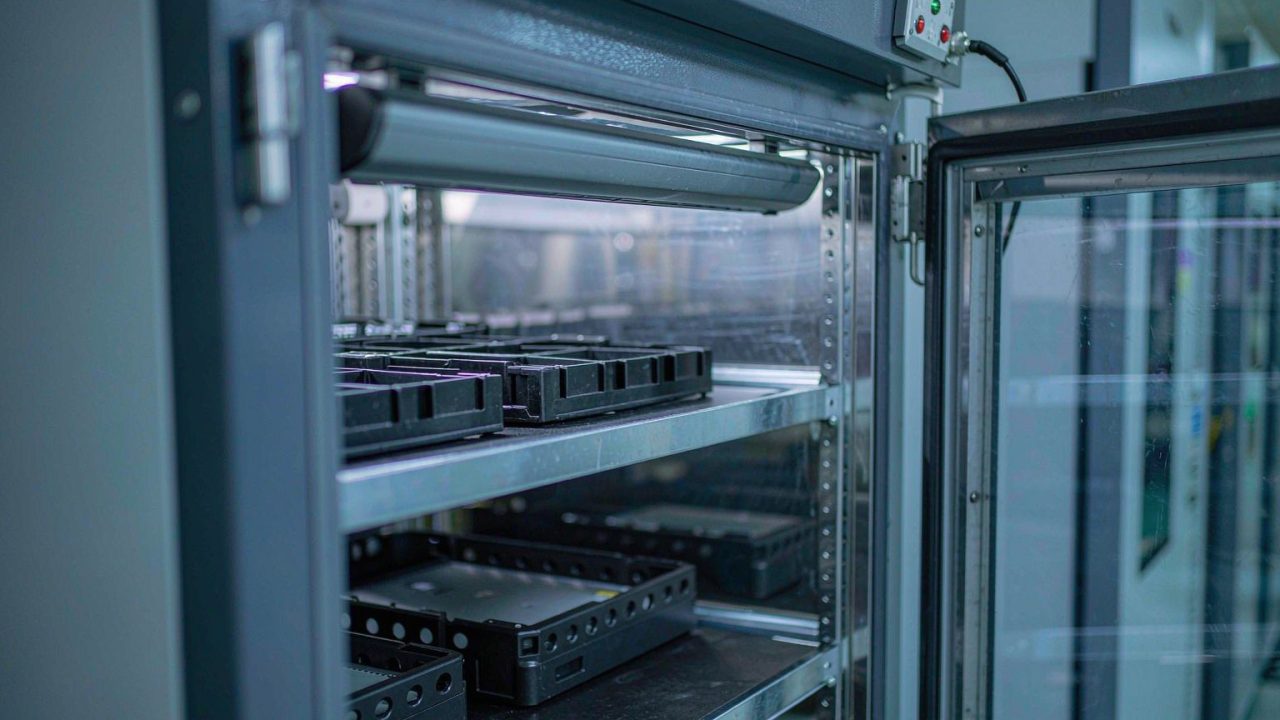
Metal shelves are naturally dissipative. Lined shelves need a liner that stays dissipative in dry air, because standard PVC or acrylic liners become insulators once dried. Dissipative formulations are available and worth specifying at the order stage, since retrofitting liners rarely fits the original budget.
Interior accessories
Trays, dividers, wafer carriers and film should be checked for surface resistivity at low humidity, not only at the condition printed on the datasheet. Ask for a reading at a humidity condition relevant to your cabinet, or measure it yourself with a surface resistivity meter.
Working Practices That Hold Up Below 5% RH
Procedures matter more than equipment once the basics are correct. These practices survive an audit and actually reduce failures.
- Strap before handle. The wrist strap goes on before the operator reaches for the door. This closes the charge path before the first contact event.
- One door, one operator. Multiple people reaching in at once multiplies charge events and makes monitoring meaningless.
- Minimum open time. Know the cabinet recovery time before open-door handling becomes a moisture problem. Very dry cabinets recover quickly once sealed, but not instantly.
- Ionization at peel points. Tape peels, film removals and bag openings should happen under ionized air. Point-of-use ionizers beat room-level units because ion density drops with distance.
- No foam at the interface. Foam is a strong charge generator. Use a dissipative bag or tray directly against the device.
- Dissipative carriers. If trays travel between cabinet and line, the container itself must be dissipative so it never becomes the largest charged object on the bench.
Monitoring: Two Instruments, Not One
Humidity logging alone will not reveal a static problem. The two measurements answer different questions and both are needed.
Humidity and temperature logging confirms the cabinet holds its setpoint and that recovery after door opening is within your limit. A logger with a defined sampling interval and a calibration record is sufficient.
Static survey answers whether charge is accumulating and where. A field meter reads surface voltage on trays, parts and clothing. A charged-plate monitor verifies that ionizers work and decay times stay within specification. A surface resistivity meter confirms trays and liners are still dissipative at the humidity you actually run.
A quarterly survey that walks the same route and records the same points will find most problems before they produce scrap. Classify readings against your own limits, and label those thresholds as facility-defined values rather than universal constants.
When Very Low Humidity Is Still the Right Choice
Sometimes very low humidity is not negotiable, for example high-package-count moisture-sensitive devices with limited floor life, or materials that oxidise quickly in ambient air. In those cases the static problem is managed, not avoided.
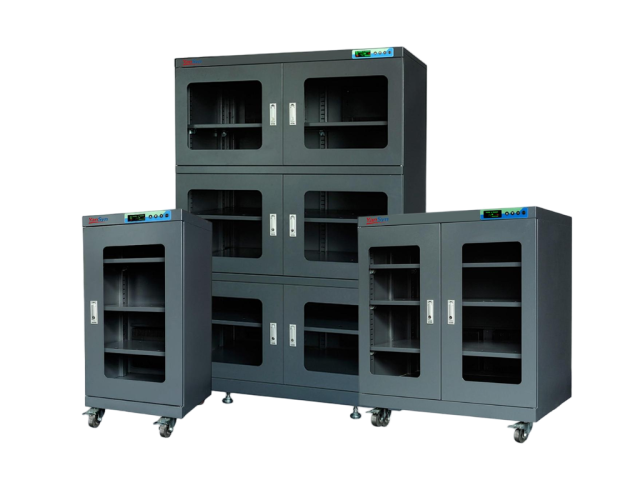
The Nitrogen series storage cabinets from YanSyn (YSN series anti-oxidation nitrogen cabinets) combine a dry nitrogen purge with a sealed chamber and are used where both residual oxygen and residual moisture must stay low. The humidity-controlled YSM series moisture-proof cabinets cover the 1 to 50% RH range and suit lines that only need controlled dryness.
For either type, the static-safety requirements described here apply: a bonded ground point, dissipative interior surfaces, and handling on a grounded transition bench rather than at the cabinet door.
Where parts must also be baked before or after storage, the profiles and their effect on solderability are covered in the MSD baking profile guide, and the cost comparison between cabinet types is set out in the five-year total cost of ownership breakdown.
Frequently Asked Questions
Is 5% RH the threshold where static becomes a problem?
There is no single threshold. Risk rises progressively as humidity falls, and the significant point depends on your materials, handling speed and device sensitivity. Below 5% RH the effect becomes noticeable on most lines, which is why the figure is used as a planning marker rather than a physical limit.
Can I just add a room humidifier?
Not if the room also contains a dry cabinet. Room humidity does nothing for the air inside a sealed cabinet, and it may work against neighbouring processes. Control the two environments separately.
Does ionized air solve the problem inside the cabinet?
No, and it should not be used that way. Ionizers are for work areas where charge is generated. Continuous ionization inside a sealed cabinet is unnecessary and can introduce contamination. The interior should be grounded and left undisturbed.
Are antistatic bags enough protection in dry storage?
Bags protect during transport and at the point of opening. Inside a cabinet, parts should rest on grounded dissipative surfaces rather than stay stacked in bags that insulate them from the shelf.
How often should the ground connection be verified?
At installation, at every preventive-maintenance interval, and any time the cabinet is moved. Record the measured resistance against your facility limit. A cabinet moved without a re-check should be treated as not ESD-safe until verified.
Do nitrogen cabinets need different static control?
The same principles apply. Nitrogen purge lowers both moisture and oxygen, making interior surfaces drier and more prone to charge accumulation. Grounding and dissipative materials remain mandatory, and handling should still happen outside the chamber.
Conclusion
Ultra-low humidity storage is a moisture solution, not a static solution. Taking a cabinet down to a few percent RH removes the water film that used to bleed charge away, and charge accumulation becomes a design question rather than a side effect.
The practical answer is to separate the two environments: keep the cabinet sealed and very dry, put a grounded transition bench in front of it, use dissipative materials through the handling path, ionize the point of peel, and monitor humidity and static with two separate instruments. None of these steps is expensive individually. Together they close a gap that appears only after the moisture problem is already fixed.
If you are planning a low-humidity storage area and need a cabinet that is also static-safe, talk to the YanSyn engineering team with your device list, target RH range and handling workflow. We will help you size the cabinet, define the grounding requirements and set up the transition bench.
YanSyn Intelligence (Shanghai) Co., Ltd. · Building10, No.568, Xueronghua Road, Pudong New Area, Shanghai, China