Medical Device Storage and Curing: Humidity and Heat Control for Implants
An implantable device cannot be recalled cheaply. Once a spinal cage, a cochlear electrode or a drug-eluting stent leaves the factory, the cost of a humidity-driven failure is measured in revision surgery, not scrap parts. That is why climate control in medical device manufacturing is judged differently: the question is not only "does the part still work?" but "can you prove, years later, that the environment never drifted?"
Most implant programmes have two climate-critical stations. The first is storage — the days or weeks components, adhesives, polymers and electronic sub-assemblies wait before assembly. The second is curing — the thermal step that sets an adhesive, cross-links a coating or anneals a metal. Getting one right and ignoring the other is the most common way a robust-looking process still produces intermittent field failures.
This article covers both stations, for process, quality and equipment engineers who need to specify a dry storage cabinet and a curing oven that will survive an ISO 13485 audit.
Why implants are less forgiving than most products
A consumer electronic device that absorbs a little moisture may still pass final test. An implant does not get that chance, for three reasons: the consequences of failure are clinical, the service life is measured in years, and the materials used are often intrinsically moisture-sensitive.
Four material families, four failure mechanisms
Implant bills of materials usually combine several of the following. Each reacts to humidity differently, which is why a single "keep it dry" rule is never enough.
| Material family | Typical use in implants | What humidity does |
|---|---|---|
| Metals (titanium, stainless steel, nitinol) | Structural components, stents, fixation plates | Bulk metal is not damaged by humidity, but surface oxides and adsorbed water change how well a coating or adhesive bonds. |
| Engineering polymers (PEEK, UHMWPE, silicone, polyurethane) | Housings, bearings, leads, seals | Absorbed moisture acts as a plasticiser: dimensions drift and bonding results vary between batches. |
| Adhesives, primers and coatings (epoxy, urethane, silicone, parylene precursors) | Bonding, encapsulation, lubricious and drug-eluting coatings | Many resins take up water before cure, causing voids, foaming, incomplete cross-linking and weak bonds. |
| Electronics in active implants (pacemakers, neurostimulators, hearing implants) | PCB assemblies, batteries, feedthroughs, sensors | Absorbed water turns to steam during reflow or welding, causing delamination and package cracking. The IPC/JEDEC J-STD-033 framework applies directly. |
| Resorbable polymers (PLA, PGA, PLGA) and hydrogels | Resorbable fixation, drug delivery matrices | Hydrolytic degradation begins before implantation: molecular weight falls during ambient storage, shortening resorption time. |
The practical consequence: an implant line often needs two different storage conditions side by side — moderate dry for polymers and metals, much drier and sometimes inert for electronics and resorbables.
Station one: specifying dry storage for implant components
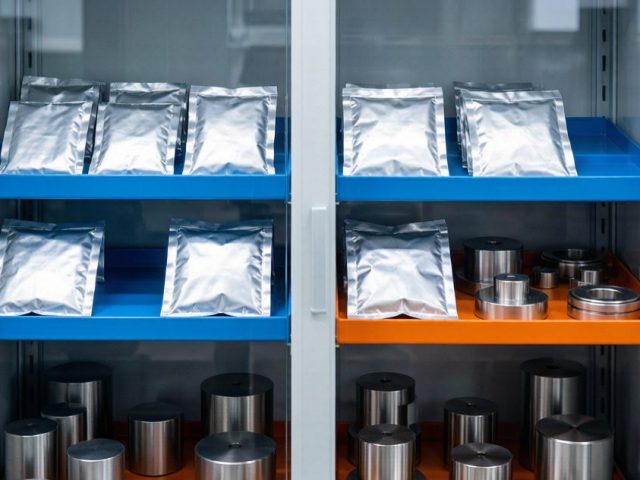
A dry cabinet for medical devices is judged on the same physics as an electronics dry cabinet, but on different purchase criteria. The humidity number matters; the documentation matters more.

The seven criteria that decide the purchase
| Criterion | What to ask for | Why it matters in a medical QMS |
|---|---|---|
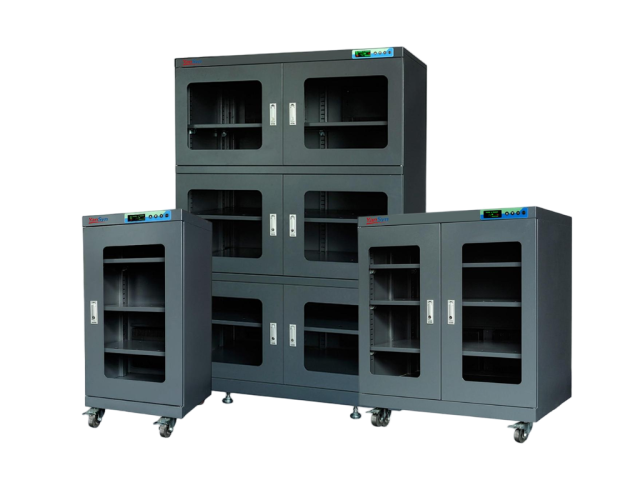
| RH control range | Confirm the achievable band and the setpoint you actually need. YanSyn YSM cabinets cover roughly 1–50% RH. | Different materials in one product need different setpoints. |
| Setpoint stability | Ask for the stability band at your setpoint, not just the range, and whether it is measured empty or loaded. | Acceptance limits in your protocol must be holdable by the equipment. |
| Recovery time | Time to return to setpoint after a defined door opening with a defined load. | Slow recovery is why operators prop doors open. Specify and test it. |
| Materials of construction | Cleanable interior surfaces, no shedding materials, sealed seams, glass or treated glazing. | Surfaces must tolerate your cleaning agents and particulate limits. |
| Monitoring and records | Independent sensor, logging interval, export format, retention period, audit trail. | You need records proving control for every batch. A display read once a shift is not a record. |
| Alarm behaviour | Local and remote alarm, delay before alarm, action on alarm, who is notified. | An unacknowledged excursion is a deviation. Define quarantine rules in advance. |
| Calibration traceability | Traceable certificate for the supplied sensor, recommended interval, field calibration method. | Auditors will ask for it. Plan the interval and a spare sensor up front. |
Choosing a setpoint: indicative starting points only
The table below gives the kind of starting band engineers typically evaluate. These are indicative assumptions for planning, not validated limits. Your setpoint must come from the material supplier's datasheet, your own stability or aging data, and your validated process protocol.
| Stored item | RH band to evaluate (indicative) | Reasoning to confirm |
|---|---|---|
| Metal components and instruments | 40–50% RH, mainly to limit condensation and corrosion | Metal is not humidity-sensitive; the goal is a stable surface for bonding or coating. |
| PEEK, UHMWPE and silicone parts | 20–40% RH | Limits absorbed moisture before machining or bonding without over-drying. |
| Adhesives, primers, uncured resins | Follow the supplier's label; often 20% RH or lower, sometimes refrigerated | Shelf life is manufacturer-specified. Temperature often matters as much as humidity. |
| Active implant electronics | Per IPC/JEDEC J-STD-033; commonly 5–10% RH or lower for sensitive packages | Floor-life control. See IPC/JEDEC floor-life rules. |
| Resorbable polymers and hydrogels | Low RH and low temperature; in some cases inert purge | Hydrolysis is driven by moisture and temperature. Where oxygen also matters, use nitrogen purge. |
Where the risk is oxidation rather than moisture — nitinol surface conditioning, oxygen-sensitive drug-eluting coatings, long-term storage of uncoated metal — the controlling variable is oxygen, not RH. In that case a nitrogen purge cabinet such as the YSN series anti-oxidation nitrogen cabinet is the right tool, because it displaces oxygen instead of only drying the air.
Station two: specifying a curing oven for implant processes
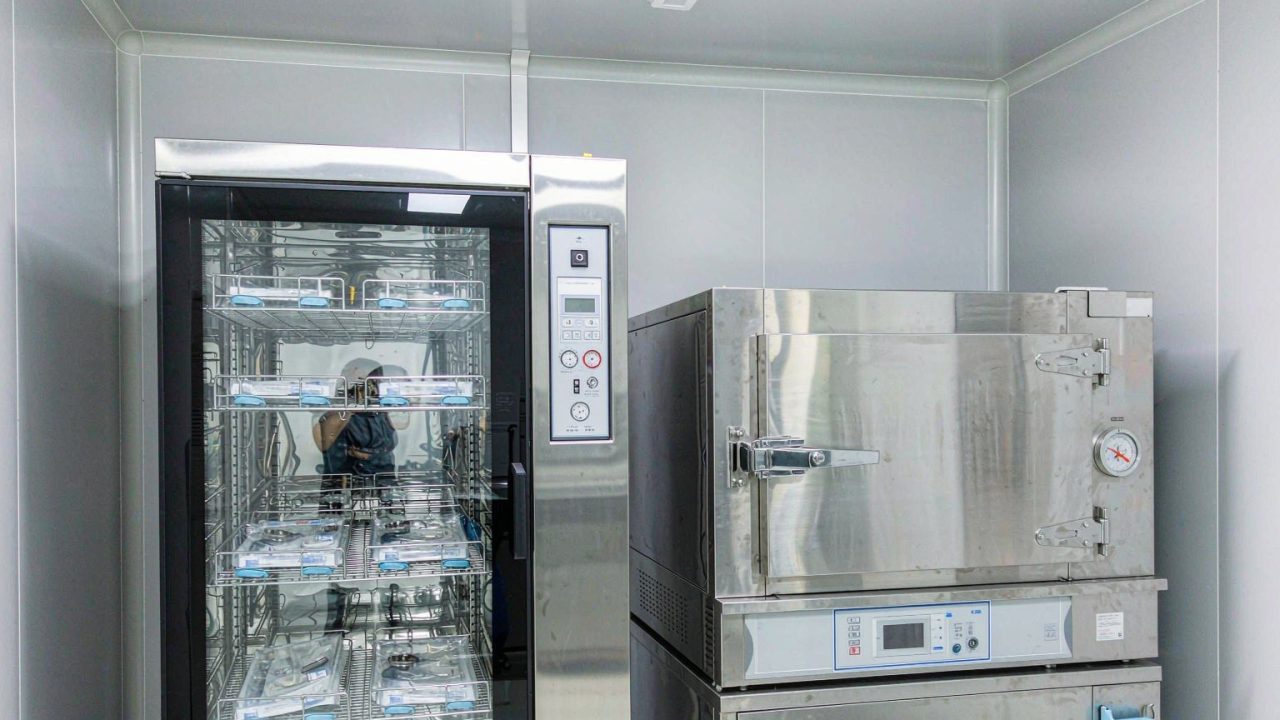
Curing is where a good bond becomes a validated bond. For implants the oven is not a generic dryer: it is a process tool whose temperature distribution becomes part of the device history record.

Six specification blocks to write into the RFQ
| Block | What to specify |
|---|---|
| Temperature uniformity | State the tolerance, the test temperature, the number and position of sensors, and whether measured empty or loaded. YanSyn YSHG ovens are built to ±2 °C uniformity, with ±1 °C available as a customised option. |
| Ramp and soak control | Ramp rate limits, soak duration, start-of-soak definition (when all sensors are in band, not when the setpoint is reached). |
| Cleanliness | Class 100 (ISO 5 equivalent) configuration with HEPA filtration where particulates affect the bond or coating. |
| Atmosphere | Air, or nitrogen purge for oxidation-sensitive cure. Define the oxygen level you need and how it is measured. |
| Outgassing | Interior materials and sealants rated for your maximum temperature, with no organics that outgas onto the product. |
| Data and integration | Recording interval, export format, user access control, IoT connectivity where available. |
Clean or standard? A frequent over-purchase
Teams often ask for a Class 100 oven "to be safe", but the decision should follow the product. If curing happens before a cleaning or passivation step, a standard oven is usually sufficient. If the oven is the last step before packaging, or the coating is applied and cured in the same chamber, a clean configuration earns its cost. See clean oven versus high-temperature oven.
Connecting both stations to the quality system
Equipment alone does not satisfy an auditor. The link between the equipment and the quality management system is what gets inspected.
Five expectations recur in device audits, and each one maps to a specific equipment capability:
- The environment is controlled. Continuous RH and temperature logging with configured alarm limits produces the trend log per cabinet.
- Excursions are handled. A time-stamped alarm with an acknowledgement trail produces the deviation record and the quarantine decision.
- Measurement is trustworthy. Traceable calibration on a defined interval produces the certificate and schedule.
- The process is validated. Documented uniformity and mapping capability produce the IQ/OQ/PQ reports with sensor positions.
- The batch is traceable. Exportable records linked to a batch or work order produce the device history record entries.
An eight-step qualification sequence that works
- Define the worst case. Identify the most moisture-sensitive material and the most temperature-sensitive cure. Design for those, not the average.
- Fix setpoints from data. Take them from supplier datasheets and internal aging data; record the source next to each number.
- Write acceptance criteria before buying. Uniformity, recovery time, logging interval, alarm limits — stated so a supplier can confirm in writing.
- Install and complete IQ. Utilities, location, ambient conditions, sensor placement, software version, access control.
- Map during OQ. Empty and loaded, at minimum, nominal and maximum of the operating range. Record sensor positions on a drawing.
- Run PQ on real product. Three consecutive production loads is a common start; the number follows your risk assessment.
- Set the monitoring plan. Logging interval, review responsibility, alarm escalation, re-mapping interval.
- Close the loop on excursions. Pre-define the quarantine rule so the first excursion follows procedure, not debate.
Frequently asked questions
Do we need a dry cabinet if our cleanroom already controls humidity?
Room control is usually designed for comfort and process stability, often around 40–55% RH — far above what moisture-sensitive adhesives, resorbable polymers or electronic packages need. A cabinet gives a local, much drier environment plus a per-location record a room sensor cannot provide.
Can one oven handle both curing and sterilization?
No. Dry heat sterilization and adhesive curing have different validation requirements; sterilization is validated to a defined lethality target on a sterilizer, not on a process oven. Keep the two separate unless your regulatory advisor approves otherwise.
How dry is too dry for polymer parts?
Some polymers and elastomers are specified with an equilibrium moisture content; over-drying can make them brittle or change dimensions. That is why the setpoint must come from the material datasheet rather than the lowest number the cabinet can reach.
Where does a nitrogen cabinet fit into a medical device line?
When the dominant risk is oxidation rather than moisture — uncoated reactive metal surfaces, oxygen-sensitive drug coatings, storage before passivation. A desiccant cabinet controls water vapour; a nitrogen cabinet controls oxygen. Some lines need both.
Is this the same as a pharmaceutical stability chamber?
No. Stability chambers condition drug products under defined temperature and humidity for shelf-life studies. This article covers component storage and thermal curing in device manufacturing. For stability chambers, see GMP-compliant stability storage.
Where to start
Two steps cover most implant programmes. First, list every item stored before assembly, note its material family, and mark those with a supplier-specified humidity or temperature limit. Second, take your highest-risk cure step and write down how you know the whole load reached temperature for the full soak time. Those answers tell you whether you need a drier cabinet, a better-characterised oven, or both.
YanSyn builds equipment for both stations: the YSM series moisture-proof cabinet and YSN series nitrogen cabinet for storage, and the YSHG series electric heating oven for curing and annealing. Share your material list and cure profile, and we will map them to a configuration with the clauses your validation needs.
Contact the YanSyn engineering team to discuss your storage and cure specification.
YanSyn Intelligence (Shanghai) Co., Ltd. — Building10, No.568, Xueronghua Road, Pudong New Area, Shanghai, China