How to Specify a Clean Oven: HEPA, Uniformity and Outgassing
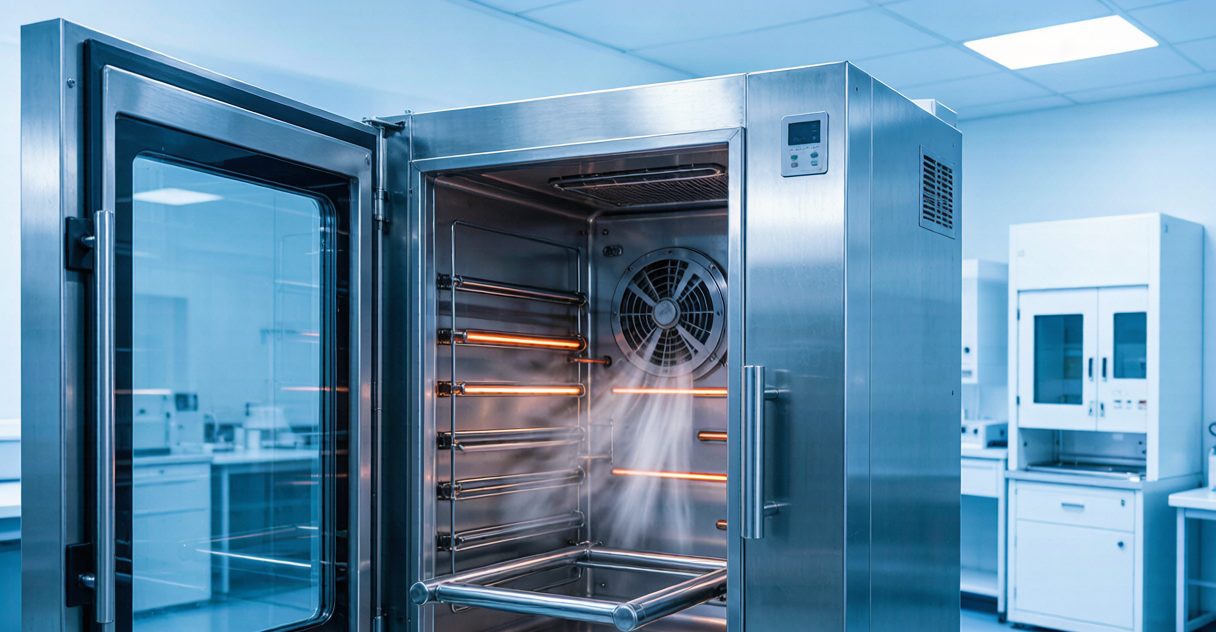
Clean oven is one of the most loosely used terms in thermal equipment. Two suppliers can quote a "Class 100 clean oven" and deliver machines that behave very differently on a real production line. The difference is almost never in the setpoint range or the controller brand. It is in three specification axes that buyers routinely under-specify: HEPA filtration, temperature uniformity, and outgassing control.
This guide explains each axis, shows what to write into a request for quotation (RFQ), and gives an acceptance checklist you can run before signing off a new oven. It is written for semiconductor, PCB, and advanced electronics teams, but the logic applies to any process where a particle, a cold corner, or a volatile residue can scrap a batch.
Why Three Axes, Not One
A clean oven solves three separate problems at the same time:
- Particle control — the air inside the chamber must not deposit particles onto the product while it is hot and, in many cases, chemically active.
- Thermal control — every part of the load must see the same temperature history, not just the sensor next to the heater.
- Chemical control — the oven itself must not become a contamination source through outgassing from seals, insulation, adhesives, or cable jackets.
Fail any one of the three and the other two do not save you. A perfectly uniform oven that sheds particles is a scrap generator. A perfectly filtered oven with a 6 °C gradient across the shelf produces two different products in one batch. A clean, uniform oven that outgasses silicone onto a wafer surface creates a defect you will only discover three process steps later.
Axis 1: HEPA Filtration and What "Clean" Really Means
Cleanliness inside an oven is a system property, not a label on the door. It depends on filtration efficiency, airflow path, pressure relationship, and — most often overlooked — how the oven is loaded and maintained.
Filtration efficiency is the easy part
HEPA filtration itself is well standardised. What matters in practice is whether the filtered air actually sweeps the product zone. Ask three questions:

- Is the filter sized for the chamber volume and the recirculation rate, so the chamber turns over its air volume often enough during ramp and dwell?
- Is the airflow path designed to sweep across the load, or does it short-circuit from inlet to return?
- Is the filter rated for the operating temperature, or is it mounted in a cooled plenum that limits the upper setpoint?
Pressure and leakage decide the steady state
Filtration only helps if unfiltered room air is not being pulled back in. A chamber that runs slightly positive relative to the room protects the load during cool-down and door recovery. Conversely, a chamber that goes negative as it cools will draw room air in through any seal imperfection. Specify the pressure relationship explicitly, and ask how the design behaves during the cool-down phase — not just at dwell.
Recovery time is the number nobody quotes
Every door opening destroys the cleanliness state. The practical question is how quickly the chamber returns to its specified class after a load change. Make recovery time a contractual line item with a defined test method, because it is the single biggest driver of real throughput in high-mix lines.
| Cleanliness building block | What to specify in the RFQ | Why it is missed |
|---|---|---|
| Filtration | Filter grade, coverage of the product zone, temperature rating, and replacement interval | Datasheets quote the filter, not the airflow path |
| Airflow path | Recirculation rate, direction of flow across shelves, and verification method | Invisible in a photo; only visible in a cutaway or a smoke study |
| Pressure relationship | Positive pressure relative to the room, including during cool-down | Usually tested at steady state only |
| Recovery time | Time to return to specified class after a defined door-open event | Affects throughput, so it should be a commercial term, not a footnote |
| Maintenance access | Filter change procedure, gasket replacement interval, and who performs it | Decided after installation, when access is already constrained |
Axis 2: Temperature Uniformity — The Most Misread Spec on the Sheet
Control accuracy and spatial uniformity are two different numbers, and quoting one when the buyer means the other is the most common source of disappointment in oven procurement.
- Control accuracy describes how tightly the controller holds the temperature at its own sensor.
- Spatial uniformity describes the spread between the hottest and coldest points in the usable work zone, under defined conditions.

YanSyn YSHG-series ovens use PID control and are specified with temperature uniformity of ≤ ±2 °C, customizable to ±1 °C, across a working range from ambient to 500 °C. Optional configurations include Class 100 cleanliness, nitrogen purge, and IoT monitoring. (All figures are manufacturer specification items to be confirmed against the datasheet for the exact model you are buying.)
Empty versus loaded
A uniformity figure measured in an empty chamber describes the oven. A figure measured with a representative load describes your process. They are rarely the same, because a dense load changes the airflow, adds thermal mass, and creates its own gradients. Always require the uniformity survey to be run with a defined load — and write the load definition into the acceptance test.
Where the sensors sit
A single sensor located next to the recirculation inlet can read beautifully while a corner shelf runs several degrees off. Insist on a multi-point survey across the full usable volume, including the corners and the top and bottom shelves, and ask for the raw readings rather than a pass/fail statement.
Ramp, dwell, and overshoot
Uniformity during ramp is a different problem from uniformity at dwell. If your process is sensitive to ramp rate — curing reactions, binder burn-out, or anything with an exotherm — specify the ramp behaviour and the allowable overshoot separately from the steady-state figure.
| Uniformity clause | Weak version (avoid) | Strong version (use this) |
|---|---|---|
| Value | "Uniformity ±2 °C" | "Spatial uniformity ≤ ±2 °C measured across the defined work zone" |
| Condition | "At setpoint" | "At dwell, with defined representative load, after stabilisation" |
| Method | "Per manufacturer standard" | "Multi-point survey at named positions, raw data supplied" |
| Dynamics | Not mentioned | "Ramp rate and maximum overshoot specified per recipe" |
| Re-verification | "At commissioning" | "At commissioning and at defined re-qualification intervals" |
Axis 3: Outgassing and Material Compatibility
Outgassing is the failure mode that arrives late. A new oven passes its particle count and its uniformity survey, then quietly contaminates product for weeks because an internal material was never qualified for the operating temperature.
Where volatiles come from
The usual suspects are door gaskets and seals, internal insulation and binders, adhesives and labels, cable and wiring jackets, and any coating applied to the interior or the shelving. At elevated temperature each releases volatile species at a different rate, and the release rate often changes sharply as you approach a material's limit.
Bake-out is a commissioning step, not an afterthought
A structured bake-out before first production use — running the empty chamber at or above the maximum process temperature with the chamber purged or vented — removes the initial burst of volatiles. Make it a documented commissioning step with a defined duration and temperature, and repeat it after any major internal maintenance.
Match interior materials to the process chemistry
Stainless interiors with compatible, high-temperature-rated seals are the common baseline. For processes sensitive to airborne molecular contamination, go further: specify silicone-free construction, restrict which adhesives and labels may be used inside the chamber, and ask for a material declaration for anything in the hot zone.
| Potential outgassing source | Typical risk | Practical mitigation |
|---|---|---|
| Door gaskets and seals | Continuous release at high temperature; hardens and sheds over time | Specify high-temperature-rated material, set a replacement interval |
| Insulation and binders | Slow, long-tail release that resists short bake-outs | Extended bake-out at commissioning; confirm insulation rating |
| Adhesives, labels, tape | Localised, high-concentration contamination near the load | Ban unqualified consumables from the hot zone; use rated tags |
| Cable and wiring jackets | Release rises steeply near the material limit | Specify high-temperature-rated wiring inside the chamber |
| Shelving and fixtures | Transfers residue directly onto product carriers | Use compatible metal fixtures; clean and re-qualify on a schedule |
Matching Configuration to Process
Not every process needs all three axes at maximum. Over-specifying a clean oven is expensive; under-specifying is worse. The table below is a starting framework for a scoping conversation — treat the priorities as indicative and validate them with your own process data.
| Process | Dominant risk | Priority axis | Configuration note |
|---|---|---|---|
| Adhesive and encapsulant curing | Incomplete or non-uniform cure | Uniformity | Loaded-chamber survey; watch overshoot on exothermic reactions |
| Wafer and substrate processing | Particle deposition on active surface | HEPA / cleanliness | Class 100 configuration; define recovery time after load change |
| Annealing of oxidation-sensitive metals | Surface oxidation during dwell | Atmosphere | Consider inert or oxygen-free configuration; see our guide below |
| MSD baking before reflow | Residual moisture causing popcorning | Uniformity + moisture removal | Follow the applicable JEDEC profile; verify coldest point in the load |
| Brazing and high-temperature joining | Flux residue and oxidation | Atmosphere + outgassing | High-temperature-rated internals; plan bake-out after maintenance |
| General drying and pre-heat | Throughput loss | Uniformity | A standard industrial oven class may be sufficient |
Acceptance Checklist Before You Sign Off
Put these items into the purchase agreement so they are tested, not assumed:
- Multi-point uniformity survey with the defined representative load, at the process setpoint, with raw data supplied.
- Cleanliness verification at operating temperature, not only at ambient, with the test method named.
- Recovery-time test after a defined door-open event.
- Documented bake-out procedure with duration and temperature, performed before first production use.
- Material declaration for everything inside the hot zone, including seals, wiring, and fixtures.
- Calibration certificates for the control sensor and the independent survey instrument.
- Re-qualification schedule and a defined spare-parts list for gaskets and filters.
Two practical notes on equipment families. If your process is cleanliness-limited rather than temperature-limited, the decision is usually clean oven versus high-temperature oven. If oxidation is the dominant failure mode, read our guide on when you need below 1 ppm O₂. And remember that the oven is only one half of the moisture story: parts must be stored correctly before and after the bake, which is where YSM-series moisture-proof cabinets and the YSN-series nitrogen cabinets take over. For baking profiles, see our MSD baking deep-dive.
Frequently Asked Questions
What temperature uniformity should I specify for a clean oven?
It depends on the process tolerance, not on the oven. As a specification baseline, YanSyn YSHG-series ovens are offered with uniformity of ≤ ±2 °C, customizable to ±1 °C, from ambient to 500 °C — but the important part is requiring the figure to be measured in a loaded chamber at your setpoint, and confirmed against the datasheet of the exact model.
Is a HEPA filter enough to call an oven "clean"?
No. Filtration is one building block. Airflow path, positive pressure, recovery time after door opening, and maintenance access all determine whether the chamber stays clean in daily production. A filter without a defined airflow path and pressure relationship does not guarantee a clean product zone.
How often should HEPA filters and gaskets be replaced?
Follow the manufacturer's stated interval, then adjust based on your own verification data. Rather than a fixed calendar period, tie replacement to evidence: rising recovery time, a failed cleanliness check, or visible seal hardening. Budget for both as routine consumables from the start.
Do I need a bake-out if the oven is new and clean?
Yes. New materials release their highest volatile load during their first hours at temperature. A documented bake-out before first production use — and after any major internal maintenance — moves that release out of your process window.
Can one oven cover both curing and high-temperature work?
Often yes, if the temperature range, the interior materials, and the airflow design support both — this is where a range from ambient to 500 °C with a Class 100 option is useful. The risk is cross-contamination between recipes, so define cleaning and bake-out steps between dissimilar processes.
Next Step
Write the three axes into your RFQ before you compare quotes. That single change converts the conversation from price-per-litre to fitness-for-process, and it makes supplier responses directly comparable.
The YSHG-series electric heating oven is the YanSyn platform for these applications, with PID control, uniformity of ≤ ±2 °C customizable to ±1 °C, a range from ambient to 500 °C, and optional Class 100 clean, nitrogen, and IoT configurations. Share your process temperature, load definition, and cleanliness target, and we will map them to a configuration.