OSAT Yield Lift: Cutting MSL Defects with Active Humidity Control

In an outsourced semiconductor assembly and test (OSAT) facility, yield is the business. Wafers arrive already carrying enormous value, and every percent of yield lost at wire bond, mold, or final test is pure margin gone. One of the most preventable causes of that loss is also one of the least visible: moisture absorbed by plastic-encapsulated packages before reflow.
This article walks through how an OSAT line can reduce moisture-sensitive device (MSD) defects using active humidity control — the combination of floor-life discipline, dry storage setpoints, and bake recovery rules described in IPC/JEDEC J-STD-033. All cost and consumption figures in this article are indicative assumptions to illustrate the calculation method; replace them with your own fab and line data before making any investment decision.
Why MSL Defects Concentrate in OSAT Lines
Most OSAT operations handle memory, logic, analog, and power packages that are moulded or re-balled in-house. Between die attach, wire bond, molding, and lead finishing, parts pass through multiple temperature excursions and multiple hand-offs. Every hand-off is a chance for a package to sit on a rack, in a tote, or on a WIP cart for longer than its floor life allows.
When a package absorbs more moisture than its moisture sensitivity level (MSL) permits and is then heated above approximately 200 °C during reflow or rework, absorbed water vaporises faster than it can diffuse out. Internal vapour pressure can delaminate the die paddle, crack the moulding compound, or pop the package body — the "popcorn effect" described in detail in The Popcorn Effect Deep-Dive: MSD Baking Curves That Save Yield.
The failure is invisible at assembly. It appears later, at final test or even in the field, as intermittent opens, delamination flagged by scanning acoustic microscopy, or early-life failures. That is what makes MSD defects expensive: they are discovered after the value has been added, not before.
The Four Exposure Clocks That Govern Your Defect Rate
MSL compliance is really the management of four clocks. An OSAT line that controls all four rarely sees humidity-driven yield excursions.
| Clock | What Starts It | What Stops or Resets It | Typical Failure Mode When Mismanaged |
|---|---|---|---|
| Floor life | Package leaves its moisture barrier bag or dry storage | Reflow, or return to dry storage / bagging | Popcorning at reflow; delamination at SAT |
| Dry-storage life | Package enters a dry cabinet | Removal for the next process step | Slow moisture uptake if the cabinet is undersized or overloaded |
| Bake recovery | Floor life is exceeded | Completed bake per J-STD-033 tables | Oxidised leads from over-baking; mis-calibrated bake times |
| Reflow window | Baked or fresh part enters reflow | Reflow completed within the allowed exposure | Queueing between oven and bonder burns the window silently |
The third and fourth clocks are where most OSAT lines lose points. Floor life rules are documented in IPC/JEDEC Floor-Life Rules: A Practical Cheat Sheet for Line Operators; the point here is that the clocks interact. A part that was returned to dry storage after only a short exposure gets a partial reset, so strict first-in-first-out by exposure time — not by date code — is required to keep the accounting honest.
Setpoints by Package Family: A Practical Starting Matrix
Dry storage does not have to be one uniform setpoint for everything. Matching the cabinet humidity to the package family frees capacity for the parts that genuinely need ultra-low humidity. The matrix below is a practical starting point consistent with J-STD-033 practice; always defer to the component manufacturer's MSL rating and your customer specifications.
| Package Family | Typical MSL Sensitivity | Suggested Storage Setpoint | Notes |
|---|---|---|---|
| Standard moulded ICs, MSL 2–3 | Moderate | 10% RH or below | Pauses floor-life clock under J-STD-033 |
| Fine-pitch / thin packages (QFN, BGA) | Elevated | 5% RH or below | Faster moisture uptake through thin moulding |
| MSL 1 tolerance parts | Low | Unlimited floor life; ambient ok, dry storage still preferred | Keeps cabinet capacity for critical parts |
| Lead-finish oxidation concerns (pre-plated frames) | Low moisture risk, high oxidation risk | Nitrogen purge storage | Oxidation control, not only moisture control |
| Wafers and bumped substrates | Varies | 5% RH or below; nitrogen for oxidation-sensitive stacks | Follow customer or spec sheet requirements |
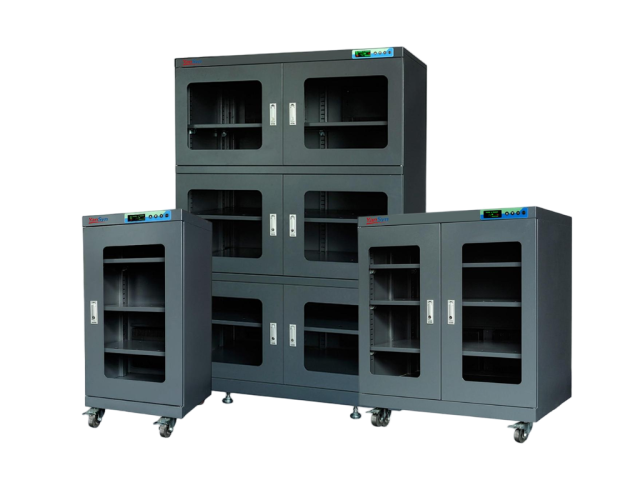
A modern moisture-proof cabinet line such as the YanSyn YSM series moisture-proof cabinets holds 1–50% RH with fast recovery after door openings, which is what makes per-family setpoints practical rather than theoretical. Cabinets should be placed at the point of use — next to die bonders, molding presses, and lead-forming equipment — not in a single central store.

Active Humidity Control vs Moisture Barrier Bags Only
Many OSATs rely on moisture barrier bags (MBB) plus desiccant as the sole protection. Bags are excellent for transport and long-term storage, but they are a poor fit for work-in-process. Compare the two approaches:
| Criterion | MBB + Desiccant Only | MBB + Active Dry Storage at Point of Use |
|---|---|---|
| WIP access during shift | Re-bagging required after every access; labour cost per cycle | Open the door, take the tray, go — floor-life clock managed by software or label |
| Moisture uptake while waiting | Any un-bagged dwell time counts against floor life | Dwell time in cabinet pauses the clock |
| Traceability | Manual labels, easily stale | Cabinet logging plus MES integration options |
| Consumables | Bags, desiccant, humidity indicator cards per cycle | Electricity only; no per-cycle consumables |
| Best role | Shipping and long-term warehousing | Live WIP between processes |
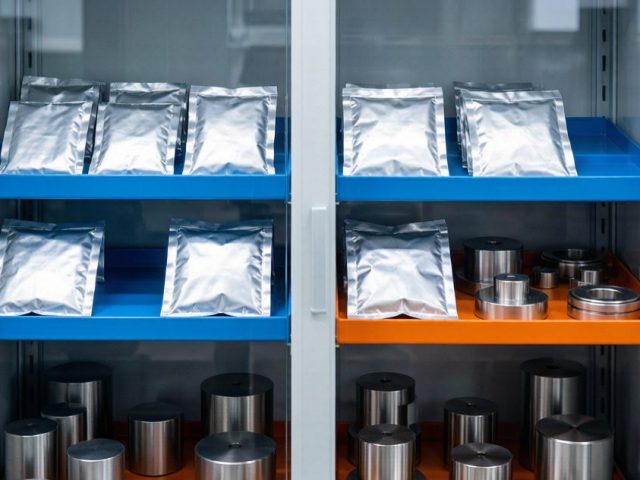
The two methods are complements, not alternatives. Bags protect parts on the road; dry cabinets protect parts at the bench. Lines that try to make bags do the cabinet's job accumulate silent exposure minutes that never appear in any report.
A 30-Day Plan to Cut MSL Defects
Yield improvement programmes fail when they try to fix everything at once. A focused month is enough to establish control:
Week 1 — Baseline
Pull three months of test-failure Pareto data and SAT (scanning acoustic microscopy) records. Separate delamination- and crack-suspect failures from electrical-only ones. Log actual door-opening counts and WIP dwell times at each process hand-off. The goal is a quantified exposure profile, not opinions.
Week 2 — Fix the Clocks
Implement first-in-first-out by exposure time. Add timer labels or MES tracking for every tray that leaves dry storage. Set explicit escalation rules: when floor life is exceeded, the part goes to bake — it does not wait for the next shift's judgement call.
Week 3 — Hardware and Layout
Position dry cabinets at the process steps where dwell actually happens: die-attach loading, mold queues, and lead-form staging. Verify each cabinet's recovery time after door openings with its own display or a calibrated logger. If recovery exceeds your shift's realistic access pattern, the cabinet is undersized or overloaded — split the WIP across more units.
Week 4 — Verify and Standardise
Re-run the Pareto from week 1's baseline on parts processed under the new regime. Document the setpoint matrix, bake rules, and escalation flow as a standard work instruction, and train to it. This is also the point to decide whether oxidation-prone lead finishes need nitrogen purge storage rather than desiccant-only control.
Modelling the Yield Lift — With Honest Assumptions
A simple model makes the business case. These numbers are illustrative assumptions, not measured performance; substitute your own figures:
- Assume a line processing 500,000 units per month, with humidity-related delamination and popcorn losses at 0.8% of units (indicative assumption).
- Assume 60% of those losses are preventable by floor-life and storage discipline (indicative assumption based on the typical share of exposure-related root causes).
- Assume fully processed unit value of ¥40 at final test (indicative assumption).
Monthly recoverable value = 500,000 × 0.8% × 60% × ¥40 = ¥96,000 per month. Against the capital cost of several point-of-use dry cabinets and the floor space they occupy, the payback period is typically measured in months rather than years — a pattern consistent with the analysis in Nitrogen Purge Cabinet vs Desiccant Dry Cabinet: The 5-Year TCO Breakdown. Run the same arithmetic with your own scrap rates and unit values before committing.
When Dry Storage Is Not Enough
Two situations call for escalation beyond desiccant dry cabinets:
Oxidation-Sensitive Lead Finishes and Bond Pads
Humidity control stops moisture uptake but does not remove the oxygen that tarnishes silver palladium finishes or copper bond pads over long dwell. If your WIP waits days or weeks — for example, substrates held for customer disposition — nitrogen purge storage is the correct tool. The YanSyn YSN series anti-oxidation nitrogen cabinets combine low oxygen levels with low RH for exactly this case.
Packages Already past Floor Life
Parts that exceeded their exposure budget need a bake before reflow, per the J-STD-033 bake tables. Use a PID-controlled process oven with verified uniformity — the same reasoning that governs general process baking in the YanSyn YSHG series electric heating ovens. Note that model number suffixes across cabinet and oven series are internal build variants, not capacity figures; always confirm capacity and dimensions from the datasheet.
Frequently Asked Questions
Does storage at 10% RH really pause the floor-life clock?
Under IPC/JEDEC J-STD-033, storage at 10% RH or below is one of the recognised ways to pause moisture uptake for MSDs. The clock resumes when the part returns to ambient conditions. Keep exposure accounting for the time spent outside the cabinet.
How fast should a dry cabinet recover after a door opening?
It depends on cabinet class and loading, but what matters operationally is that recovery is faster than your realistic door-opening frequency. If a shift's access pattern keeps the cabinet above setpoint most of the day, you need more capacity or better access discipline, not a better setpoint.
Should we bake more often just to be safe?
No. Unnecessary bakes cost cycle time and can oxidise lead finishes, and excessive bake cycles can degrade some moulding compounds. Bake when the exposure accounting says so, with the correct time-temperature combination for the package's MSL and thickness.
Can we track exposure automatically?
Yes. Labels and timers are the low-tech route; MES integration and cabinet data logging are the scalable route. What matters is that exposure time is recorded per tray or reel, not per batch guesswork.
Do MSL defects really show up as "yield" losses, or only as quality escapes?
Both. Delamination caught at SAT or final test is a yield loss; the same defect that slips through becomes a field failure and a customer complaint. Active humidity control reduces both, which is why it belongs in the yield programme, not only in the quality audit.
Conclusion
MSD defects are among the few yield losses in an OSAT flow that have a well-documented, standardised, and inexpensive countermeasure. The recipe is disciplined exposure accounting, point-of-use dry storage at the right setpoints, bake recovery exactly when the standard requires it, and nitrogen purge where oxidation — not just moisture — is the enemy. Every figure in the model above is an assumption waiting to be replaced by your line's data; the method, however, is not optional for any facility competing on yield.
If you are mapping cabinet capacity against your WIP dwell profile, contact YanSyn with your package mix and dwell data — we will help you size a point-of-use dry storage layout and setpoint matrix for your specific flow.