University and Research Labs: Building a Compliant Sample Storage Workflow
In a university lab, samples are the research. A stained tissue section, a batch of synthesised polymer, a calibrated reference material, a tray of seed specimens — each one represents months of work, and each one degrades on its own schedule if the storage environment is wrong. Unlike a production line, an academic lab rarely has a dedicated quality department watching the storage room. The result is a familiar pattern: equipment is bought one grant at a time, conditions are remembered rather than recorded, and the first real audit — or the first lost sample set — exposes the gaps.
This article describes a compliant sample storage workflow that a university or research laboratory can build with modest resources. It covers how to classify samples, how to match them to storage equipment, how to document and monitor conditions, and how to make the whole system survive an inspection or a personnel change. Every numerical value used as an example below is an indicative assumption for illustration; always replace it with the requirement stated by your protocol, standard, or sample supplier.

Why Sample Storage Needs a Workflow, Not Just a Cabinet
Most sample damage in research labs is silent. Moisture uptake does not visibly change a powder or a packaged component; it shifts measurement results weeks later. Temperature excursions during a weekend, a holiday, or a compressor failure show up as anomalous data that nobody can explain. The common root cause is the same: storage conditions existed, but they were not specified, monitored, and recorded as a process.
A workflow fixes this by answering five questions in writing:
- What does each sample class require? Temperature range, humidity range, light, orientation, container.
- Which piece of equipment holds which class? A named zone per sample class, not "whatever shelf is free".
- How are conditions proven? Continuous logging with defined reading intervals and retained records.
- What happens when a limit is breached? An alarm path, a response step, and a note in the sample record.
- Who owns the process? A named person per lab or per storage room, with a deputy.
Labs that work under ISO/IEC 17025, GLP, or customer audits already recognise these questions — they are the standard structure of any controlled process. The good news is that a small lab can implement the same structure with two or three pieces of equipment and a simple logbook or monitoring system.
Step 1: Classify Your Samples by Environmental Sensitivity
Do not organise storage by project or by principal investigator. Organise it by environmental requirement. In practice, most university lab inventories fall into five classes:
| Sample class | Typical examples | Failure mode if mis-stored | Indicative storage condition (assumption) |
|---|---|---|---|
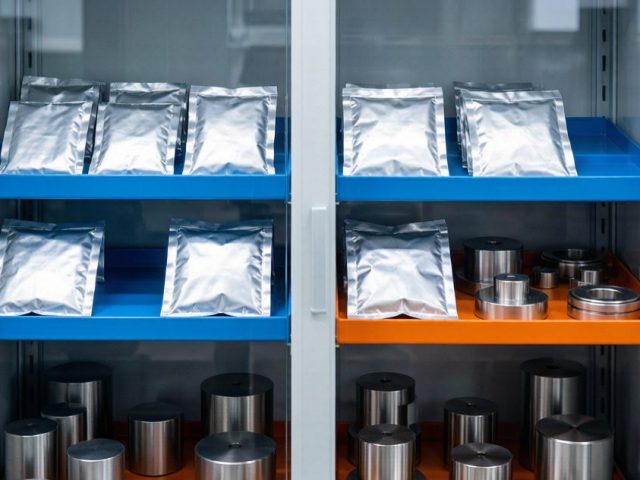
| Moisture-sensitive solids | Hygroscopic powders, hygroscopic polymers, electronic components, MSDs | Water uptake changes mass, reactivity, solderability; later processing defects | Ambient temperature, low RH — for example 1–10% RH depending on sensitivity class |
| Oxidation-sensitive materials | Metal powders, reactive alloys, functional coatings, prepared metallographic specimens | Surface oxidation alters composition and test results | Low RH, optionally inert (nitrogen) storage |
| Biological and reference standards | Reference materials, reagent kits, biological specimens awaiting analysis | Degradation invalidates calibration curves and assay results | Defined temperature band, for example 2–8°C or 15–25°C, with controlled humidity where specified |
| Environmental-conditioning samples | Adhesive cure samples, coating conditioning, material aging studies | Uncontrolled conditioning invalidates the experiment itself | Exact temperature and RH setpoints per test standard, held long-term |
| General dry goods | Glassware, tools, sealed archives, documentation | Corrosion, mould, label degradation | Ordinary dry storage; no active control required in most cases |
The classification table becomes the master reference for the whole workflow. Print it, post it at the storage zone entrance, and require every new sample batch to be assigned to a class before it goes on a shelf.
Step 2: Match Each Class to the Right Equipment
A compliant storage zone usually needs only two or three equipment types. The important discipline is that the equipment is chosen to serve the sample class — not the other way round.
| Equipment | What it controls | Best for | Notes for lab use |
|---|---|---|---|
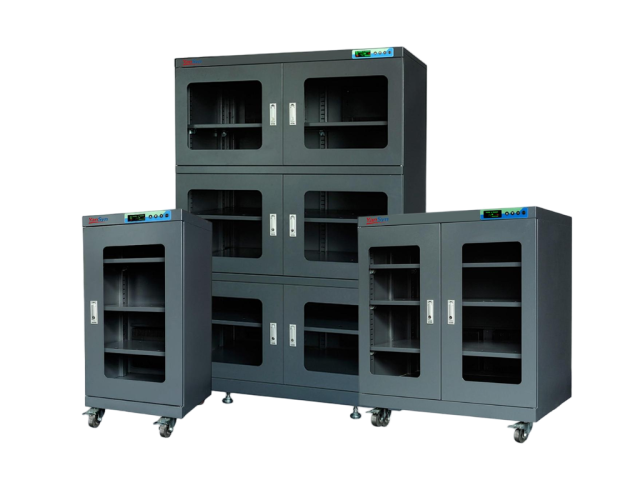
| Moisture-proof dry cabinet (YSM class) | Relative humidity (settable low-RH band, roughly 1–50% RH class equipment) | Moisture-sensitive solids, MSDs, hygroscopic powders, optics | Ambient temperature inside; fast recovery after door opening; per-shelf labelling recommended |
| Constant temperature and humidity chamber | Both temperature and RH at defined setpoints | Conditioning per test standard, reference material storage, stability-style holds | Setpoints follow the governing standard or protocol; map the chamber before first use |
| Nitrogen purge cabinet (YSN class) | Oxygen level plus low RH | Oxidation-sensitive metals, reactive samples | Requires a gas supply plan and consumption budget; log cylinder changes |
| Laboratory oven (YSHG class) | Elevated temperature (drying, baking, preconditioning) | Drying samples before weighing, baking out moisture, preconditioning per standard | Not storage: use as a process step inside the workflow, then return samples to a storage zone |
Two clarifications that prevent the most common mistakes. First, a low-humidity dry cabinet does not control temperature — if your protocol specifies a temperature band as well, that is the job of a constant temperature and humidity chamber. Second, an oven is a process tool, not a storage device; samples come out of an oven into a controlled storage environment, which is exactly the logic behind MSD baking profiles in electronics labs.

Step 3: Map the Zone, Place the Sensors, Define the Limits
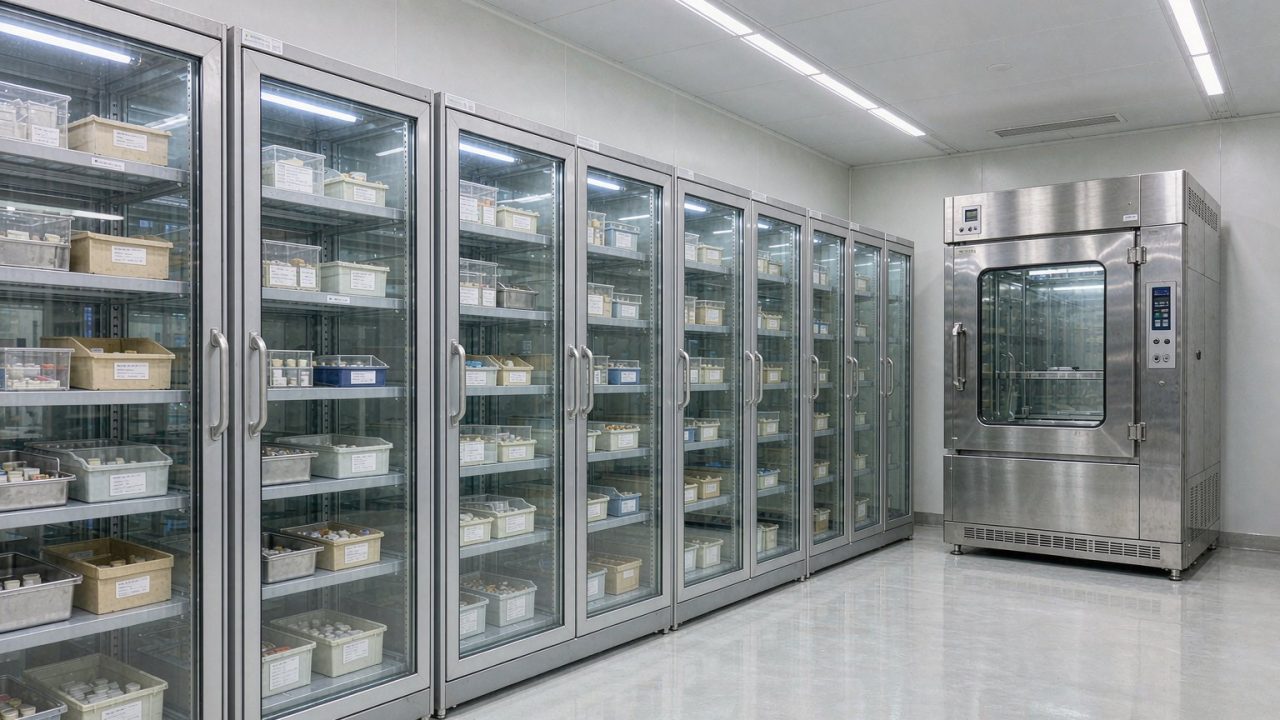
Every controlled storage space — chamber, cabinet bank, or cold room — should be mapped once: measure temperature and humidity at several positions over a representative period, find the worst corners, and place your permanent monitoring sensors where they see realistic conditions, not next to the control panel. If you use a chamber for standardised conditioning, mapping is effectively mandatory; the same habit applied to a cabinet bank costs almost nothing and prevents "the sensor says 5% RH but the top shelf is different" arguments.
For each zone, write down three numbers:
- Setpoint — the target condition (for example, a low-RH band inside a dry cabinet).
- Alert limit — the deviation that triggers attention.
- Action limit — the deviation that triggers documented action, such as moving samples or quarantining the batch.
Equipment capability matters here. A PID-controlled chamber with good uniformity — the class of oven and chamber equipment described on the YSHG heating oven series page — gives you a tight, predictable band to work with. A cheap uncontrolled cabinet gives you a number on a display that you cannot defend in an audit.
Step 4: Monitor, Record, and Alarm
Compliance lives in the record, not the equipment. The minimum viable monitoring system for a university lab is:
- Continuous logging at a fixed interval (for example every 5 to 15 minutes — an indicative assumption; match it to your audit requirement).
- Local display visible at the zone, so the current condition is always checkable without software.
- Out-of-band alert that reaches a person, not just a buzzer in an empty building — email or messaging to the zone owner and deputy.
- Retained records with time stamps, exported on a schedule and backed up. Record also the equipment's own events: setpoint changes, door-open alarms, maintenance, sensor calibration.
Keep it proportionate. A spreadsheet export once a month is a legitimate record system for a small lab; a full validated monitoring platform is overkill unless your funding or accreditation requires it. What is not acceptable in any audit is "we think it stayed at the setpoint".
Step 5: Run the Workflow Day to Day
The daily routine is what turns equipment into a compliant process:
- Intake: new samples get a class assignment, a label, and a location record before storage.
- Placement: samples go only in the zone assigned to their class — never "temporarily" on an open bench.
- Check: a short daily or weekly visual check of zone displays, plus review of the alert log.
- Move and track: every transfer in or out is logged; sample custody follows the record.
- Respond: any action-limit breach generates a note in the affected samples' records, so downstream data users know the history.
- Review: a monthly review of trends catches drift — a slowly rising RH baseline usually means a desiccant, seal, or door-seal issue developing.
Assign one owner and one deputy by name. Most workflow failures in academic settings trace back to "everyone assumed someone else was checking".

FAQ
Do we need a humidity-controlled cabinet if we already have desiccators?
A desiccator with desiccant is a passive tool: its condition depends on how fresh the desiccant is and how often the door opens. It is acceptable for low-value, short-duration storage. For sensitive samples or anything under an audit regime, an actively controlled dry cabinet that maintains a set RH band automatically — the class of equipment on the YSM moisture-proof cabinet page — gives you a defensible, logged environment.
What humidity should we set for general electronic and material samples?
It depends on the sensitivity class, and you should follow the governing standard (for example, the IPC/JEDEC MSD framework summarised in our floor-life cheat sheet). As an indicative assumption, many labs use a low single-digit to low-double-digit RH band for sensitive solids, but the correct setpoint is the one your protocol specifies.
How is a storage workflow different from just buying a test chamber?
Equipment selection answers "what can hold the condition". A workflow answers "how do we prove we held it, and what do we do when we did not". If your need is equipment selection rather than process design, our constant temperature and humidity chamber buyer's guide and the test chamber specification guide cover that side in depth.
Can one chamber serve both storage and conditioning?
Only if the setpoints coincide and the door-opening schedule does not disturb the conditioning samples. In practice, separating long-term storage (cabinets) from active conditioning (chamber) avoids both cross-contamination of conditions and constant door-opening.
Conclusion
A compliant sample storage workflow is not a procurement project; it is a small set of written decisions. Classify samples, assign each class to a named zone, map and monitor that zone, record what happens, and name an owner. With one low-humidity dry cabinet, one temperature and humidity chamber, and a disciplined log, even a two-person university lab can store samples in a way that survives audits, personnel changes, and the awkward question "what were the conditions on the 14th?".
If you are planning or upgrading a laboratory storage zone and want help matching cabinet and chamber classes to your sample list, contact the YanSyn team with your sample classes and target conditions.