Metal 3D Printing Powder Storage: Nitrogen Cabinet Best Practices for Reactive Alloys
Metal additive manufacturing has moved from prototyping shops into serial production of aerospace brackets, medical implants, and energy components. As production volumes grow, one quiet cost driver keeps surfacing in every powder-bed shop: powder degradation. A single drum of Ti-6Al-4V or nickel superalloy powder can represent a substantial investment, and unlike sheet metal, that investment can silently lose value while it sits on a shelf. Exposure to ordinary shop air — with its roughly 21% oxygen and fluctuating humidity — changes how powder flows, how it spreads in the recoater, and ultimately how the printed part performs. The good news is that most of that degradation is preventable with disciplined storage, and a nitrogen purge cabinet is the workhorse tool that makes disciplined storage practical at shop scale.
Why Metal AM Powder Degrades in Ambient Air
Metal powders for laser powder bed fusion and electron beam melting have one defining property: enormous specific surface area. Every kilogram of fine powder presents many square meters of reactive surface to whatever atmosphere surrounds it. When that atmosphere is shop air, three degradation mechanisms run continuously.
Oxygen Pickup and Embrittlement
Oxygen is a potent interstitial element in titanium. A small amount strengthens the alloy; too much turns it brittle. That is why specifications for additive-grade Ti-6Al-4V ELI, such as ASTM F3001, cap oxygen content tightly — and why every build cycle that recirculates powder through open air erodes the margin between your powder and the spec limit. Once interstitial oxygen climbs, it cannot be removed economically. The powder does not look different, the drum does not weigh differently, but the tensile ductility of the next build quietly drops. For aerospace and medical programs with certified material properties, a batch that drifts out of specification can be a total loss.
Moisture: The Secondary Contaminant
Water vapor does double damage. First, adsorbed moisture on powder surfaces contributes hydrogen pickup during melting and can promote porosity in the melt pool. Second, humidity drives agglomeration — fine particles cling together, which degrades the uniform powder layer the recoater is trying to lay down. In nickel superalloys and stainless grades the effects are less dramatic than in titanium, but flowability losses still show up as thin spots, recoater streaks, and porosity signatures in CT scans.
Flowability Loss That Shows Up on the Machine
Flow behavior is the most immediate symptom shops notice. Hall flow testing per ASTM B213 is the standard quick check: powder that once ran freely starts sticking in the funnel as oxygen and moisture films build up on particle surfaces. Poor flow translates directly into uneven spreading, and ASTM F3049 exists precisely because powder characterization — including these handling properties — has become a formal part of qualifying feedstock for AM. Degradation between builds is part of what those checks catch.
Storage Options Compared
Shops typically choose among four storage strategies for powder between builds and between sieving cycles. Each has a distinct cost and protection profile.
| Storage option | Atmosphere | Strengths | Limitations |
|---|---|---|---|
| Original sealed vendor container | Inert (typically argon), sealed at the powder producer | Best protection while sealed; traceable condition | Degrades quickly once opened; impractical for daily build cycles |
| Open shelf / ambient cabinet | Shop air | Zero cost, fastest access | Continuous oxygen and moisture pickup; unacceptable for reactive alloys |
| Inert-gas glovebox | Very low oxygen inert atmosphere | Excellent protection; allows open handling | High cost; low throughput; poor fit for storage of many drums |
| Nitrogen purge storage cabinet | Continuous low-oxygen nitrogen atmosphere | Strong protection at moderate cost; high capacity; quick door access | Requires nitrogen supply; sealed drums still recommended for very reactive powders |
The nitrogen purge cabinet occupies the practical middle ground: it keeps powder in a controlled low-oxygen environment between every build and sieving cycle, without the cost and throughput ceiling of a glovebox. For most stainless, nickel, and tool-steel powders — and for many titanium workflows once powder is in sealed secondary containers — it is the right level of protection. Always confirm with your powder supplier, because a few highly reactive materials specify argon rather than nitrogen.
How a Nitrogen Purge Cabinet Protects Powder
A purge cabinet works by continuously displacing ambient air with dry nitrogen, holding the interior at an oxygen level far below the 20.9% of shop air. Three design details determine how well a given cabinet performs in real shop conditions.
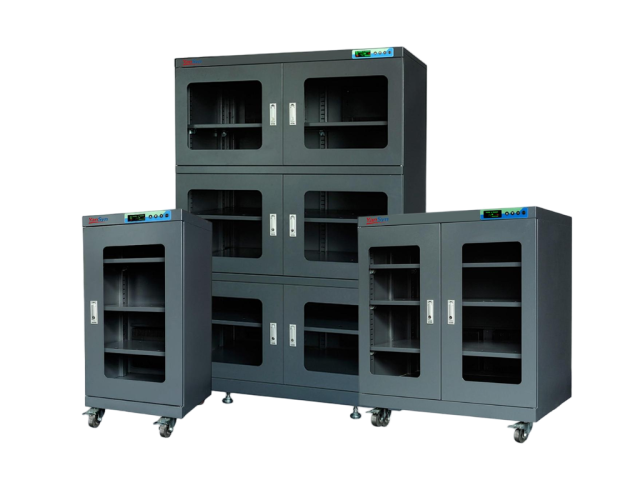
Controlled, metered purge flow. Nitrogen is not free, and blasting the cabinet achieves little beyond a high gas bill. A precision flow meter — like the one fitted to the YanSyn YSN series nitrogen cabinet — lets you set the minimum flow that holds your target atmosphere, which is the difference between an economical system and an expensive one. It also makes the purge rate auditable when a quality program asks how stored powder is protected.
Fast recovery after door openings. Every time an operator loads a powder jar, ambient air rushes in. A well-designed cabinet restores the protective atmosphere quickly, so brief access does not translate into hours of elevated oxygen. This matters most in busy shops where powder is touched daily, not weekly.
Visible, monitorable conditions. Operators need confidence that the cabinet is doing its job. Digital readouts of interior conditions and a stable, low-oxygen baseline make deviations visible immediately — a failing door seal or an exhausted nitrogen bottle should be caught at a glance, not at the next Hall flow test.
A Practical Storage Workflow Between Builds
Hardware alone does not protect powder; the surrounding routine does. Shops that keep powder healthy for many reuse cycles tend to converge on a similar workflow:
- Sieve immediately after a build. Return powder through the sieving station the same day, removing oversize agglomerates and spatter before they contaminate the bulk.
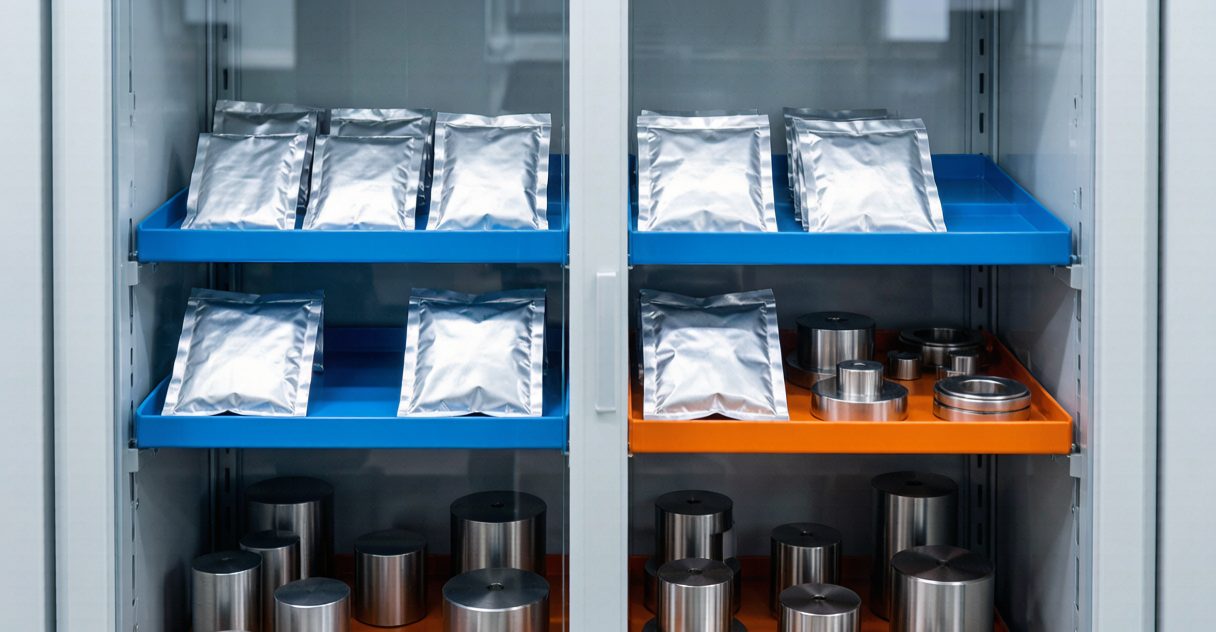
- Transfer to sealed secondary containers. Label each container with alloy, lot, build count, and date. Mixing lots complicates traceability and makes degradation trends impossible to read.
- Store in the purge cabinet, not on the bench. Containers wait in the nitrogen atmosphere until the next build. The cabinet is the buffer that absorbs every unplanned delay — a machine breakdown, a canceled shift, a postponed CT scan — without punishing the powder.
- Track condition over cycles. Periodic flow testing or supplier-recommended checks turn storage quality into a number. When a batch trends toward its limit, you know before it becomes a scrap build.
The same logic extends beyond metal AM. Oxidation-sensitive alloys, sintered parts awaiting treatment, and even hygroscopic post-processing materials benefit from identical storage discipline — which is why many shops standardize on one cabinet family for all of it.
What to Look for When Specifying a Cabinet
When evaluating nitrogen storage for AM powder or other oxidation-sensitive stock, prioritize these characteristics over price alone:
- Adjustable purge control with a real flow meter, so nitrogen consumption matches your actual door traffic and inventory turnover.
- Stainless interior that tolerates powder dust, wipes clean, and will not itself corrode in a low-humidity environment.
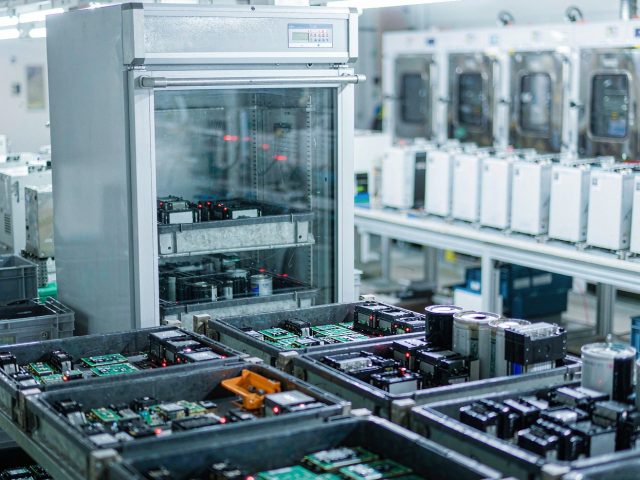
- Capacity matched to your drums and jars, with shelving that suits powder containers rather than flat electronics trays.
- Clear condition indication and alarm behavior when atmosphere or supply drifts out of range.
- Door and seal quality, because recovery speed after access depends on how little ambient air enters in the first place.
For a closer look at how these features are implemented in a production-grade unit, see the YSN series anti-oxidation nitrogen cabinets. Where the workflow also includes drying steps — for example, preheating containers or curing coated parts — a compact industrial oven such as the YSHG series complements the cabinet rather than replacing it.
Common Mistakes That Undo Good Storage
Even shops that invest in proper equipment lose powder to a handful of recurring errors:
- Storing opened vendor containers at the machine. The hour a jar sits open by the printer undoes a week of good storage. Return it to the cabinet after every use.
- Ignoring the nitrogen supply. An empty bottle silently converts the cabinet into an expensive ambient shelf. Low-supply alarms or a simple daily checklist prevent this.
- Treating all alloys the same. Titanium margins are tighter than stainless margins. Follow supplier guidance on atmosphere and container type per alloy, not one blanket rule.
- No build-count tracking. Without reuse records, the first evidence of degraded storage is a failed mechanical test on a finished part — the most expensive possible place to learn.
Conclusion: A One-Page Checklist
Metal powder is one of the highest-value consumables in an AM shop, and its worst enemy is invisible. A working minimum standard looks like this: sieve the same day, store in sealed labeled containers inside a nitrogen purge cabinet, verify atmosphere with metered flow and visible readouts, track build counts per lot, and test flow behavior on a schedule. None of it is exotic — it is simply the discipline of keeping reactive surfaces away from reactive air. A dedicated nitrogen storage cabinet turns that discipline from a habit that depends on everyone's memory into a condition of the storage room itself, which is exactly what certified aerospace and medical production demands.