Solvent in the Chamber: LEL Limits, Purge Rates and Safe Drying-Oven Operation
Most drying specifications are written around temperature and uniformity, because that is what decides whether a part is dry. Then someone mentions that the coating is 30 % solvent, or that the parts were degreased in IPA, and the question changes from how fast the oven heats to whether the mixture inside can burn.
A standard forced-air oven is an excellent water dryer, and the features that make it good at that — a sealed box, a heater, a fan, no measurement of what is in the air — are exactly what make it wrong for solvent.
Adding exhaust is not the same as controlling vapor
An exhaust fan is the right instinct, but on its own it is a guess. The question it must answer is quantitative: how much vapor is generated per hour, and how much air must leave the chamber to hold the concentration below a defined fraction of the lower explosive limit? Two ovens with identical volume, identical fans and identical setpoints can have completely different answers, because everything depends on the evaporation rate of the load. A tray of stamped parts with a thin IPA film releases grams per hour; a pail of NMP slurry releases kilograms. The fan does not know the difference.
Three properties, three different questions
The flash point is the temperature at which a liquid gives off enough vapor to flash when a flame passes over it. The lower explosive limit (LEL) is the concentration in air below which there is too little fuel to propagate a flame. The autoignition temperature is where it ignites with no ignition source at all.
For oven safety the working number is the LEL, and it is a percentage by volume, not a mass. That is where intuition fails. Isopropanol has an LEL near 2.0 vol%, which sounds like a wide margin until a normal batch is converted into chamber concentration.
| Solvent | Flash point | LEL (vol%) | Boiling point | Autoignition |
|---|---|---|---|---|
| Isopropanol (IPA) | 12 °C | 2.0 | 82 °C | 399 °C |
| Acetone | -20 °C | 2.5 | 56 °C | 465 °C |
| Toluene | 4 °C | 1.1 | 111 °C | 480 °C |
| Methanol | 11 °C | 6.0 | 65 °C | 464 °C |
| NMP | 91 °C | 1.3 | 202 °C | 270 °C |
Table 2. Indicative constants for common process solvents, from typical SDS literature; use the SDS for your batch. A high flash point is not a low hazard: NMP has the highest flash point here and the lowest autoignition temperature.
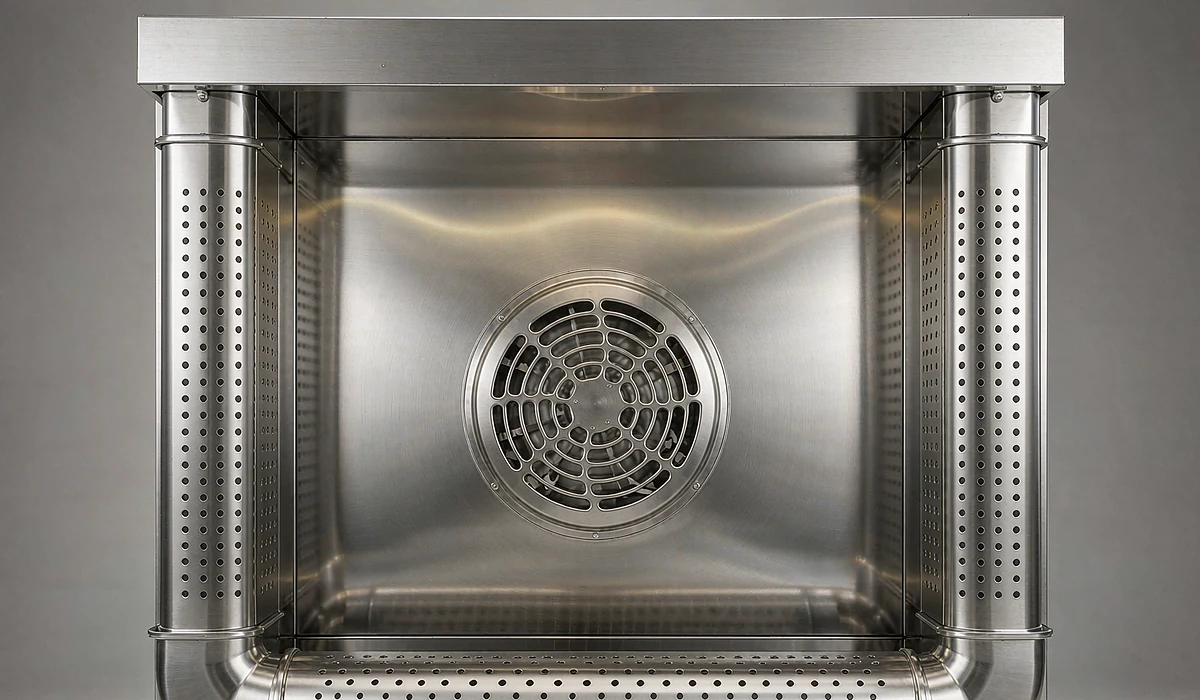
Worked example: 500 mL of IPA in a 620 L chamber
Take a 620 L oven and a batch of parts carrying 500 mL of isopropanol that was not flashed off before loading. All figures below are indicative and rounded. At 0.786 g/mL that is 393 g, or 6.5 mol, and at room temperature a mole of vapor occupies about 24 L, so complete evaporation gives roughly 157 L of vapor.
Held in the chamber, 157 L in 620 L is about 25 vol% — roughly twelve times the LEL and well inside the flammable range. Ignoring thermal expansion and imperfect mixing moves these numbers by tens of percent, not by a factor of fifty.
Run it the other way to see a defensible batch. Most solvent-rated practice alarms at 25 % of the LEL, which for IPA is 0.5 vol%, or 3.1 L of vapor in 620 L. That is 0.13 mol, about 7.8 g, or roughly 10 mL of liquid — in a closed chamber with no ventilation at all. Ten millilitres per batch is a very different instruction from "spray the parts and load them".
Dilution: size the exhaust to an evaporation rate
Continuous ventilation turns a total into a rate. If the 500 mL above evaporates across a one-hour cycle, generation averages 157 L of vapor per hour. To hold 0.5 vol%, the exhaust must remove that vapor at 0.5 % concentration, which means an air flow near 31,000 L per hour — about 50 air changes per hour in a 620 L chamber.
Fifty air changes is a lot of air for a heated box, and it is why solvent-rated ovens are rated in grams of solvent per hour rather than in chamber litres. It is also why a bigger oven does not solve a solvent problem: twice the volume tolerates twice the mass at the same concentration but needs twice the flow to get there. Throughput per cubic metre is unchanged, so engineers cut the load per cycle and accept a longer schedule. The airflow and load-layout effects on uniformity are covered in our uniformity mapping article.
Purge before heat, and the interlocks that enforce it
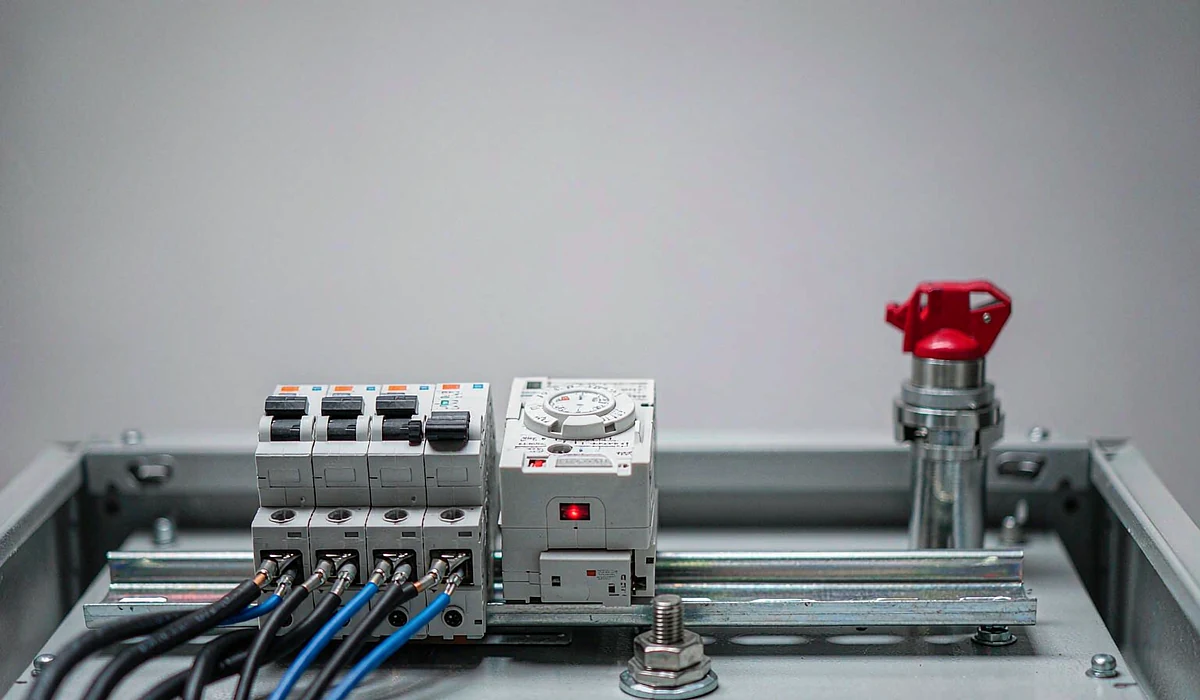
The most common omission is the sequence, not the fan. A chamber heated first and ventilated afterwards has already put its heaters in contact with a flammable atmosphere. The safe order is prove airflow, purge, then enable heat. Purge is usually specified as four chamber volumes and enforced by a timer that will not release the heat contactor until the count completes.
Airflow needs proof — a differential pressure switch across the fan, or a flow switch in the duct, wired to drop the heaters and not merely light a lamp. A purge timer without airflow proof counts down happily while the fan is broken.
Detection belongs downstream. Solvent vapor is heavier than air, so it accumulates low and leaves with the exhaust: a catalytic or IR LEL sensor in the duct, alarming at 25 % LEL and cutting heat at 50 % LEL, is the standard arrangement. Catalytic elements are poisoned by silicones and halogenated compounds, so a bump test with the process solvent before each campaign is worth more than an annual calibration certificate.
Where nitrogen inerting fits, and where it does not
Inerting attacks from the other side: hold oxygen below the limiting oxygen concentration, typically 8–11 vol% for common organics, and no vapor concentration will ignite. For a process that already needs nitrogen — a reactive powder, a bare copper surface — this is elegant. We covered the oxygen side of that trade-off in the oxygen-free oven guide.
It is not a substitute for ventilation. Nitrogen displaces oxygen in the room as well as the chamber, so an inerted oven in a small room is an asphyxiation hazard needing its own monitoring. Inerting also protects nothing at door opening: the vapor still leaves, and exposure limits still apply.
Choosing the concept
Once the worst-case concentration is known, the choice between dilution, inerting and vacuum is usually driven by the solvent load rather than by preference.
| Safety concept | What it controls | Solvent load it suits | What it does not cover |
|---|---|---|---|
| Standard forced-air oven | Temperature only. Fixed low-rate exhaust, if any; no vapor detection. | None to trace, water-based moisture and waterborne coatings. | Any flammable volatile. A closed box plus a heater is an ignition source. |
| Solvent-rated oven | Exhaust sized to an evaporation rate, airflow proving, pre-purge, LEL detection in the duct, deflagration relief, heat interlock. | A rated evaporation rate in grams per hour, set by the builder. | The rating is a ceiling. One extra rack exceeds it silently. |
| Vacuum oven with cold trap | Removes air and vapor together; solvent is condensed, not vented. | Small, heat-sensitive, high-value batches. | Batch operation, trap emptying, and air ingress on each door opening. |
| Nitrogen-inerted oven | Holds oxygen below the limiting oxygen concentration, so no mixture can ignite. | Oxidation-sensitive loads, often with solvent present. | Asphyxiation risk in the room, and operator exposure limits. |
Table 1. Four safety concepts and the failure mode each one leaves open. Load figures are indicative; a specific oven's rated evaporation rate comes from its builder.
Three processes where this decides the oven
Battery electrode drying. NMP-based slurry is dried at 90–130 °C with solvent recovery, and the exhaust is a product stream, not waste air. Concentration in the drying zone stays low both for safety and for recovery economics.
Conformal coating cure. The load per board is small, which invites the assumption that no protection is needed. But 200 boards at a few tenths of a millilitre each is the same order as the IPA example above.
Aerospace cleaning. Parts degreased in IPA arrive wet. Flash off in a ventilated enclosure first, so the oven sees a surface film rather than a puddle.
A seven-step qualification workflow
- Inventory the solvents — flash point, LEL, autoignition, boiling point and exposure limit, from the SDS actually in use.
- Calculate the worst-case batch — solvent mass to vapor volume, as a percentage of chamber volume, using the worst operator behaviour you can imagine.
- Choose the concept — dilution, inerting, or vacuum with a trap.
- Size exhaust to the evaporation rate, not the chamber volume, and check the fan curve with the filter loaded.
- Lock the purge recipe — chamber volumes, purge timer interlocked to heat enable, airflow proving in the safety chain.
- Instrument the duct — LEL detection with a 25 % alarm and 50 % heat cut-out, plus a logged record; an oxygen analyser if inerted.
- Validate with a spiked trial — run the real load with the detector logged, confirm the peak stays below alarm, then freeze the recipe and train operators on the load limit, the part that erodes first.
What this means for a standard drying oven
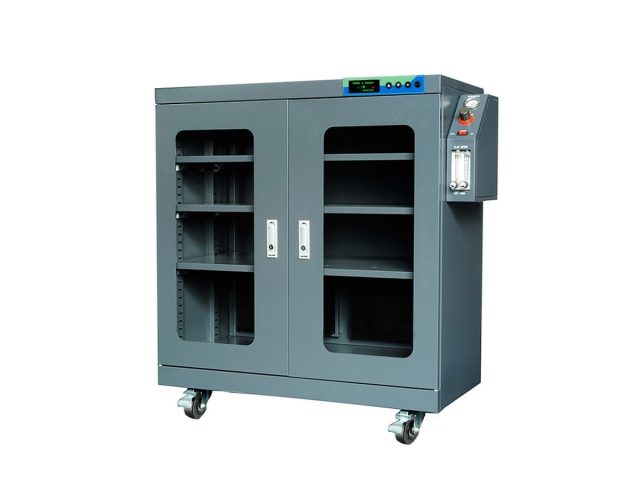
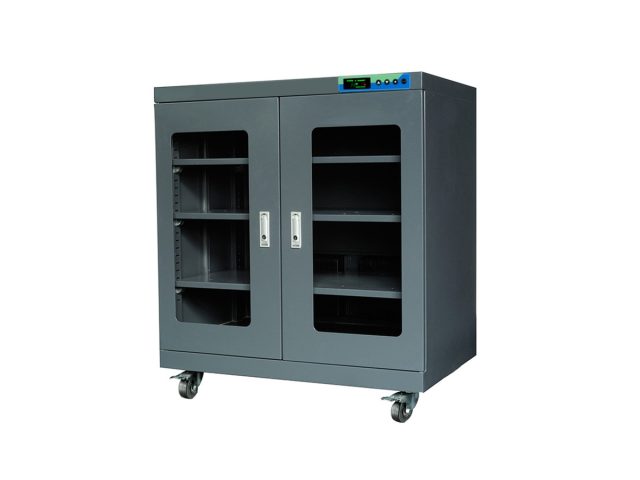
Most loads reaching a YanSyn oven are water: moisture in a populated board, residual water in a machined housing, waterborne adhesive. For those, everything above collapses to temperature, uniformity and drying air change, and a standard forced-air oven is the correct and cheaper machine. A YSHG-620A cabinet — PID control, uniformity in the ±2 °C band (tighter to ±1 °C on request), working range to 500 °C, optional Class 100 or nitrogen configuration — is built for exactly that job.
The boundary is worth stating plainly: the safety chain on a standard oven protects the oven and the load from overtemperature. It does not measure vapor and is not a substitute for an LEL interlock. If the process carries flammable solvent, raise it while the exhaust, interlock logic and detector location are still being drawn; retrofitting vapor safety in the field is how projects become expensive and unsafe at once.
FAQ
Can I dry solvent-wetted parts in a normal oven with the door slightly open?
No. That is an uncontrolled exhaust with no airflow proof, no purge sequence and no detection, and it destroys uniformity. It is the most common improvised answer, and the least defensible.
What does a 25 % LEL alarm point mean?
The detector alarms at a quarter of the lower explosive limit, keeping a factor of four to the flammable range; heat is cut at 50 % LEL. That margin covers sensor response time and imperfect mixing, not an operating level.
Does a vacuum oven remove the explosion risk?
It removes the sustained flammable atmosphere, because very little air is left to mix with vapor. It brings its own risks: a trap full of liquid solvent, and air ingress each time the door opens.
Does nitrogen inerting replace the exhaust?
Not for operator protection. It stops ignition inside the chamber, but not vapor reaching the room at door opening, and it adds an asphyxiation hazard.
Why do LEL sensors fail without warning?
Catalytic elements are poisoned permanently by silicones, sulphur compounds and halogenated solvents; IR sensors tolerate more but cost more. A bump test with the process solvent is the only check that reflects the sensor today.
The takeaway
Solvent safety is decided by arithmetic before it is decided by hardware. Convert the batch to vapor volume, compare it with chamber volume and with the LEL, and let that number choose between dilution, inerting and vacuum. Only then does it make sense to argue about fans, timers and detectors.
If you are specifying an oven and are unsure which side of that line your process sits on, send us the solvent, the batch mass and the cycle time — before the oven is built. Talk to a YanSyn engineer.