Oxygen Monitoring in Nitrogen Cabinets: PPM Targets, Sensor Placement and Verification
Most nitrogen cabinets are bought on a humidity number, but the job the nitrogen does is oxygen displacement. For parts whose failure mode is chemical rather than physical — bondable wire and pad finishes, solderable surfaces, reactive metal powders, battery electrode materials — the number that actually predicts shelf life is residual oxygen, usually expressed in parts per million (ppm), not relative humidity.
Yet the oxygen readout on a cabinet is one of the most misunderstood instruments on the production floor. Buyers treat it like a certification: whatever the display says becomes the guarantee. In reality the reading is a single point measurement of a gas mixture that changes every time a door opens, drifts as the sensor ages, and depends heavily on where the sensor sits in the airflow.
This article explains what residual-oxygen numbers mean in a purge cabinet, what targets are realistic for common applications, how the two mainstream sensor types differ, why placement changes the reading, and a five-step verification workflow you can run on an existing installation without any special equipment.
Percent, PPM and What the Numbers Actually Mean
Ambient air is about 20.9% oxygen, which is roughly 209,000 ppm. The conversions trip people up constantly: 1% O2 is 10,000 ppm, and 0.1% is 1,000 ppm. A cabinet spec of "below 1% oxygen" therefore still leaves ten thousand ppm of the reactive gas in the chamber — a dramatic improvement over ambient, but a very long way from oxygen-free.
A well-sealed purge cabinet running a continuous nitrogen flow typically reaches a steady state somewhere between 0.1% and 2% residual O2, depending on cabinet tightness, flow rate, door usage and the purity of the supply gas (indicative assumption — actual values vary by installation and should be verified, not assumed). Pushing well below 100 ppm continuously is a different class of equipment: gloveboxes and sealed desiccators with airlocks, interlocked load-locks and much higher purge consumption. If a standard cabinet quote promises single-digit ppm with a pass-through door in daily use, treat the number as a laboratory condition, not a production one.
Realistic PPM Targets by Application
Different failure chemistries need different oxygen budgets. The table below collects commonly used starting points; all figures are indicative assumptions drawn from industry practice — they are not manufacturer guarantees, and your own process specification or customer requirement always takes precedence.
| Application | Typical residual O2 target | Why this range | Practical note |
|---|---|---|---|
| Gold and aluminium bonding wire, bondable pad finishes | ≤ 1,000 ppm (0.1%) | Tarnish and oxide growth on platings becomes visually and electrically significant above this range | Benefit plateaus; chasing single-digit ppm in an open-door cabinet buys little |
| Solderable finishes and MSD storage under nitrogen (J-STD-033 practice) | ≤ 2,000 ppm, combined with low RH | Oxidation of finish plus moisture pickup jointly degrade solderability | Track both O2 and RH; nitrogen alone does not fix a wet cabinet |
| Titanium and reactive-alloy powder storage (additive manufacturing) | ≤ 1,000 ppm | Every oxygen pickup increments interstitial content and embrittles the part | Weight the O2 budget against hopper open/close frequency |
| Lithium battery electrode and anode materials | ≤ 1,000 ppm alongside dew-point control | Materials are sensitive to both oxygen and moisture | Many lines still move final handling to gloveboxes; cabinets cover staging |
| General anti-oxidation storage: machined parts, dies, spare components | ≤ 2% (20,000 ppm) | Visible oxidation slows markedly below roughly 2% O2 | Cost-effective target; tighten only if discoloration appears |
Notice the shape of the table: the tighter targets belong to chemistry that accumulates irreversibly (powder, battery materials, platings), while looser targets cover parts where oxidation is cosmetic or recoverable. Specifying 50 ppm for stamped steel brackets wastes nitrogen; specifying 2% for titanium powder loses parts.
How Cabinet Oxygen Sensors Work, and How They Drift
Two sensor families dominate. Zirconia (oxygen-ion conduction) sensors operate at elevated temperature and read accurately in the ppm range; they are non-consumable but need a stable, warm-up-powered installation and periodic span verification. Electrochemical (galvanic) cells are cheaper and simple to swap, but they are consumables: the cell depletes as it is exposed to oxygen, with service life typically one to two years depending on how much of that time it spends reading high oxygen (indicative assumption). A cell that spends its life in a nitrogen atmosphere ages slowly; one that reads ambient air for twelve hours a day ages fast.
Both types drift. That is why a cabinet display should never be treated as a certificate. A two-point check — fresh air reads near 20.9% and high-purity nitrogen reads near zero — catches most aging and calibration errors in ten minutes. If your sensor cannot be span-checked with the tools you have, that is a purchasing question, not an operations one.
Why Sensor Placement Changes the Reading
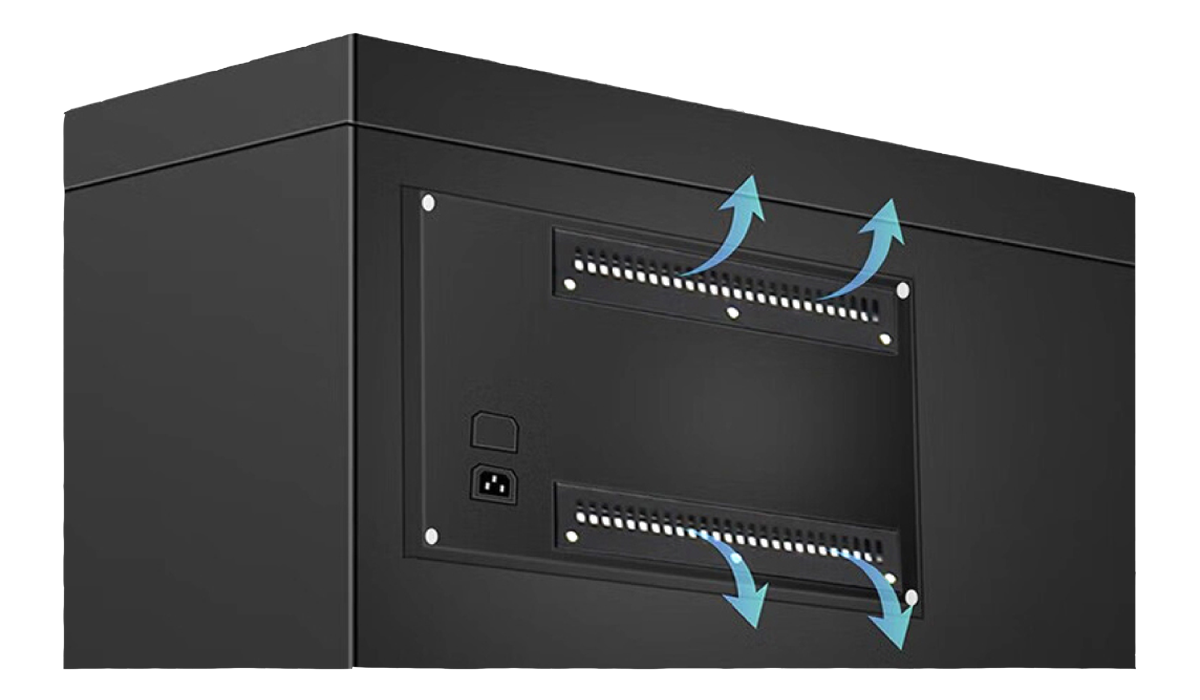
A sensor reports the gas where the sensor sits, nothing more. In a circulating purge cabinet the meaningful location is in the chamber airflow — typically the return path, where gas that has passed over the stored parts is measured before being re-purged. A sensor mounted on the nitrogen supply line only verifies gas purity at the inlet; it can read a healthy zero while the chamber itself leaks like a sieve. Conversely, a sensor in a dead corner stratifies and lags.
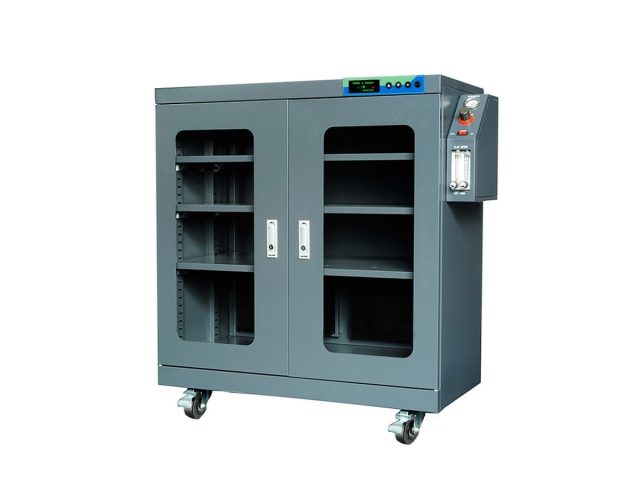
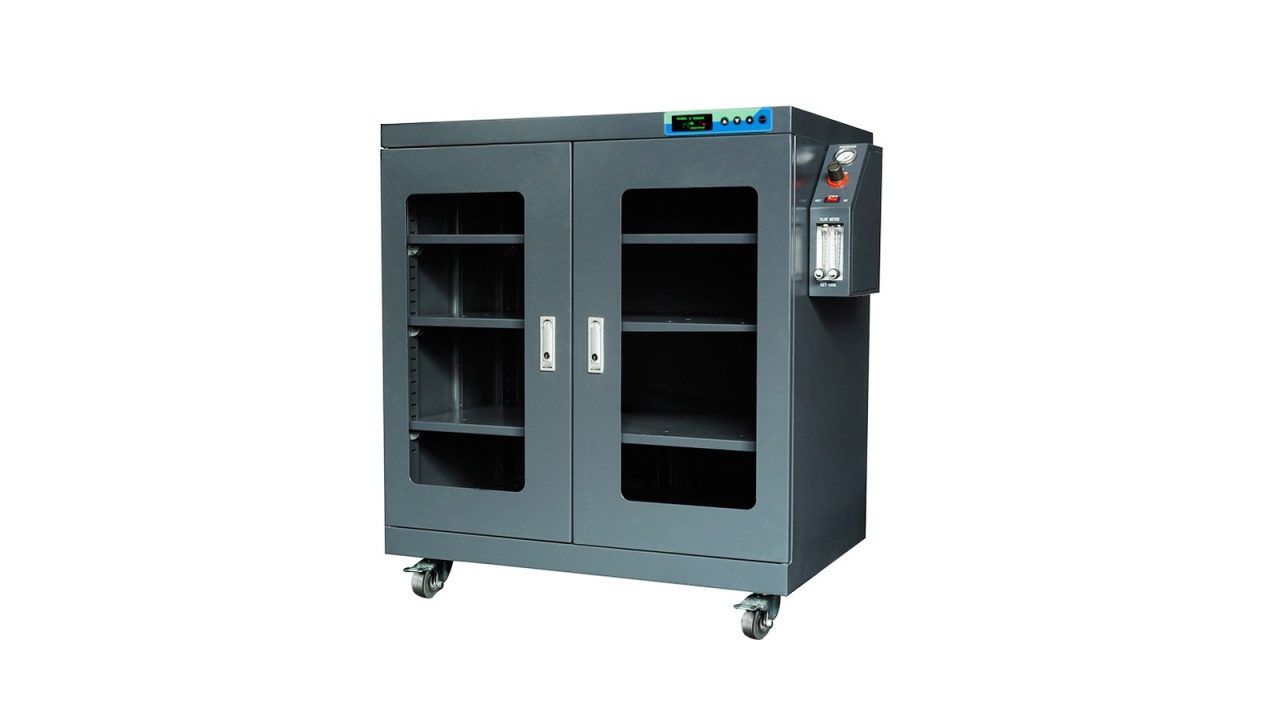
Gradients inside the cabinet are usually small because nitrogen and air differ by only one gram per mole in molecular weight, so buoyant stratification is weak — but a cabinet without circulation fans can still develop local pockets after door closures, especially on deep shelves. This is one reason YSN cabinets circulate the purge flow rather than just injecting gas at the top: the sensor, the parts and the flow meter then describe the same gas.
Reading Spikes and Steady State Correctly
When the door opens, oxygen floods in and the display jumps. This is not a fault; it is physics. A thirty-second door opening on a mid-size cabinet can push the reading up by several percentage points, and recovery time back to baseline depends on purge flow versus chamber volume (indicative: minutes, not seconds, for typical production cabinets). Operators who panic at the spike and crank the flow meter to maximum usually waste gas on a transient that the baseline purge was already sized to clear.
The numbers that actually characterize a cabinet are therefore: the baseline steady-state reading achieved between uses, the recovery time from a standardized door opening back to baseline, and the trend of both over weeks. A slowly lengthening recovery time is the classic signature of a developing leak — a gasket, a cable gland, a cracked viewing window seal — long before the baseline shifts visibly.
A Five-Step Verification Workflow
Run this on any existing cabinet in one shift; repeat quarterly.
- Verify supply gas purity. Check the specification of the cylinder, dewar or PSA generator at its outlet. A cabinet cannot be cleaner than the gas it is fed — if you need 1,000 ppm in the chamber, supply gas an order of magnitude better is a sensible margin (see PSA vs. membrane generator sizing).
- Hunt leaks before blaming the sensor. Inspect door gaskets, view-window seals, cable glands and shelf penetrations. Continuous oxygen ingress raises the baseline purge demand and shows up first as longer recovery times.
- Two-point sensor check. Fresh air should read near 20.9%; high-purity nitrogen should read near zero. Replace or recalibrate any sensor that fails either point, and log the check date on the cabinet.
- 24-hour baseline test. Sealed, doors unopened, at the normal production flow rate, log the O2 reading overnight. The stable value you record is the cabinet’s real specification — write it on the cabinet, not in a drawing file.
- Standardized door-recovery test. Open the main door for a fixed duration (for example 30 seconds), close, and record time back to baseline at normal flow. Repeat after any maintenance. Set alarm thresholds with a time delay so door-opening transients do not trigger them.
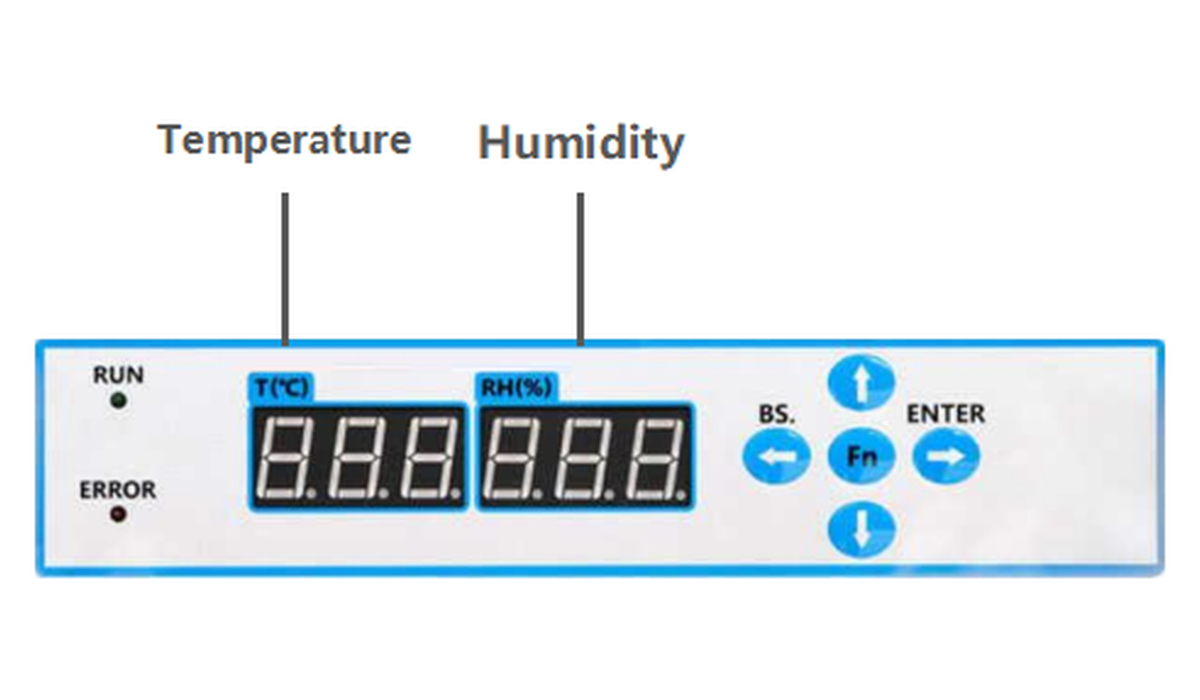
On cabinets with an HMI, steps 4 and 5 are easier if the controller logs readings internally or exposes them over a network connection; a hand-written logbook works, but it will not show you the trend the first time someone asks why a powder lot came back with high interstitial oxygen.
Frequently Asked Questions
Can a standard nitrogen cabinet reach below 100 ppm O2?
Generally no during daily use. Well-sealed production cabinets typically settle between 0.1% and 2% residual oxygen (indicative assumption). Sustained sub-100-ppm operation is glovebox territory, with airlocks and interlocked transfer chambers.
How often should the oxygen sensor be calibrated or checked?
A two-point check (fresh air, then nitrogen) every quarter is a sensible routine (indicative). Replace electrochemical cells when they fail either point or reach their rated life, typically one to two years depending on exposure.
If the oxygen reading is low, is the humidity automatically low?
Not reliably. Bottle nitrogen is dry, so purge helps, but moisture rides in on parts, packaging and door openings. Track RH and O2 independently; see why 5% RH is not a moisture spec.
The O2 reading jumps whenever someone opens the door — is the cabinet faulty?
Almost certainly not. Transient spikes after door openings are expected; what matters is the baseline between uses and the recovery time. Only a rising baseline or a lengthening recovery suggests a leak or sensor problem.
Do I need the oxygen reading for ordinary component storage?
Usually no. For moisture-sensitive devices under J-STD-033 practice, RH is the controlling parameter and humidity cabinets do that job. Oxygen monitoring earns its cost when the failure mode is oxidation of a reactive surface, not moisture pickup.
Conclusion: Spec the Baseline, Verify the Sensor
Residual oxygen in a nitrogen cabinet is a real, measurable and useful number — as long as you ask for it in ppm, match the target to your actual failure chemistry, remember that the display is one point in a moving gas system, and verify it with the same two-point discipline you would apply to any other instrument. Cabinets that get this treatment hold their numbers for years; cabinets treated as sealed black boxes quietly drift until a customer audit finds them.
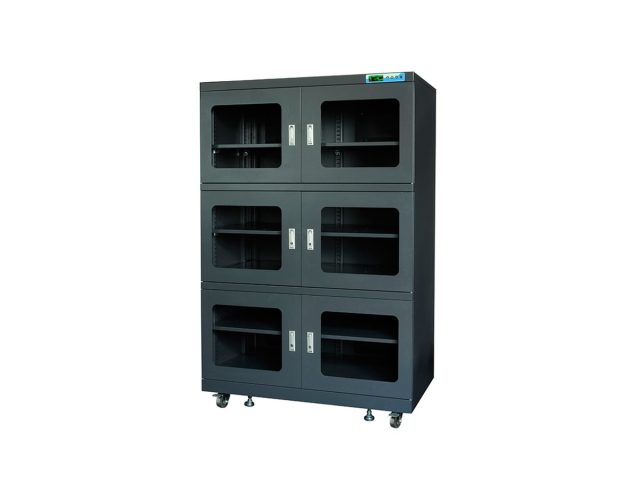
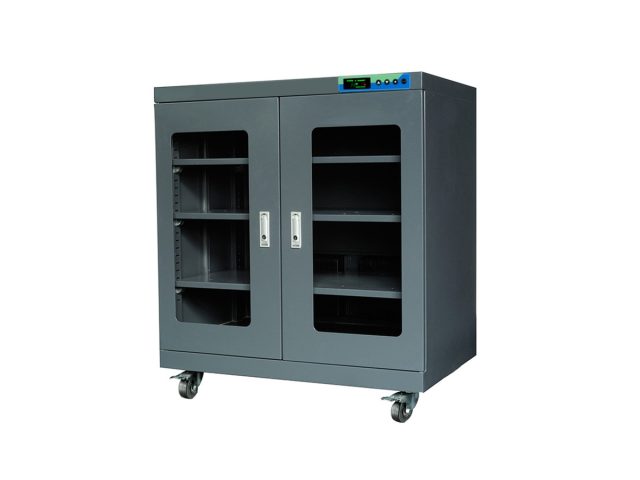
YanSyn YSN nitrogen cabinets from 100 to 1430 litres use circulating purge modules with dual flow meters and an HMI for N2 control, so baseline, flow and door-recovery behavior can all be observed on one panel. For reactive-powder storage workflows, see our metal 3D printing powder storage practices.
YSN450 nitrogen cabinet · YSN1430-6 large-format cabinet · Contact YanSyn for a nitrogen purge configuration →