5% RH Is Not a Moisture Spec: Dew Point and Absolute Humidity Explained
A purchase order that says "dry cabinet, 5% RH" is not a moisture specification. It is half of one. Relative humidity is a ratio, and a ratio only means something when you know the temperature it was taken at. Two cabinets can both display 5% RH and hold very different amounts of water: at 30 °C, air at 5% RH carries about 1.51 g of water per cubic metre, while at 20 °C the same 5% RH carries about 0.86 g. That is a 1.76× difference in the water available to your parts, hidden behind an identical number on the display.
This matters because the failures that scrap moisture-sensitive parts — popcorn cracking during reflow, creep corrosion on copper, delamination in a battery electrode — do not respond to a percentage. They respond to how much water has diffused into the material. This guide covers the two numbers that travel with your parts, absolute humidity and dew point, and how to write a specification and verification routine that survive a real production floor.
What relative humidity actually measures
Air at a given temperature holds a finite amount of water vapour before it saturates. That ceiling is the saturation vapour pressure, and it rises steeply with temperature — roughly 6–7% per degree Celsius at room conditions. Relative humidity is the ratio of the vapour pressure present to that ceiling.
Because the denominator moves with temperature, the same mass of water produces different RH readings. Seal a sample bag, warm it by 5 °C, and its RH falls by roughly a quarter with no water removed at all. Nothing dried; the ratio moved.
This explains a familiar complaint: a cabinet that held 5% RH all winter alarms in summer. The module has not degraded. The room got warmer, the ceiling rose, and holding the same ratio now demands more from a module sized for the cooler condition.
Absolute humidity: the number that stays with the parts
Absolute humidity (AH, or volumetric humidity) is the mass of water vapour per cubic metre of air. It has no temperature in the denominator, so it is the honest way to compare two storage conditions. It follows from temperature and RH:
AH (g/m³) = 216.7 × (RH/100 × es) / (T + 273.15) where es = 6.112 × exp(17.62T / (243.12 + T)) in hPa
The table is the argument for putting temperature into every RH conversation. Read down the 5% RH column: the water load nearly quadruples between 15 °C and 40 °C.
| Cabinet air temp | 40% RH (g/m³) | 20% RH (g/m³) | 10% RH (g/m³) | 5% RH (g/m³) | 1% RH (g/m³) | Dew point at 5% RH |
|---|---|---|---|---|---|---|
| 15 °C | 5.12 | 2.56 | 1.28 | 0.64 | 0.13 | −24.5 °C |
| 20 °C | 6.90 | 3.45 | 1.72 | 0.86 | 0.17 | −20.9 °C |
| 25 °C | 9.19 | 4.59 | 2.30 | 1.15 | 0.23 | −17.3 °C |
| 30 °C | 12.11 | 6.05 | 3.03 | 1.51 | 0.30 | −13.8 °C |
| 35 °C | 15.79 | 7.89 | 3.95 | 1.97 | 0.39 | −10.3 °C |
| 40 °C | 20.39 | 10.20 | 5.10 | 2.55 | 0.51 | −6.8 °C |
Values calculated with the Magnus formula at standard atmospheric pressure; dew point applies to the stated RH at that cabinet temperature.
Dew point: where the margin disappears
Dew point is the temperature to which air must be cooled, at constant pressure and water content, for RH to reach 100%. At 5% RH and 25 °C it is about −17 °C, which is why a correctly running cabinet never condenses inside a normal factory.
The useful part is the interface between cabinet and process. A part pulled from a 25 °C cabinet at 5% RH into a 30 °C, 60% RH assembly area does not stay dry: that room air has a dew point near 17 °C, far above the part surface, so water starts adsorbing at once. The cabinet did its job; the transfer undid it. Dry-storage procedures that stop at the cabinet door fail intermittently for exactly this reason.
Dew point also settles supplier comparisons. Convert both quoted conditions and the ambiguity disappears: 10% RH at 20 °C (−11.2 °C) is drier than 5% RH at 40 °C (−6.8 °C), though the second number looks far better on a datasheet.
Why cabinet temperature drifts in the first place
A dry cabinet is not an isothermal box. It sits in a room whose temperature changes, and it makes a little heat of its own:
- Room HVAC setback. Night and weekend set-backs of 3–5 °C are common where production is not 24/7, and the cabinet follows the room.
- Module heat. Thermoelectric and compressor dryers reject heat near the chamber; a module at high load warms the interior by a degree or two.
- Adjacent equipment. Reflow ovens, wave solder machines and curing tunnels radiate into the aisles where cabinets are usually parked.
- Position. A west-facing wall in summer is not the same thermal environment as a conditioned corridor.
The arithmetic is unforgiving. A 3 °C rise at a 5% RH setpoint raises absolute humidity by roughly 18% if the controller holds the ratio — and if it is fighting to hold the ratio, duty cycle, regeneration frequency and energy all climb. Neither effect appears on a one-line datasheet.
What the three standard storage jobs actually need
Moisture-sensitive devices. J-STD-033 floor life is reset by dry storage, and the standard writes that option as a low-RH environment, not a water-content limit. The diffusion that matters is into the molded compound, which equilibrates with ambient vapour pressure — so 5% RH at 30 °C is a wetter reset condition than 5% RH at 20 °C. If your reset validation was done in a cool winter room, re-check it in summer.
Corrosion and oxidation. Creep corrosion, ionic contamination and solderability loss accelerate sharply above a critical RH, usually quoted in the 40–60% band depending on finish and chloride loading. Below it, the driver shifts to absolute moisture and time. Nitrogen storage pushes the mechanism further away by removing oxygen as well as water — see our five-year TCO comparison.
ESD. Very dry is not automatically better: below about 5% RH, surface resistivity climbs and charge accumulates faster on plastics and carriers (see ESD at ultra-low humidity).
Why the display is not a measurement of your load
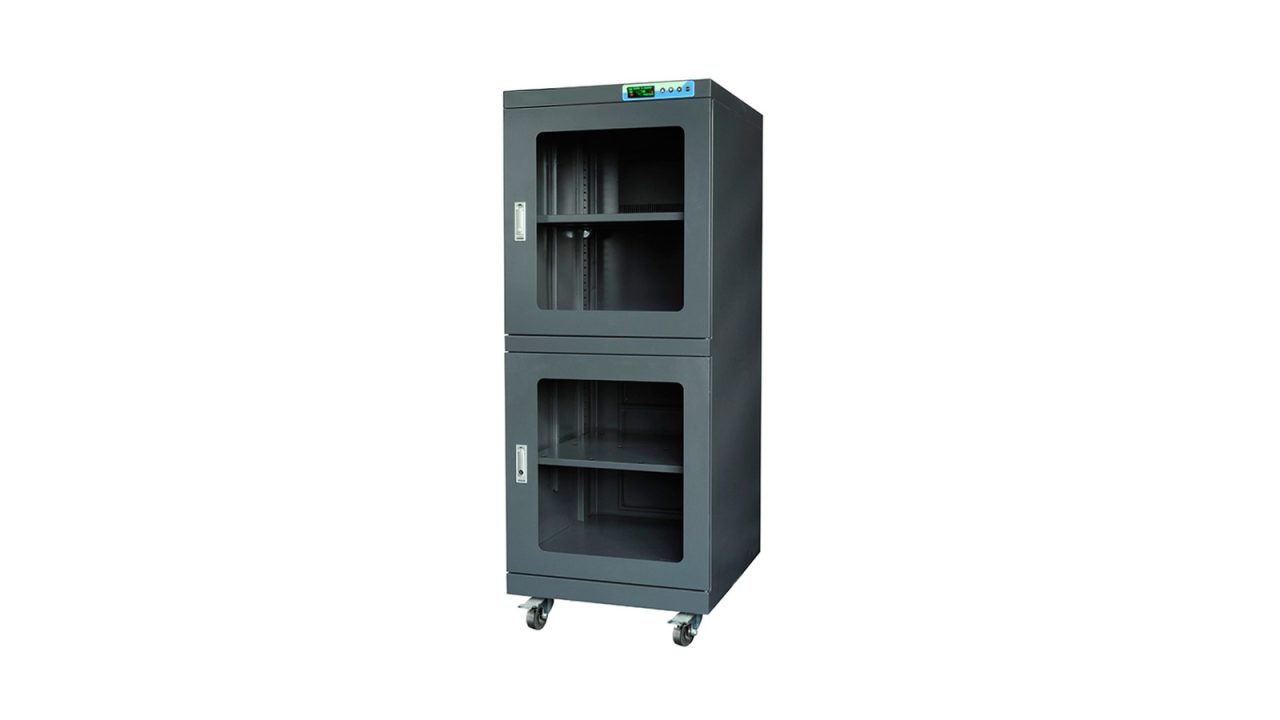
Most cabinets report RH from one capacitive sensor on the controller board, usually at the top front. That is a real measurement of one point in the air, subject to three ordinary errors:
- Sensor tolerance. Standard elements are specified at ±2% RH and ±0.3 °C. At a 5% setpoint, a 2% error is a 40% error in the reading.
- Drift and contamination. Polymer sensors drift with age and faster with solvent vapour, flux volatiles or fine dust; a unit reading 4.5% RH after three years may be seeing 7%.
- Position. In a 730 L cabinet the top shelf runs a degree or so warmer than the bottom, and a sensor near the desiccant outlet reads air leaving the module, not air around your trays.
A display is an indicator. A certificate plus a periodic reference check is a measurement — the difference between an audit finding and a passing record.
Writing a specification that can be verified
The fix is not a longer datasheet. It is six lines, each testable on site.
| Specification line | What to ask for | Why it belongs in the RFQ |
|---|---|---|
| RH setpoint and tolerance | Setpoint ≤ 5% RH, control tolerance ±1% RH or ±20% of reading | Stops a "5% RH" claim from hiding a ±3% swing that doubles the water load |
| Reference temperature | The cabinet temperature range the RH spec applies to, e.g. 20–25 °C | Without it the RH figure is not convertible to water content |
| Sensor accuracy and type | Capacitive RH sensor, ±2% RH / ±0.3 °C, with calibration certificate | Determines whether the display can resolve a 1% RH difference at all |
| Internal temperature spread | ΔT between top and bottom shelf under loaded conditions | A 1 °C gradient shifts local RH by roughly 6% of reading |
| Recovery after door opening | Time to return to setpoint after a 30-second opening at 60% RH ambient | Real lines open doors dozens of times per shift |
| Logging interval | 1-minute data log, CSV export, deviation alarm | Turns the cabinet from a guess into a record you can audit |
Lines marked as tolerances are typical commercial targets; confirm final values with the supplier against your own validation data.
A verification workflow for one afternoon
- Stabilise and log. Close the doors, stop traffic, let the cabinet sit at setpoint for two hours, and record 60 minutes of RH, temperature and module duty at one-minute resolution. You want the size of the swing, not the average.
- Add a reference instrument. Place a calibrated hygrometer or chilled-mirror dew-point meter at mid-height, 100 mm clear of walls and shelves, away from the outlet. Measure temperature at the same point.
- Compare in the same units. Convert both readings to dew point or absolute humidity first. Comparing RH at different temperatures is the most common error in these audits.
- Map the loaded cabinet. Repeat at top, middle and bottom with shelves loaded as normal. A 2 °C spread is a 12% RH spread at equal water content.
- Correct and document. If controller and reference disagree by more than the sensor tolerance, recalibrate or replace the sensor, re-run step 2, and file the as-found / as-left record.
Repeat annually, and again after any move, HVAC change or unexplained rise in module duty. The record also settles supplier disputes, because it separates a cabinet problem from a room problem with data instead of opinion.
Frequently asked questions
Is 5% RH at 30 °C the same as 5% RH at 20 °C?
No. The ratio matches, the water content does not — roughly 1.51 versus 0.86 g/m³. For anything sensitive to absorbed moisture, the cooler condition is the drier one.
Should I specify RH or dew point?
Specify RH with a temperature range and tolerance, because that is what the controller holds and what operators act on. Use dew point for comparison, validation records and anything crossing a temperature boundary.
How accurate is a built-in sensor?
Typically ±2% RH and ±0.3 °C for a capacitive element, with drift over time. At low setpoints that is a large fraction of the reading, so annual verification is normal practice, not a sign of a defective cabinet.
Why does my cabinet read higher in summer?
Warmer room air raises the saturation ceiling, so the module must remove more water to hold the same ratio and runs longer. Check ambient temperature first, then duty cycle, then sensor calibration.
Does a nitrogen cabinet avoid this?
Partly. Dry nitrogen purging displaces oxygen and water vapour and is far less sensitive to room humidity, but temperature still sets the ceiling inside the chamber and gas use rises with door openings.
Conclusion: two numbers, one specification
The takeaway is short. When you buy, qualify or audit a dry cabinet, write the RH setpoint with its tolerance and reference temperature, then verify it in dew point or absolute humidity. A cabinet holding 5% RH at a stable 23 °C is a controlled environment; the same cabinet in an uncontrolled corner of the plant, drifting five degrees across an afternoon, is a number on a display.
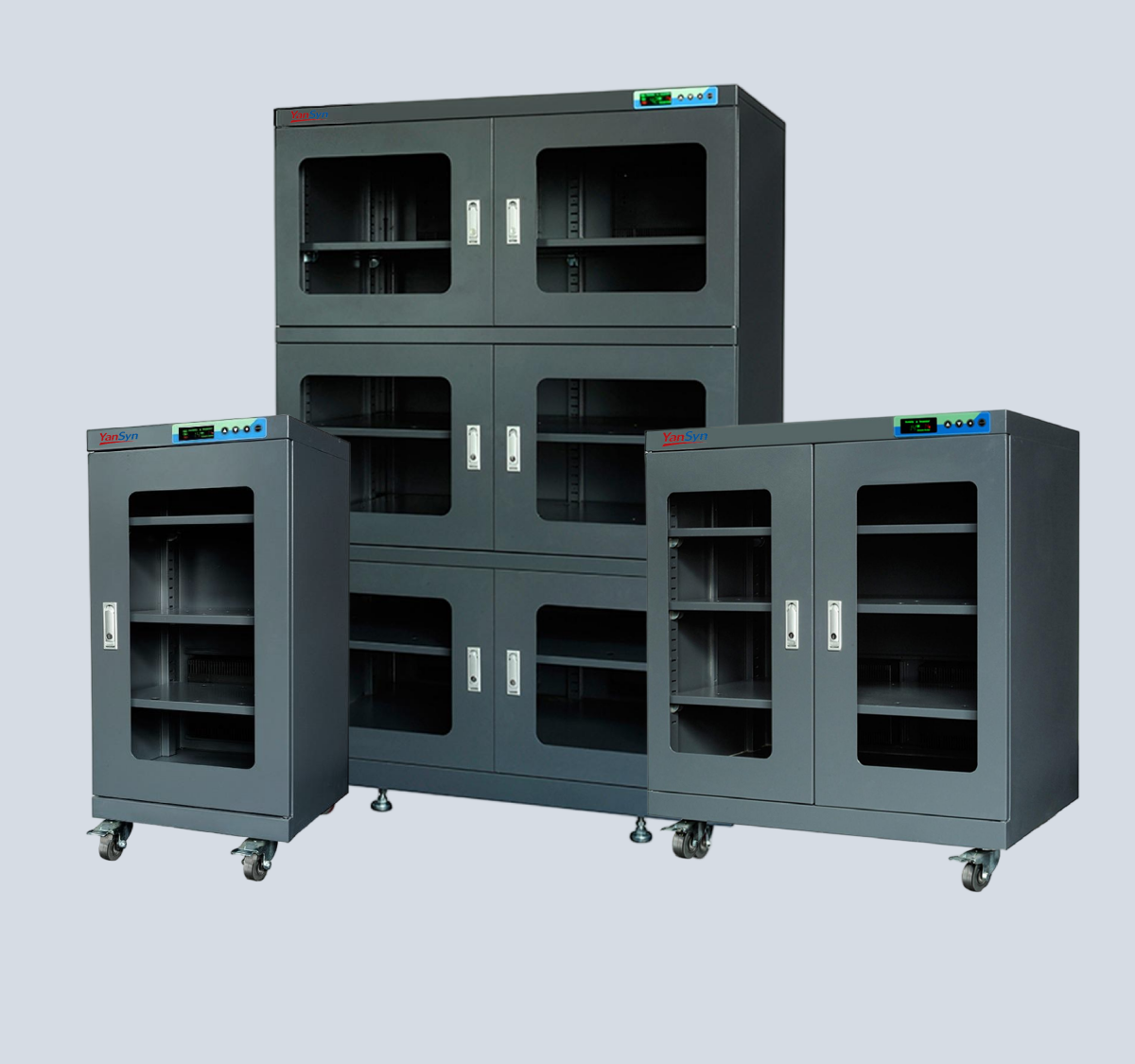
YanSyn's YSM series moisture-proof cabinets hold 1–50% RH from 100 L to 1430 L, with digital RH and temperature control and calibrated sensors; where oxygen as well as water must be controlled, the YSN nitrogen cabinets extend the same architecture to low-oxygen storage. If you are rewriting a storage specification and want a second opinion on setpoint, tolerance and verification interval, send our engineers your current wording and we will mark it up against the application.