Prepreg Out-Time Is a Budget: Cold Chain, Thawing and Dry-Room Rules for Composite Layup
A frozen roll of prepreg arrives at −18 °C, gets signed for, and is cut open on the layup bench fifteen minutes later. Nothing in that sequence fails immediately. The failure appears three days later as porosity on a C-scan — and by then the roll is back in the freezer and the panel is scrap.
Prepreg runs two clocks at once, and most shops only log one of them. The first is chemical: the resin advances slowly even at room temperature, which is why out-time is tracked. The second is physical: the resin and the fiber sizing absorb water from the air, and that water becomes vapor inside the laminate at exactly the moment the cure needs the resin to flow. Cutting a cold roll open in a warm room feeds the second clock directly.
This article covers the moisture side of prepreg handling: why absorbed water becomes void content, where condensation really occurs in the cold chain, and what low-humidity staging changes in practice — for shops laying up 180 °C-cure epoxy for aerospace, motorsport and wind parts, where a few tenths of a percent of water separates a passing laminate from rework.
Where the Water Goes, and Why 100 °C Is the Reckoning
An epoxy prepreg is a partially reacted resin film on fiber, with specified resin and volatile content. The resin is hygroscopic: hydroxyl and amine groups in the network, plus residual hardener in the B-staged film, all hold water. Moisture enters from the air, collects at the fiber–resin interface, and diffuses inward over hours to days.
During cure that water has nowhere to go. The vacuum bag is a barrier, the laminate is consolidating, and resin viscosity is falling through the gel point. As the part passes roughly 100 °C, absorbed water and volatiles turn to vapor. Vapor pressure at 100 °C is one atmosphere; if bag pressure is also about one atmosphere, the gas cannot be suppressed, so it opens a void that stays once the resin gels. The result is porosity and lower interlaminar shear strength — in a laminate that can still pass a tap test and fail ultrasonic inspection.
Thresholds are resin-specific, but as an indicative assumption, moisture content above roughly 0.1–0.3% by weight is enough to shift void content measurably in a 180 °C-cure system, while most aerospace material specifications cap volatile content near 1% or tighter. Suppliers verify this by moisture analysis or thermogravimetry on a sample cut from the roll — not by touch.
The Three Clocks Printed on a Prepreg Label
A compliant roll label carries at least three limits, and they expire on different schedules:
Frozen shelf life — commonly 6 to 12 months at −18 °C, indicative and resin-dependent. Out-time — the cumulative hours or days spent above freezer temperature while the resin advances; a 180 °C-cure epoxy often allows 10 to 30 days, a 120 °C-cure system 3 to 10 days. Tack life — hours in the layup room before the film stops sticking usefully, usually the shortest clock of the three and the one that decides how a ply kit gets sequenced.
Out-time is cumulative, not consecutive, and it does not reset when the roll goes back into the freezer. A roll thawed four times for two hours each has spent eight hours of its budget. Moisture behaves differently: some of it does leave in very dry air, but slowly and never completely inside a sealed bag. For planning purposes, treat water as irreversible.
The Thaw Step Is Where Condensation Actually Happens
The cold chain has one genuinely unsafe minute, and it is the minute the bag is cut. Room air at 23 °C and 60% RH has a dew point near 14.8 °C. Any surface colder than that collects condensation, and a roll straight out of a −18 °C freezer is far below it. Water beads on the film, wicks along the fiber, and is sealed into the ply the moment the next layer goes down.
Thermal mass makes this worse than it looks. A production roll needs many hours to reach room temperature at the core even when the surface feels neutral. Indicative figures: three to six hours for a 150 mm roll, twelve to twenty-four hours for a production roll, longer if rolls are stacked. The surface is not the indicator; the core is.
The rule that follows is simple and is broken daily: thaw sealed, for the full duration, and only then open. Opening early is defensible only when the surrounding air has a dew point below the roll surface temperature — which is precisely what a low-humidity enclosure provides.
What a Dry Cabinet Changes, and What It Cannot Do
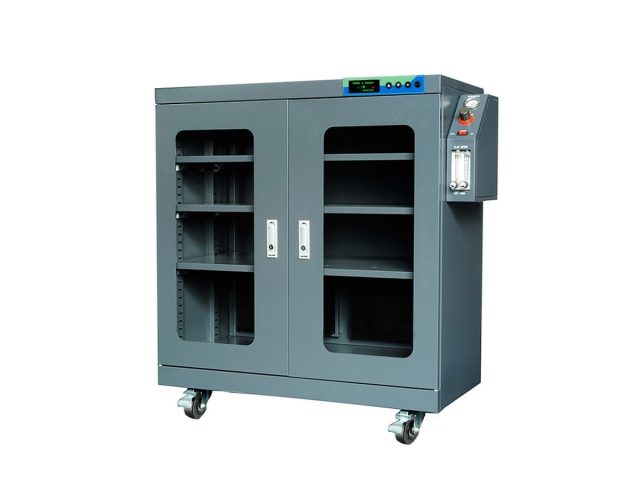
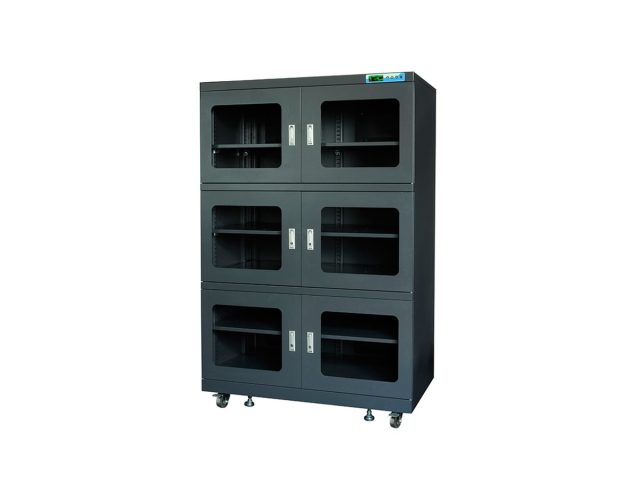
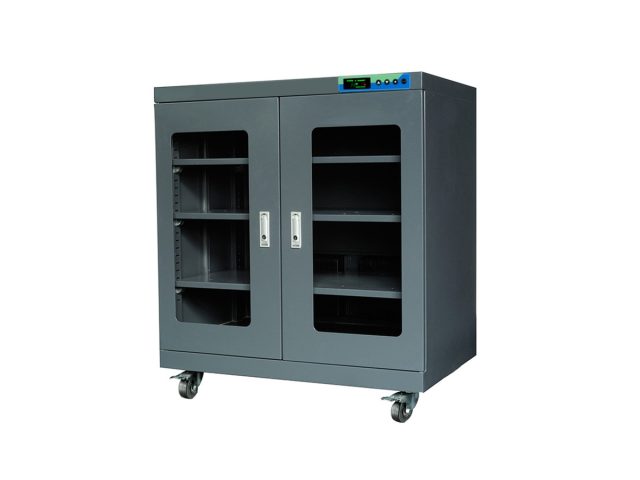
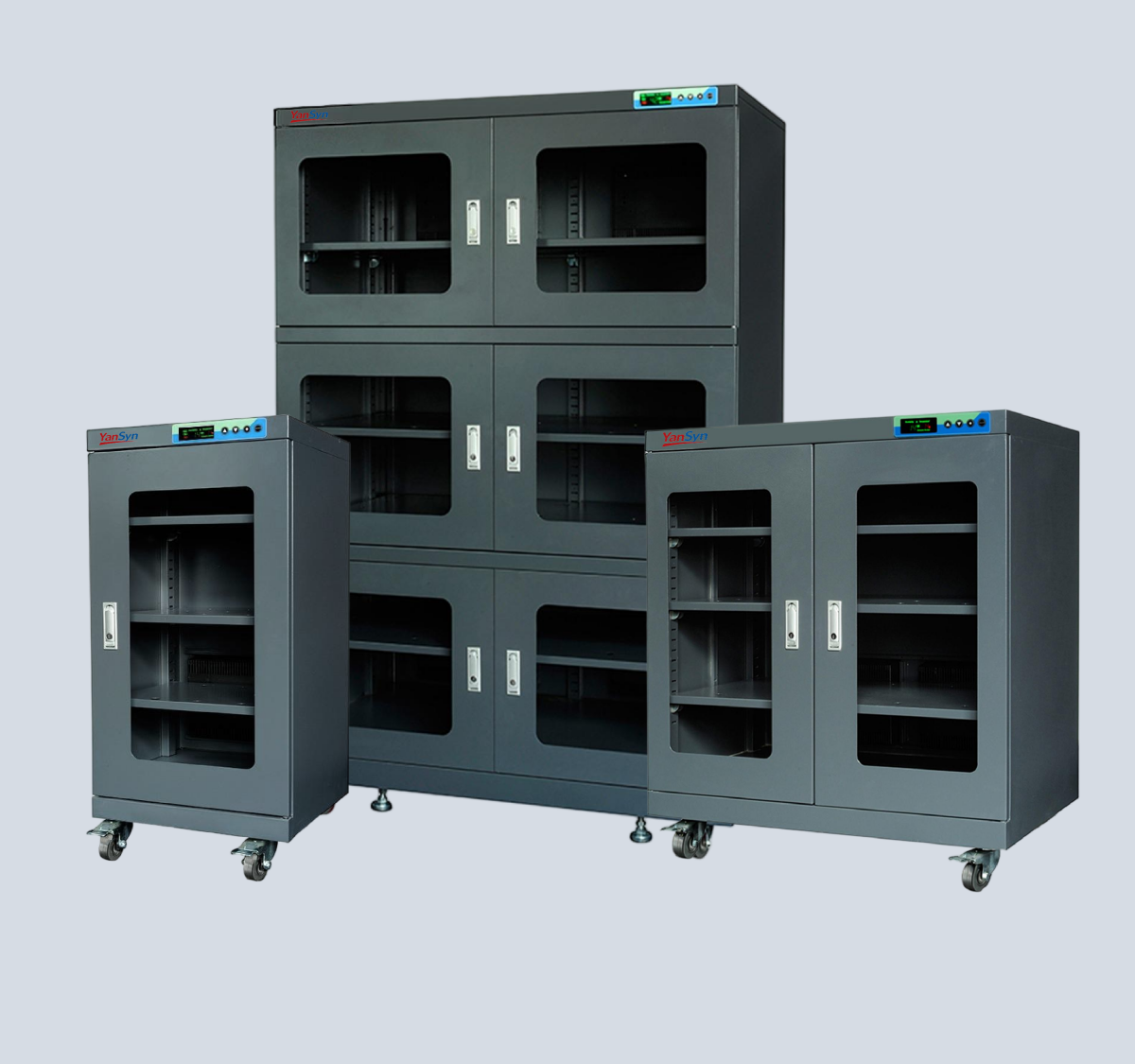
A desiccant dry cabinet such as the YSM 1430-6 moisture-proof cabinet holds 1–50% RH at ambient temperature. It is not a chiller and it does not replace the freezer. What it changes is the dew point of the air around the material, and therefore the condensation threshold.
At 23 °C and 30% RH the dew point is about 4 °C; at 20% RH it is about −2 °C. In that air a roll warmed to 8 or 10 °C can be opened without sweating, and a cut ply kit can wait between cutting and layup without picking up water. In a 60% RH room the same roll must be above 15 °C before it is safe — several hours of waiting, or one scrapped kit.
So the cabinet’s job is staging, not freezing: post-thaw equilibration, ply kits queued for layup, film adhesive, dry fabric and overnight work-in-progress. In humid climates that staging step is where most of the water in a rejected laminate was actually picked up. Size the cabinet by what sits in the queue at shift change, not by the freezer’s footprint, and place it where the door is not opened every few minutes — recovery to 20% RH is measured in minutes, not seconds.
Staging and Cure Parameters at a Glance
| Stage | Environment | Typical setpoint* | What it controls | Watch-out |
|---|---|---|---|---|
| Frozen storage | Freezer, sealed bag | −18 °C (keep below −15 °C) | Resin advancement | Bag integrity; frost on the bag |
| Thaw | Sealed bag, ambient or low-RH | 20–25 °C; RH not critical while sealed | Condensation | Full core warm-up, not just the surface |
| Post-thaw staging | Desiccant dry cabinet | 20–30% RH at 23 °C | Moisture uptake | Door discipline; recovery time |
| Ply kit WIP | Desiccant dry cabinet | 20–30% RH, 18–24 °C | Tack retention, water pickup | Cumulative out-time, not shift time |
| Layup room | Conditioned room | 30–50% RH, 18–24 °C | Operator comfort and slow uptake | Local humidity near ovens and doors |
| Cure | Forced-air oven | Ramp 1–3 °C/min, dwell per datasheet | Void content, degree of cure | Uniformity spread across the tool |
* Setpoints are indicative starting points for 180 °C-cure epoxy prepreg. The material datasheet and your customer’s process specification always take precedence — these are not manufacturer guarantees.
Curing Without Re-Wetting the Part
You cannot bake moisture out of prepreg the way you bake moisture out of a moisture-sensitive device. Baking an MSD at 125 °C works because the part is inert; baking prepreg at 125 °C advances the resin and consumes out-time. Prevention is the only real control, and the cure profile only decides how much of the damage shows up.
What the oven can do is avoid making things worse. Ramp slowly enough that volatiles leave through the bleeder before the resin gels — 1 to 3 °C per minute, with a hold near 80–100 °C for thick laminates. Verify vacuum integrity before the ramp, because a bag leak pulls humid room air into the laminate at the worst moment. And check uniformity: a two-metre tool in a chamber with a ±5 °C spread cures unevenly, and the cool corner is where porosity concentrates. Our guides to oven uniformity mapping and PID control cover both points in depth.
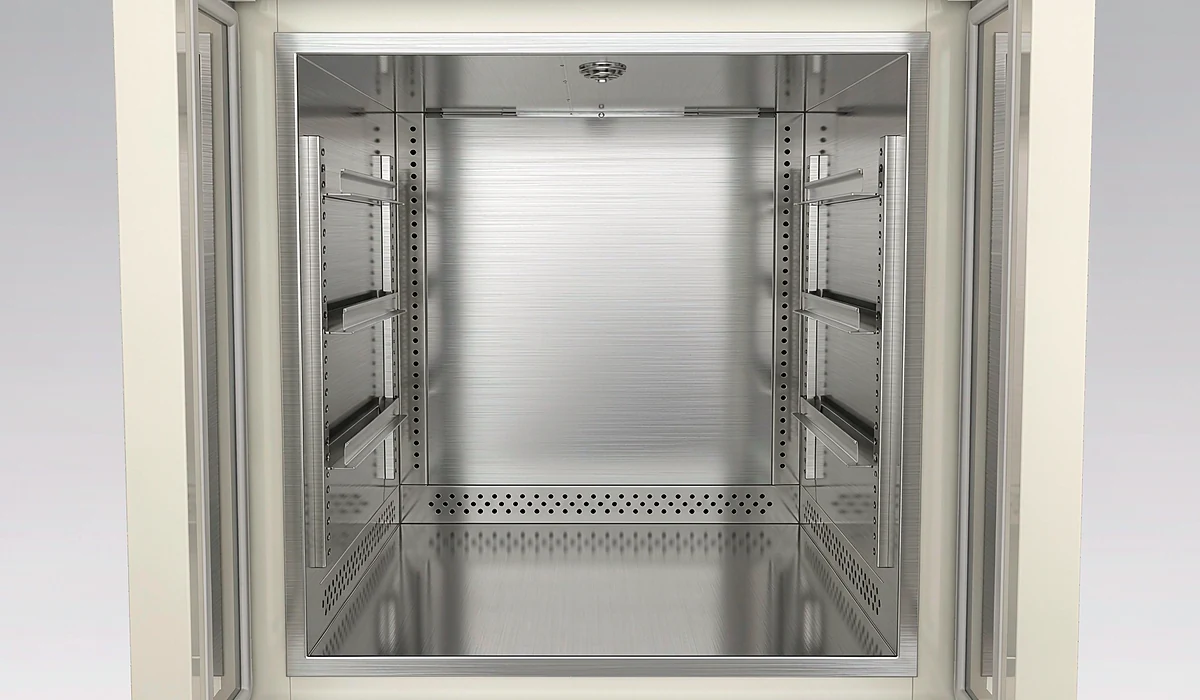
For large tools and thick sections, a forced-air convection oven such as the YSHG-620A industrial drying oven is the workhorse: ±2 °C uniformity as standard with a ±1 °C option, up to 500 °C, and an optional Class 100 HEPA configuration when layup cleanliness is specified. Vacuum ovens help where solvent or trapped air must be pulled out of a stack, but they do not fix wet prepreg either.
A Workflow That Survives a Real Shop Floor
- Label on receipt: resin system, batch, frozen shelf life, out-time remaining, thaw count.
- Keep frozen until the job is released. Do not park rolls at −5 °C to save thaw time; resin still advances and the bag is more likely to leak.
- Thaw sealed for the calculated duration and log start and end times against the roll, not the job.
- Open only when the roll surface is above the room’s dew point. In doubt, open it inside the dry cabinet.
- Cut kits and stage them at 20–30% RH, labelling each kit with the out-time already consumed.
- Track cumulative out-time per roll; a kit-level number hides the total.
- Bag and re-freeze remnants before the end of the shift, and record the second thaw.
- Before cure, verify bag integrity and keep the most recent uniformity survey for that oven on file.
FAQ
Can a dry cabinet replace the freezer?
No. A desiccant cabinet controls relative humidity at ambient temperature; it cannot hold −18 °C. It replaces the bench as the place where material waits, which is a different and often more valuable job.
How long does prepreg need to thaw?
Indicatively three to six hours for a 150 mm roll and twelve to twenty-four hours for a production roll at 23 °C. The test is core temperature, not elapsed time.
If the bag stays sealed, does room humidity matter?
Not while sealed. The exposure window is the moment of opening plus every minute the plies sit on the bench — which is why staging in 20–30% RH air earns its floor space.
Can thawed prepreg be re-frozen?
Yes, if re-sealed, still inside its out-time allowance, and logged. Every cycle adds handling risk and one more condensation opportunity, so minimise the count rather than banning it.
What humidity should the layup room be?
A common target is 30–50% RH at 18–24 °C, but the resin datasheet and the customer’s specification govern. The cabinet exists to give the material a tighter environment than the room can hold.
Does nitrogen help?
A nitrogen cabinet holds below 5% RH with low oxygen — useful when film adhesive or oxygen-sensitive core must sit longer than a shift. The benefit for prepreg comes from the dryness, not the nitrogen itself.
Conclusion
Prepreg does not fail in the oven. It fails on the bench, in the twenty minutes between cutting the bag and closing the vacuum, and again every time a thawed kit waits overnight in a humid room. The controls that work are unglamorous: a thaw log, a core-temperature check, a dew-point-aware opening rule, and a low-humidity place for material to wait. Shops that install those four things stop discovering porosity on the C-scan and start finding it in the material certificate, where it belongs. For a wider view of humidity control in MIL-spec programmes, see our aerospace component storage guide.
YanSyn builds both halves of that workflow: YSM desiccant dry cabinets from 100 to 1430 litres for low-humidity staging, and YSHG industrial ovens with ±2 °C uniformity (±1 °C optional), RT to 500 °C, and optional Class 100 or nitrogen configurations. Tell us your resin system and shift pattern, and we will size the staging capacity against your actual queue.
Contact YanSyn for a prepreg staging and cure configuration →