
Aerospace and defence hardware is often stored far longer than commercial electronics. A spares depot may hold an avionics line-replaceable unit for ten years before installation. During that waiting time nothing looks wrong on the outside, yet two slow chemical processes — moisture uptake and oxidation — quietly reduce the margin the part was qualified with.
This guide explains how to build a defensible storage environment for aerospace components, when a humidity-controlled dry cabinet is sufficient, when an oxygen-controlled nitrogen cabinet is required, and how to document the result for an audit.
Why aerospace storage is not the same as commercial storage
Four differences change the engineering answer:
- Dwell time. Commercial surface-mount devices are usually consumed in weeks. Aerospace spares, obsolescence buys and last-time-buys can sit for many years. Any slow degradation mechanism that is harmless in a short supply chain becomes significant over a decade.
- Mixed material set. One store may hold assembled PCBs, moisture-sensitive devices, bare aluminium and titanium parts, silver-plated connectors and adhesive films. These materials want different atmospheres.
- Traceability. AS9100-style quality systems expect you to define the storage environment, monitor it, and produce records on request.
- Cost of failure. The dominant cost is rarely the part. It is re-qualification, line stoppage, or a field event investigation.
The two enemies: moisture and oxygen
Most storage failures can be traced to one of two mechanisms. Treating them separately is important, because the equipment that controls one does not necessarily control the other.
What moisture does
Moisture enters by diffusion through packaging and by adsorption onto surfaces. Inside a plastic-encapsulated package it expands violently during reflow soldering and can crack the die paddle or the package body — the popcorn effect. Moisture also enables electrochemical migration and creep corrosion on bare copper and silver finishes, reduces laminate insulation resistance, and weakens adhesive bonds applied to a damp surface. We covered the reflow mechanism in our deep-dive on MSD baking profiles.
What oxygen does
Oxygen does not need heat to act. At room temperature it grows a thin oxide film on any reactive metal surface. On copper, silver and tin finishes that film raises contact resistance and degrades solder wetting, which shows up as a poor joint or an intermittent connector. On parts destined for adhesive bonding, an aged oxide changes the surface energy and shortens the window in which a qualified bond can be made. For reactive alloys and freshly machined or plated surfaces, oxygen is the more damaging of the two.
A dry cabinet controls water vapour. It does not remove oxygen. That distinction is the whole basis of the selection below.
What the standards actually require
A common misconception is that a military standard prints a storage humidity number. In practice, the documents define a programme: identify the hazard, define a controlled environment, prove it is maintained, and keep records. The numbers come from your material set and your customer contract.
| Document | What it governs | Storage implication |
|---|---|---|
| MIL-STD-883 | Test methods and procedures for microelectronics | The qualification evidence a part must still meet after storage |
| MIL-PRF-38535 | General specification for microcircuit manufacture | Storage controls are expected to be defined and audited within the same system |
| MIL-STD-810 | Environmental engineering considerations and laboratory tests | Useful reference when setting cabinet alarm limits |
| MIL-STD-1686 | Electrostatic discharge control programme | Storage furniture in the protected area must be dissipative and grounded |
| MIL-STD-2073-1 | Standard practice for military packaging | Covers barrier bags, desiccant and humidity indicators for shipment |
| IPC/JEDEC J-STD-033 | Handling, packing, shipping and use of moisture-sensitive devices | Defines the dry-cabinet conditions that stop the floor-life clock |
| IPC-1601 | Printed board handling and storage guidelines | Covers bare board storage and shelf life before assembly |
Always check the current revision and your customer's own flow-down requirements. Contract text overrides any general guidance, including this article.
Step 1: Classify parts by the dominant failure mechanism
Sorting the store by mechanism, rather than by part number, immediately tells you which control each item needs. This step usually removes both over-specification and under-protection.
| Part class | Dominant risk | Control that addresses it |
|---|---|---|
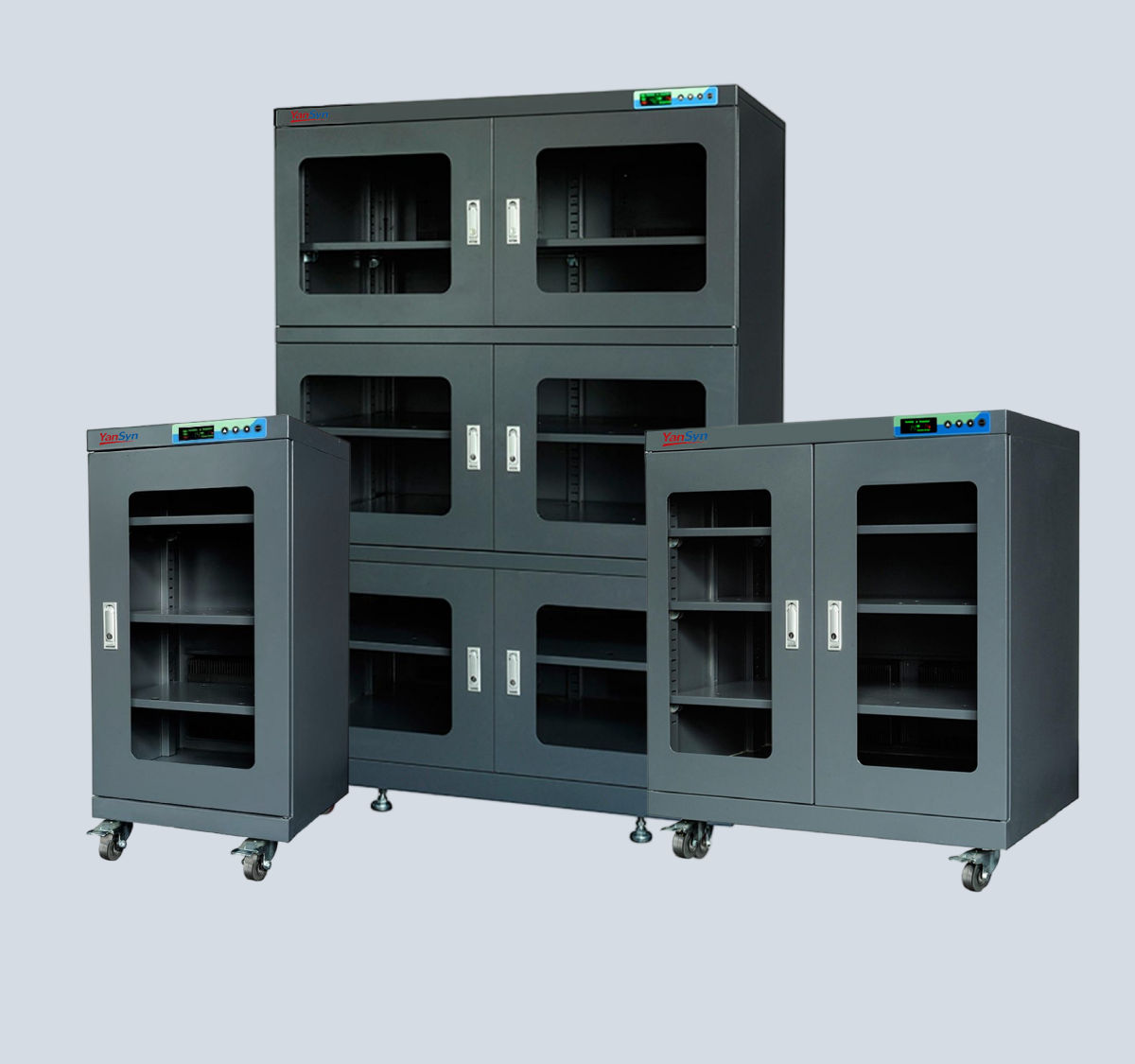
| Moisture-sensitive devices, PCBs, assemblies | Reflow cracking, delamination, electrochemical migration | Low relative humidity — YSM series moisture-proof cabinet, 1–50% RH range |
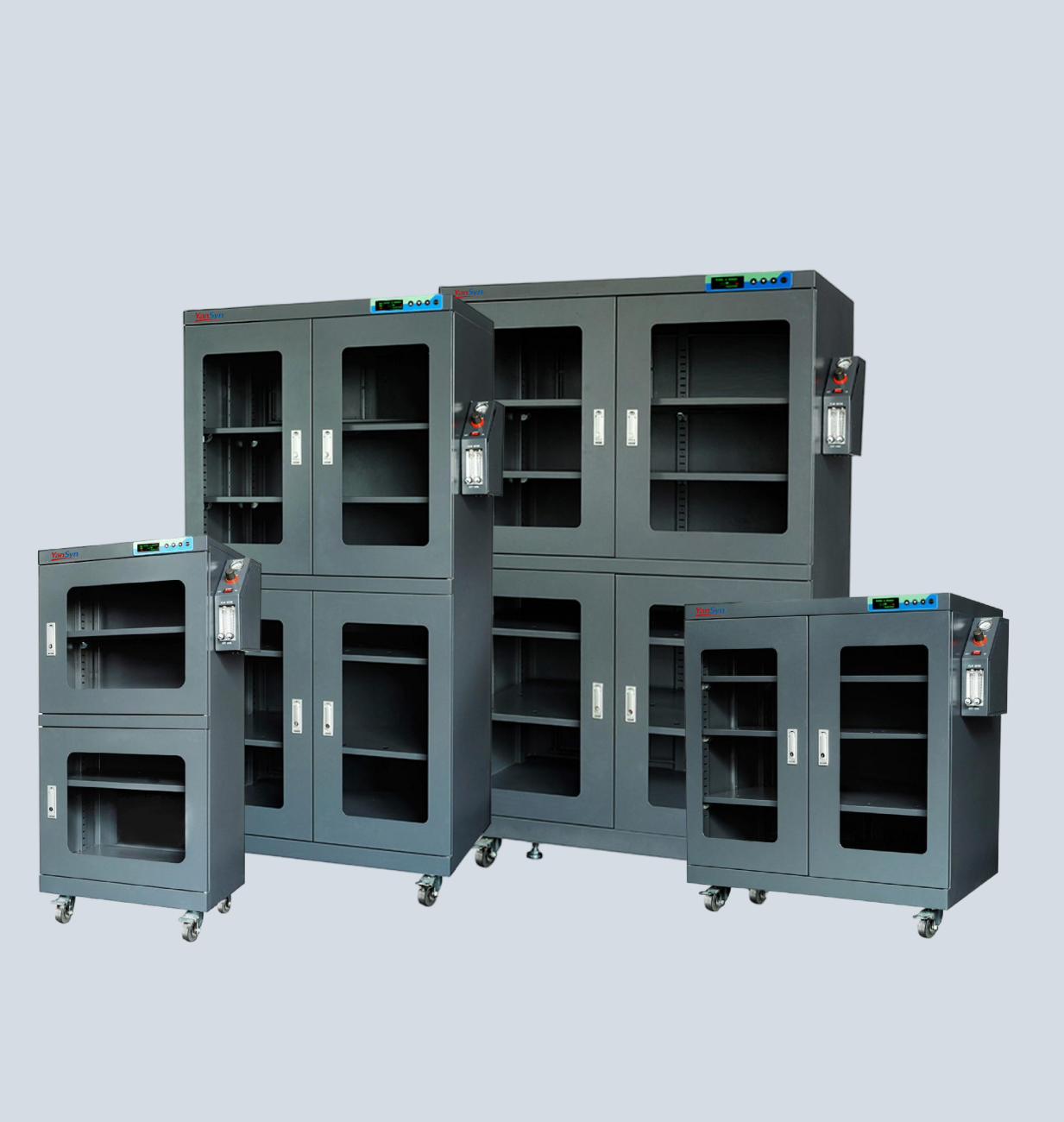
| Bare or plated metal parts, connectors, contacts | Oxide film growth, loss of solderability and contact resistance | Oxygen control — YSN series nitrogen cabinet |
| Parts awaiting adhesive bonding | Surface ageing and adsorbed moisture before bond | Combined low RH and low O₂; respect the qualified surface-preparation window |
| Reactive alloy powders, electrodes, cell hardware | Rapid oxidation, sometimes with a safety dimension | Nitrogen cabinet with continuous O₂ indication and alarm |
| Composite prepreg and film adhesives | Advance cure during cold-chain storage | Freezer or cold room — outside the scope of a dry or nitrogen cabinet |
Note the last row. A dry cabinet will not hold prepreg — honesty about scope saves money.
Step 2: Write a specification you can defend
A storage specification that survives audit has seven defined items. Fill each one in before you request quotations, because these choices drive cost more than cabinet size does.
| Spec item | Why it matters | How to set it |
|---|---|---|
| Setpoint and tolerance | The number you will be audited against | Take the strictest requirement in your part population; for packaged MSDs the widely used dry-cabinet figure is 5% RH or below — confirm against the current J-STD-033 revision |
| Recovery time | Every door opening is a humidity excursion | Specify recovery to setpoint after a door-open event, not just steady-state performance |
| Measurement uncertainty | An uncalibrated reading is not evidence | Require a traceable calibration certificate and stated sensor accuracy at your setpoint |
| Alarm behaviour | Decides how fast an excursion is caught | Define local and remote limits, and who acts on them outside working hours |
| Records | Proof the environment was maintained | Sampling interval, export format, and retention aligned to programme life |
| ESD compatibility | Required inside a protected area | Dissipative surfaces and a grounding point; very low RH increases charge generation, so handling rules may be needed |
| Operating cost | Nitrogen is a recurring line item | Model purge volume per door event; treat consumption figures as indicative until measured |
If you are weighing a nitrogen cabinet against a desiccant cabinet on cost, the trade-off is not only purchase price but years of purge gas and maintenance. We modelled that comparison in the nitrogen versus desiccant five-year TCO breakdown, and ways to cut purge consumption in the smart flow-control article. Both are indicative models — replace the inputs with your own rates and duty cycle.
Step 3: Design for the way the store is actually used
Most storage failures are operational, not equipment failures. Three checks catch the majority:
- Door cycles. A cabinet that holds 5% RH overnight but needs an hour to recover after each pick is effectively unprotected for much of the shift. Recovery time often matters more than the steady-state figure.
- Mixed loading. Storing recently unpacked goods alongside qualified parts drags the whole volume up. Define a staging area for incoming material.
- Access versus control. Larger, frequently opened cabinets are harder to hold at setpoint. Where throughput allows, use several smaller cabinets zoned by part class.
Where moisture has already entered the parts, storage cannot remove it. Baking before reflow or conformal coating is a separate step — see the MSD baking profile guide and the YanSyn YSHG electric heating oven.
Step 4: Prove it on paper
An auditor will rarely argue with your setpoint. They will ask how you know it was maintained. Be able to produce the monitored parameter and its range, the calibration status of the sensor that measured it, the alarm history with the action taken on each alarm, and a clear link between a stored batch and the conditions it saw. Cabinets with data export make this a routine download rather than a reconstruction exercise.
A worked example: avionics spares depot
A depot holds three populations: assembled avionics modules, a last-time-buy of plastic-encapsulated devices, and silver-plated connector shells. Rather than one large cabinet, the sensible split is two zones. The packaged devices and assemblies go into humidity-controlled storage at a low RH setpoint, which also stops the MSD floor-life clock. The connector shells — where the failure mode is tarnish and contact resistance, not absorbed water — go into a nitrogen cabinet. Mixed populations that need both are the exception, not the rule.
Frequently asked questions
Is a dry cabinet enough for aerospace parts, or do I always need nitrogen?
Neither is universal. If the dominant risk is absorbed moisture in packaged devices or laminates, humidity control is the correct tool and nitrogen adds cost without addressing the mechanism. If the risk is surface oxidation on bare or plated metal, humidity control alone will not stop it. Classify by mechanism first.
Do military standards specify a storage humidity value?
Generally they specify a control programme rather than a single cabinet number. The setpoint comes from the component datasheets, IPC/JEDEC guidance for moisture-sensitive devices, and the flow-down requirements in your customer contract. Always verify against the current revision cited in your contract.
How low should relative humidity go?
Go as low as the strictest item in the store requires, and no lower. Excessively dry air increases electrostatic charge generation, so balance the moisture requirement against your ESD control measures.
Can a controlled cabinet replace moisture-barrier packaging?
For in-house storage of moisture-sensitive devices, controlled low-humidity storage is the normal alternative to dry packing, and it avoids the labour of bagging and unbagging. For shipment, barrier bags, desiccant and humidity indicators remain standard. Confirm acceptance with your customer before changing a qualified packaging method.
What about composite prepreg and film adhesives?
These are cold-chain materials with a defined out-time and shelf life. They belong in a freezer or cold room with out-time logging, not in a dry or nitrogen cabinet. Lumping them with electronics is a common and expensive error.
How often should sensors be calibrated?
Set the interval from your quality system, the manufacturer's recommendation and the criticality of the parameter. An out-of-calibration sensor invalidates every reading since its last check — a larger problem than the calibration cost.
Building your storage specification
Aerospace storage problems are almost always classification problems in disguise. Once every part is assigned to the mechanism that actually threatens it, the equipment choice becomes obvious: humidity control for moisture-driven failure, oxygen control for oxidation-driven failure, and honest exclusions for materials that belong in a cold chain.
YanSyn builds both sides of that split — the YSM series moisture-proof cabinets covering the 1–50% RH range for devices, boards and assemblies, and the YSN series nitrogen cabinets for oxidation-sensitive metal parts and reactive alloys. Tell us your part population, dwell time and throughput, and we will help you size the zones.
Related Posts

FAQ: Frequently Asked Questions by clients
1. What kind of services do you provide: Orignal manufacturer in China, OEM & customization are available as well. 2.Transportation: Defaulted by sea freight, can also through other ways according to your request. 3.After-sales service Free-maintenance & spare parts for…
Moisture & Oxidation Control in Lithium-Ion Battery Manufacturing: From Electrode Storage to Cell Assembly
Lithium-ion cells are built from materials that react with water and oxygen at levels far below what a normal factory floor would call dry. A cell plant can invest in a large dry room and…
MSD Management: Why IPC/JEDEC J-STD-033D Matters
Moisture-sensitive devices (MSDs) absorb moisture from the air. During reflow soldering, the rapid heating turns that moisture into steam, causing internal cracks—a defect known as the “popcorn effect.” This leads to latent failures or immediate…