Peltier or Desiccant Rotor? How Dry Cabinets Reach 5% RH and Below
Every dry cabinet on the market removes water vapour from air using one of two engine technologies: a thermoelectric module (a Peltier device) that condenses moisture onto a cold surface, or a renewable desiccant rotor that adsorbs moisture onto a rotating molecular-sieve wheel. The choice between them is not cosmetic. It defines the RH floor the cabinet can actually hold, how fast it recovers after a door opening, how much power it draws, and how it behaves at 25°C versus 35°C on a summer afternoon.
Buyers often compare cabinets by capacity and price first and by dehumidification technology second — the reverse of what they should do. This article explains how each technology works, where the physical limits sit, and a four-step way to match the technology to your setpoint and workload. For the bigger picture on how a cabinet is assembled around these modules, see How a Dry Cabinet Works: Dehumidification Modules, RH Recovery and Maintenance.
Why the Technology Choice Matters Below 10% RH
The physics is simple but unforgiving. Relative humidity has a corresponding dew point, and a condensation-based dryer cannot push air below the temperature of its coldest surface. At 25°C, 10% RH corresponds to a dew point of roughly −9.5°C; 5% RH corresponds to about −17°C; 1% RH corresponds to around −35°C. (These are theoretical values from the Magnus formula — indicative assumptions, not product guarantees.) A compressor-based or Peltier-based condensation dryer can plausibly reach the first, struggles at the second, and cannot realistically reach the third.
Adsorption works differently: a molecular sieve binds water molecules onto an enormous internal surface area regardless of whether any dew point is crossed. That is why cabinets specified to 1–5% RH almost universally use desiccant-based dehumidification, while cabinets specified to 10–50% RH can use either. If you want to reason about what a setpoint really means in absolute moisture terms, our earlier article on dew point and absolute humidity covers the maths.
How Thermoelectric (Peltier) Dehumidification Works
A Peltier module is a solid-state heat pump: pass DC current through a junction of two semiconductor materials and one face turns cold while the other turns hot. In a dry cabinet, the cold face is bonded to a finned condenser that sits in the airflow; moisture in the circulating air condenses on the fins and drains away, and the hot face rejects its heat outside the cabinet (or into a heatsink with a small fan).
The strengths follow directly from the construction. There are no moving parts in the dehumidification path, no consumables, no regeneration heater, and essentially no vibration — useful for optics, metrology and other vibration-sensitive storage. The modules are silent, compact, and cheap to scale by simply adding more of them, which is why mid-size moisture-proof cabinets for the 10–50% RH band use them so widely.
The limitation is the cold-face temperature. A typical dry-cabinet Peltier stage holds its condenser surface tens of degrees below ambient (indicative assumption — it varies with design and ambient conditions). Near ambient 25°C, that supports setpoints in the 10–20% RH region comfortably, and it slows down noticeably as the target approaches 5% RH. It also loses grip as ambient rises: at 35°C ambient, the same absolute moisture content reads as a lower RH, but the condenser has less margin, so recovery slows and the achievable floor rises. Condensation-based drying also introduces a subtle risk below roughly 5% RH: if a cold surface ever contacts room-temperature humid air (for example right after a door opening), frost and transient condensate become a design concern.
How Renewable Desiccant Rotor Dehumidification Works
A desiccant-rotor module uses a slowly rotating wheel packed with molecular sieve or silica gel. Most of the wheel sits in the process airstream, adsorbing moisture; a small sector is isolated and purged by a heated airstream that drives the water out of the desiccant and vents it away (or, in sealed cabinet designs, exhausts it outside the loop). Because regeneration is continuous, the wheel never needs replacement — it is "renewable desiccant" in the literal sense, which is why you will see that phrase in dry-cabinet spec sheets.
The advantage is that adsorption does not care about dew points. The sieve keeps binding water even when the surrounding air is at 5% RH or 1% RH, so the achievable floor is set by wheel design, seal quality and airflow rather than by a physical cold-temperature limit. Recovery after a door opening is also faster at low setpoints, because the full adsorption capacity of the wheel is available immediately. The trade-offs are a small constant load from the regeneration heater, a rotating mechanism that adds one wear part, and a purge stream that must be engineered so it does not leak humid air back into the chamber. Heat from regeneration also means the module itself needs thermal management so it does not warm the cabinet interior it is drying.
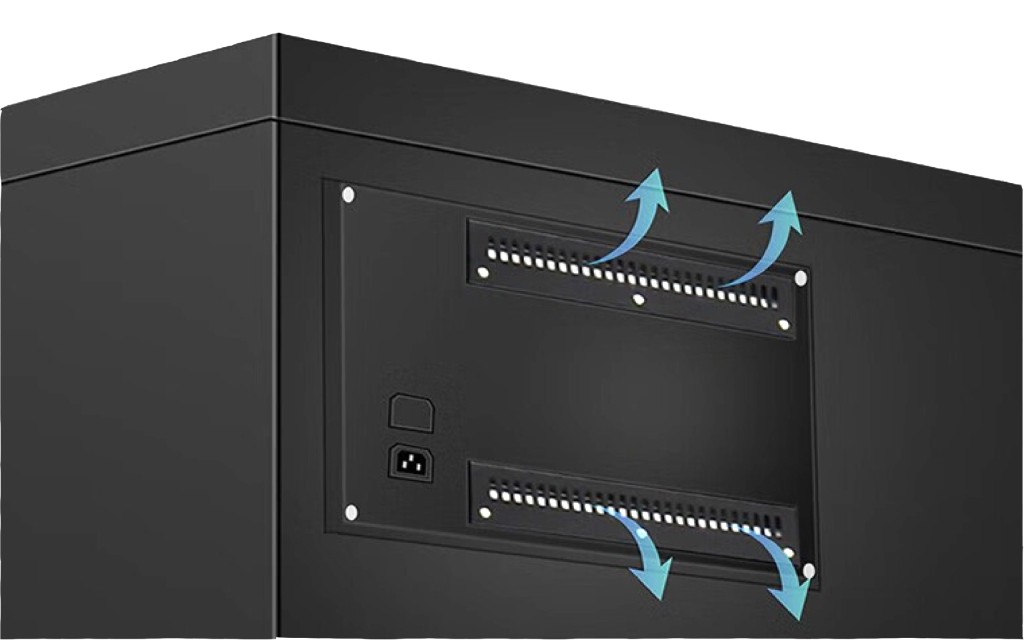
A dehumidification module of this type is compact enough to mount inside the cabinet roof or back wall, which is how most ultra-low-RH moisture-proof cabinets integrate it:
Peltier vs Desiccant Rotor: Side-by-Side Comparison
The table below condenses the two technologies into the factors that matter for purchasing decisions. Figures marked as indicative are engineering assumptions for typical cabinet-class equipment — always confirm against the specific model’s datasheet:
| Factor | Thermoelectric (Peltier) | Desiccant Rotor |
|---|---|---|
| Working principle | Moisture condenses on a Peltier-chilled surface and drains away | Molecular-sieve wheel adsorbs moisture; heater sector regenerates continuously |
| Practical RH floor (indicative assumption) | Comfortable at 10–50% RH; approaching 5% RH is the physical edge of the cold-face limit | 1–5% RH routine; adsorption does not depend on dew point |
| Recovery after door opening | Good in the 20–50% RH band; slower as setpoint approaches 5% RH | Fast at low setpoints; full adsorption capacity available immediately |
| Sensitivity to ambient temperature | Cold-face margin shrinks as ambient rises; floor rises and recovery slows | Minor effect; regeneration heater output needs managing in hot workshops |
| Moving parts and wear | None in the dehumidification path (solid-state) | Rotating wheel and drive; heater is a standard wear item |
| Consumables | None | None (desiccant is regenerated in place) |
| Power profile | DC draw scales with module count; no heater load | Small continuous heater plus airflow load (indicative assumption: tens of watts per module) |
| Typical best use | Optics, metrology, vibration-sensitive storage at 10–50% RH | MSD floor-life control, semiconductor and precision storage at ≤5% RH |
Recovery Speed: Why Door Openings Change the Equation
On paper, a 5% RH setpoint is the headline number. In production, the number that actually protects your MSD inventory is how long the cabinet spends above the setpoint after every door opening. Every access event admits a slug of room air; at 60% RH ambient, a ten-second door open on a 450-litre cabinet can push chamber RH into the tens for several minutes (indicative assumption — the exact excursion depends on door size, opening time, load mass and ambient conditions).
This is where the technologies separate. A Peltier-based cabinet must re-chill its condenser and grind through that moisture load one condensation cycle at a time — fine at 40% RH setpoints, slow when the target is 5%. A desiccant-rotor cabinet re-adsorbs immediately, because the wheel does not need to be colder than anything; it just needs to be drier than the air passing through it. Facilities with frequent door traffic — line-side MSD storage, incoming inspection, prototyping labs — feel this difference most. If your RH readings ever look suspicious during a recovery event, the sensor accuracy, drift and calibration article explains how to verify what the display is actually telling you.
Matching Technology to Your Setpoint: A Four-Step Workflow
Step 1 — Write down your real setpoint band, not one number. If your MSD policy is IPC/JEDEC floor-life control, most components want 5% RH or below after exposure; optics and completed assemblies may only need 20–40% RH to prevent mould and corrosion. Different bands, different technologies.
Step 2 — Estimate your door traffic. Count accesses per shift and the load mass coming and going. High traffic at a low setpoint is the clearest case for a desiccant-rotor cabinet; low traffic at a mid setpoint is where Peltier modules shine.
Step 3 — Check your ambient. Workshops running at 30–35°C compress the condensation margin; desiccant-based designs hold their floor more predictably in hot environments. Also verify power availability — regeneration heaters add a modest but real load (indicative assumption: tens of watts per module).
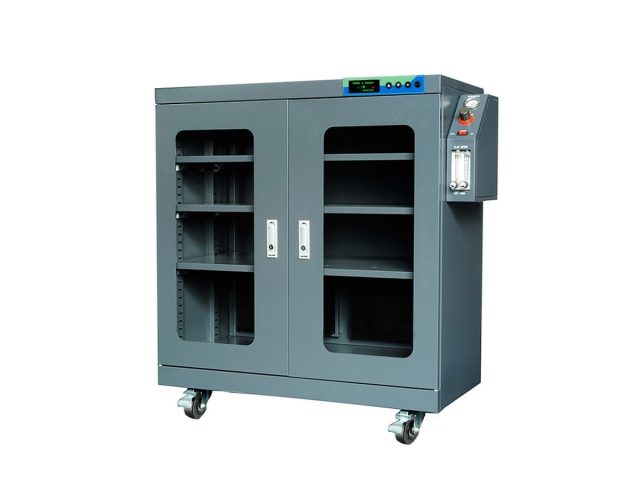
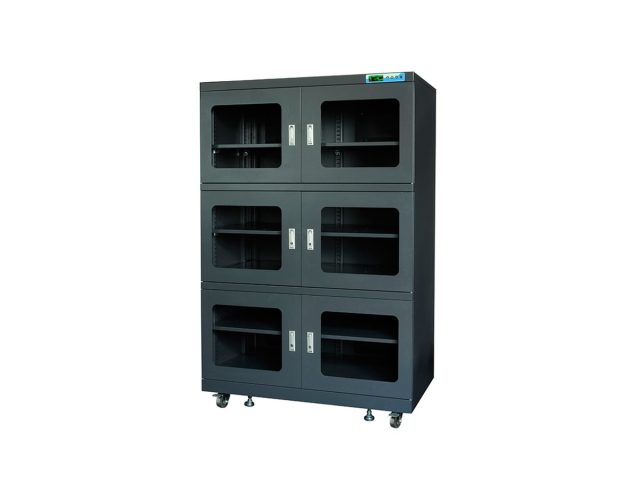
Step 4 — Size capacity and modules to the workload, then verify with a recovery test. Larger chambers need proportionally more dehumidification capacity; a YSM 450 moisture-proof cabinet and a YSM 1430-6 high-capacity cabinet serve very different door traffic patterns. Ask the supplier for a measured recovery curve (time back to setpoint after a standardised door opening) rather than a bare setpoint figure — that single curve tells you more about the dehumidification engine than any RH floor number.
Frequently Asked Questions
1. Can a Peltier dry cabinet ever hold 5% RH?
Some well-designed units can approach it near 25°C ambient, but it sits at the physical edge of the condensation limit and the achievable floor rises with ambient temperature. For a dependable ≤5% RH hold, desiccant-based dehumidification is the standard choice.
2. Does the desiccant wheel need replacing?
No. It regenerates continuously in place, which is why it is called renewable desiccant. The heater element and drive mechanism are serviceable parts with normal service lives.
3. Which technology uses less electricity?
It depends on the setpoint and duty cycle. Peltier modules draw less at rest but work harder for longer at low RH; rotor modules add a small continuous heater load. For a given cabinet this is a tens-of-watts question, not a kilowatt question (indicative assumption — confirm per model).
4. Are hybrid cabinets common?
Yes. Many moisture-proof cabinets pair Peltier stages for the mid-RH band with desiccant modules for the final approach to ultra-low RH, giving fast mid-band performance without asking the Peltier stage to break the condensation floor.
5. What should I ask a supplier before buying?
Ask which dehumidification technology is inside the specific model, what RH floor it holds at your workshop ambient, and for a measured door-opening recovery curve at that ambient. Those three answers separate real specifications from brochure numbers.
Conclusion
Peltier modules and desiccant rotors are not competitors so much as tools for different bands of the humidity scale. Condensation-based dehumidification is silent, maintenance-free and ideal for 10–50% RH storage of vibration-sensitive goods; desiccant-rotor dehumidification owns the sub-5% RH territory where MSD floor-life control and semiconductor storage live, and it recovers faster after every door opening. Choose by setpoint band, door traffic and ambient temperature — then make the supplier prove the recovery curve.
YanSyn builds both technologies into the YSM moisture-proof cabinet range, from 100-litre benchtop units to 1430-litre high-capacity cabinets. If you are unsure which dehumidification engine fits your setpoint and workload, send us your door traffic and ambient conditions — we will size it with you.