How Accurate Is Your Dry Cabinet's RH Display? Sensor Accuracy, Drift and Calibration
What the RH Sensor Actually Measures
Every dry cabinet, nitrogen cabinet and low-humidity storage system relies on one small component to make its most important claim: the relative humidity shown on the display. In nearly all storage cabinets this is a capacitive polymer sensor. A polymer film absorbs and releases water vapor as the surrounding air changes, and its dielectric constant shifts accordingly; the electronics convert that shift into an RH reading.
Two consequences follow from this. First, the sensor measures the air immediately around it, not the moisture content of your parts. If the probe sits near the dehumidification module's return airflow while your reels sit at the far end of a shelf, the display and the load can legitimately disagree by a percentage point or two while everything is working correctly. Second, a single-point reading says nothing about gradients inside a large cabinet; a 1430 L cabinet with densely packed shelves can hold air that differs meaningfully between the top tray and the bottom tray even when the display is accurate at its own location.
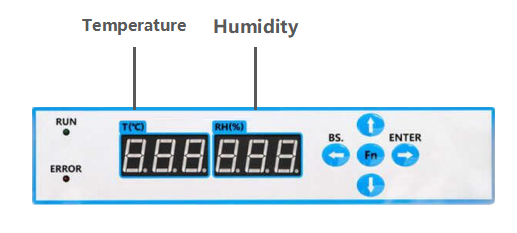
Resolution Is Not Accuracy
The most common procurement mistake is reading the display's resolution as its accuracy. A controller that shows "3.0% RH" is presenting the value to 0.1% steps — that says nothing about how far the true value may be from the displayed one. A typical capacitive RH sensor carries an accuracy specification of around ±2–3% RH across the 10–90% RH range, and accuracy generally degrades toward the extreme dry end, exactly where MSD-sensitive applications operate. Hysteresis (a small offset that remains after the sensor has seen a humidity spike and come back down) and temperature effects add further uncertainty.
Put practically: a cabinet displaying "5% RH" with an uncalibrated ±3% RH sensor may genuinely be anywhere between roughly 2% and 8% RH. For passive components this difference is usually tolerable — IPC/JEDEC floor-life rules (see our IPC/JEDEC floor-life cheat sheet) are defined at <10% RH and <5% RH boundaries, and a 2–3 point error can push a compliant cabinet out of compliance, or mask a real problem behind an optimistic reading. For nitrogen cabinets the parallel risk is oxidation: an RH display that drifts high triggers unnecessary nitrogen purge, while one that drifts low hides moisture ingress.
None of this means the sensor is bad. It means the number on the display is an indication that must be anchored to a known reference through calibration — the same discipline every quality system already applies to torque wrenches, multimeters and thermocouples.
Comparing Sensor Technologies
Before planning calibration, it helps to know what class of sensor your cabinet uses and what uncertainty it can realistically deliver:
| Sensor technology | Typical RH accuracy* | Typical long-term drift* | Relative cost | Maintenance | Best suited for |
|---|---|---|---|---|---|
| Capacitive polymer RH sensor | ±2–3% RH (10–90% RH) | 0.5–1% RH per year in clean air | Low | None; replaceable probe | Standard dry cabinets, MSD storage, general electronics |
| Resistive RH sensor | ±3–5% RH | Higher; sensitive to chemical contamination | Low | More frequent replacement | Cost-driven, wide-tolerance storage only |
| Chilled-mirror dew-point meter | ±0.5–1% RH equivalent | Very low with regular mirror cleaning | High | Mirror cleaning; skilled operation | Reference measurement, calibration audits, ultra-low RH verification |
*Accuracy and drift figures are indicative assumptions based on typical vendor specifications for each sensor class; they are not guarantees. Confirm exact values with your cabinet supplier or sensor datasheet.
The practical takeaway: capacitive polymer sensors are the right choice for storage cabinets because they are stable, low-cost and maintainable — but they must be calibrated periodically, because their accuracy class is only meaningful against a reference.
Why RH Sensors Drift
Capacitive sensors age, and storage environments accelerate that aging in specific ways:
- Chemical contamination. Solvent vapors, flux residues and cleaning agents diffuse into the polymer layer and permanently shift its response. Cabinets storing freshly cleaned parts or conformal-coating WIP are the worst cases.
- Condensation events. A sensor that has seen liquid water or a rapid high-humidity spike can carry a hysteresis offset for hours or, after repeated events, permanently.
- Heat exposure. Long operation near the upper end of the rated temperature range accelerates polymer aging.
- Ordinary aging. Even in clean air, drift of roughly 0.5–1% RH per year is a reasonable planning assumption (indicative assumption; actual rate depends on the sensor model and environment).
Drift is usually gradual, which is exactly what makes it dangerous: the display keeps looking normal, the line keeps trusting it, and the error only surfaces when a customer audit or a mysterious MSD defect rate forces a measurement.
Calibrating the Sensor: Saturated Salt Solutions and Reference Probes
Two practical calibration methods cover most factory situations:
- Saturated salt baths. A sealed container over a saturated salt solution maintains a fixed, well-documented humidity at a given temperature. Three points cover the useful range of a storage cabinet: lithium chloride at 11.3% RH, magnesium chloride at 32.8% RH, and sodium chloride at 75.3% RH (all at 25 °C). Place the removable sensor or probe in the chamber, let it equilibrate for an hour or more, and record the offset at each point. This is inexpensive, traceable to published physical constants, and fully achievable in-house.
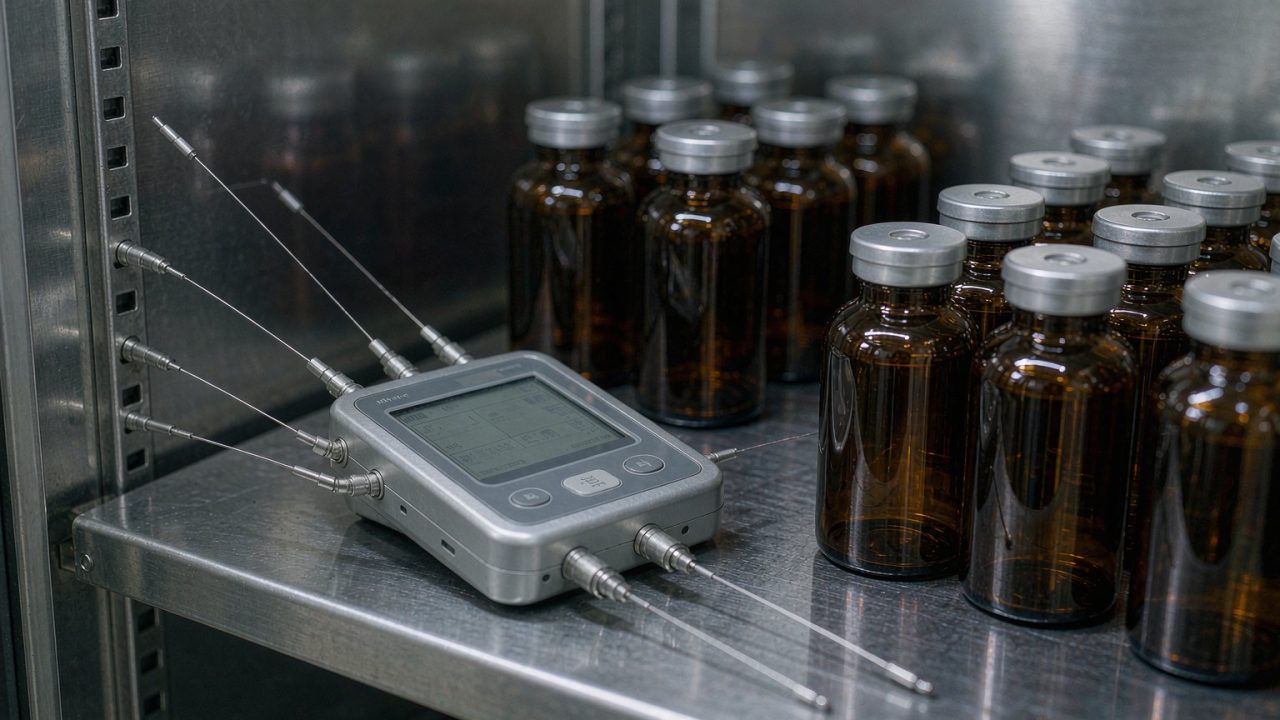
- Comparison against a reference instrument. A calibrated handheld hygrometer or chilled-mirror reference placed inside the cabinet alongside the cabinet's own sensor zone gives a direct differential. This is faster and is the standard method for verifying installed sensors that cannot be removed.
Small fixed offsets can often be compensated in the controller itself; larger or nonlinear errors mean the probe should be replaced. Keep dated records of every calibration — auditors ask for the chain, not just the fact.
| Salt bath (saturated solution, 25 °C) | Nominal RH point | Typical use in calibration |
|---|---|---|
| Lithium chloride (LiCl) | 11.3% RH | Low-point check for 1–10% RH dry cabinets |
| Magnesium chloride (MgCl₂) | 32.8% RH | Mid-point check; general storage cabinets |
| Sodium chloride (NaCl) | 75.3% RH | High-point check; verifies sensor linearity |
Validate the Cabinet, Not Just the Sensor
A calibrated sensor proves the display is honest at one point in space. It does not prove your parts are stored at the intended humidity. That requires mapping the cabinet itself, the same logic used to qualify ovens and stability chambers:
- Place a multi-channel temperature/humidity data logger with five or more probes — four near the corners of the storage volume and one at the center, at load height, not at the sensor's height.
- Load the cabinet as it is normally loaded in production (empty-cabinet mapping flatters the result).
- Log for at least 24 hours, including several door-opening cycles.
- Acceptance criteria should be set by your process requirement; a common practical expectation for a working dry cabinet is that all points recover to within roughly ±3% RH of setpoint within the manufacturer's stated recovery time after a door opening (indicative assumption — define your own limit from IPC/JEDEC or internal quality requirements).
- Repeat the mapping after relocation, module service, gasket replacement, or any significant change to the loading pattern.
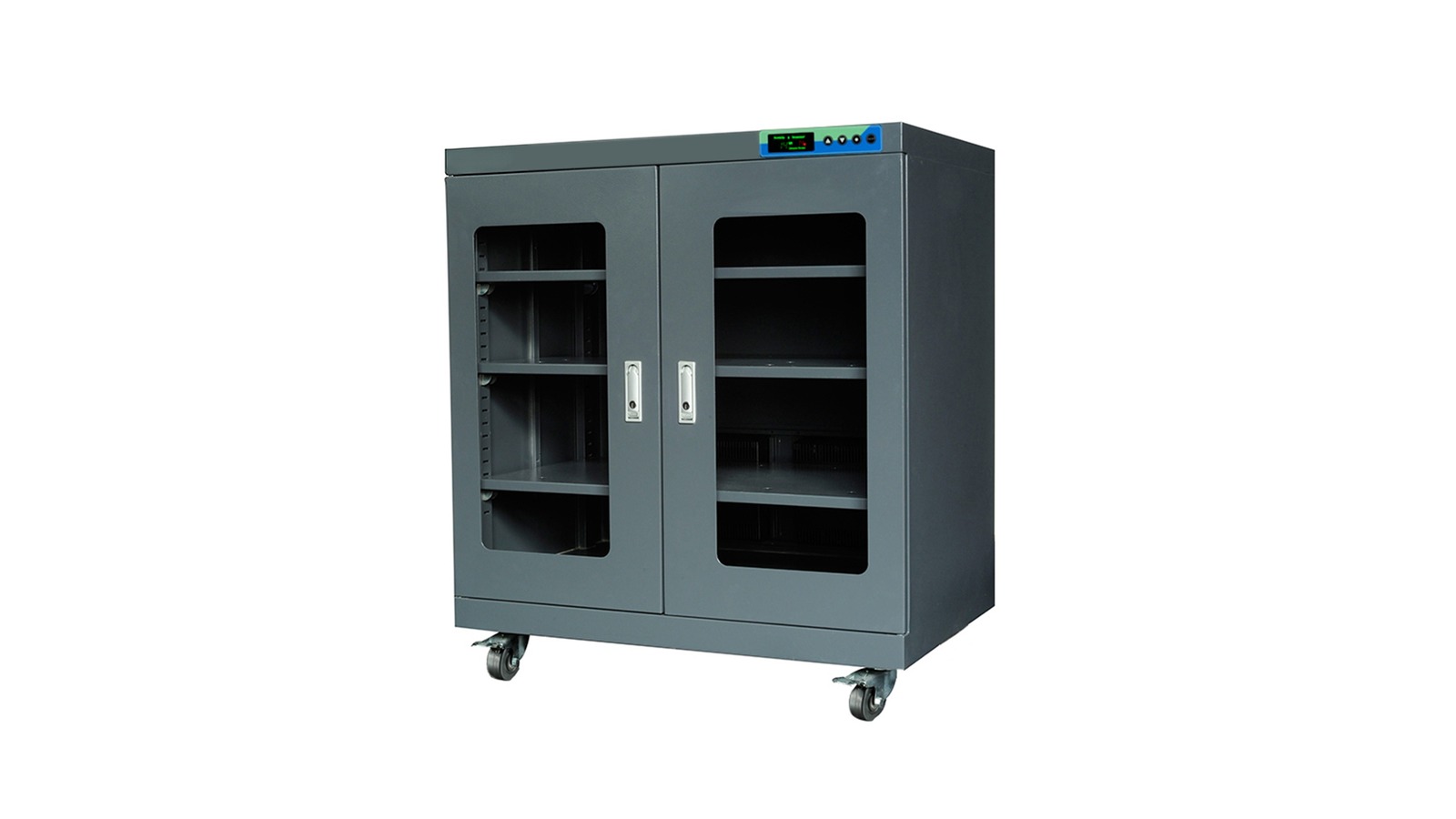
Mapping also validates the mechanical factors a sensor calibration cannot see: door-seal integrity, shelf airflow blockage, and recovery speed after openings. If your center probe lags the corners badly, the problem is airflow or loading, not the sensor.
A Practical Annual Calibration Workflow
- Schedule annually (12 months is the common interval for stable, clean environments; 6 months for chemically aggressive production areas). Add the date to your calibration register at commissioning.
- Verify before calibrating: compare the cabinet display against a calibrated reference at two RH levels. If the difference is within your tolerance, log it and stop — a full recalibration is unnecessary.
- Calibrate the removed probe at three salt-bath points (11/33/75% RH), or swap in a calibrated spare probe and send the old one out for laboratory calibration with a certificate.
- Adjust or replace: apply small controller offsets; replace probes showing large or nonlinear errors.
- Map the cabinet after any sensor replacement or mechanical service, using the five-point method above.
- Record everything: as-found and as-left readings, reference instrument ID and calibration date, environmental conditions, and who performed the work.
Facilities that run nitrogen cabinets should note that this workflow covers the RH sensor only; oxygen analyzers on nitrogen cabinets are separate instruments with their own calibration cycle, and both belong on the same register.
Frequently Asked Questions
How often should a dry cabinet's RH sensor be calibrated?
Twelve months is a sensible default for clean environments, and six months where solvents, flux vapors or frequent humidity spikes are present. After any condensation event or chemical spill near the cabinet, verify immediately rather than waiting for the schedule.
Can I trust the cabinet display for IPC/JEDEC compliance evidence?
Only if the sensor is calibrated against a traceable reference and the cabinet itself has been mapped under realistic load. An uncalibrated display is an indicator, not compliance evidence.
My display shows 0.1% RH steps. Isn't that precise enough?
That is resolution, not accuracy. A display can resolve 0.1% while the underlying sensor carries ±2–3% RH uncertainty. The extra decimal digits describe the electronics, not the measurement.
Do nitrogen cabinets need the same RH calibration?
Yes — most nitrogen cabinets still monitor RH, and the same capacitive sensors and drift mechanisms apply. In addition, their oxygen sensors (where fitted) require their own, usually shorter, calibration interval against a known gas standard.
My handheld meter disagrees with the cabinet. Which one is right?
Neither, until one of them is traceably calibrated. Compare both against a recently calibrated reference instrument; two uncalibrated meters routinely differ by 3–5% RH, which is exactly the error size this article is about.
Conclusion: Anchor the Number Before You Trust It
Humidity control earns its value only when the measurement behind it is trustworthy. Sensor accuracy at the ±2–3% RH class is entirely adequate for MSD storage, oxidation prevention and general moisture control — provided the sensor is periodically calibrated and the cabinet itself is mapped under real load. The annual cost of a salt-bath check and a mapping session is trivial compared with a single lot of moisture-damaged components.
YanSyn YSM450 moisture-proof cabinets, YSN450 nitrogen cabinets and YSHG industrial ovens are built around stable, serviceable measurement and control hardware. If you are specifying storage for a new line or preparing for an audit, contact us and we will help you match the cabinet, the sensor specification and the calibration plan to your process requirement.