Solderability Has a Shelf Life: Humidity Control for Component Warehouses and Long-Term Inventory
Solderability is a shelf-life property, and most warehouses treat it as a constant. A connector that wets in under a second when it arrives from the supplier can fail a wetting balance check a year later without ever being touched, because the termination finish has been reacting with water vapour, oxygen and trace sulfur for every one of those months. The bill arrives at reflow — graping, non-wetting, cold joints, rework — and it is almost always charged to the process engineer rather than to storage.
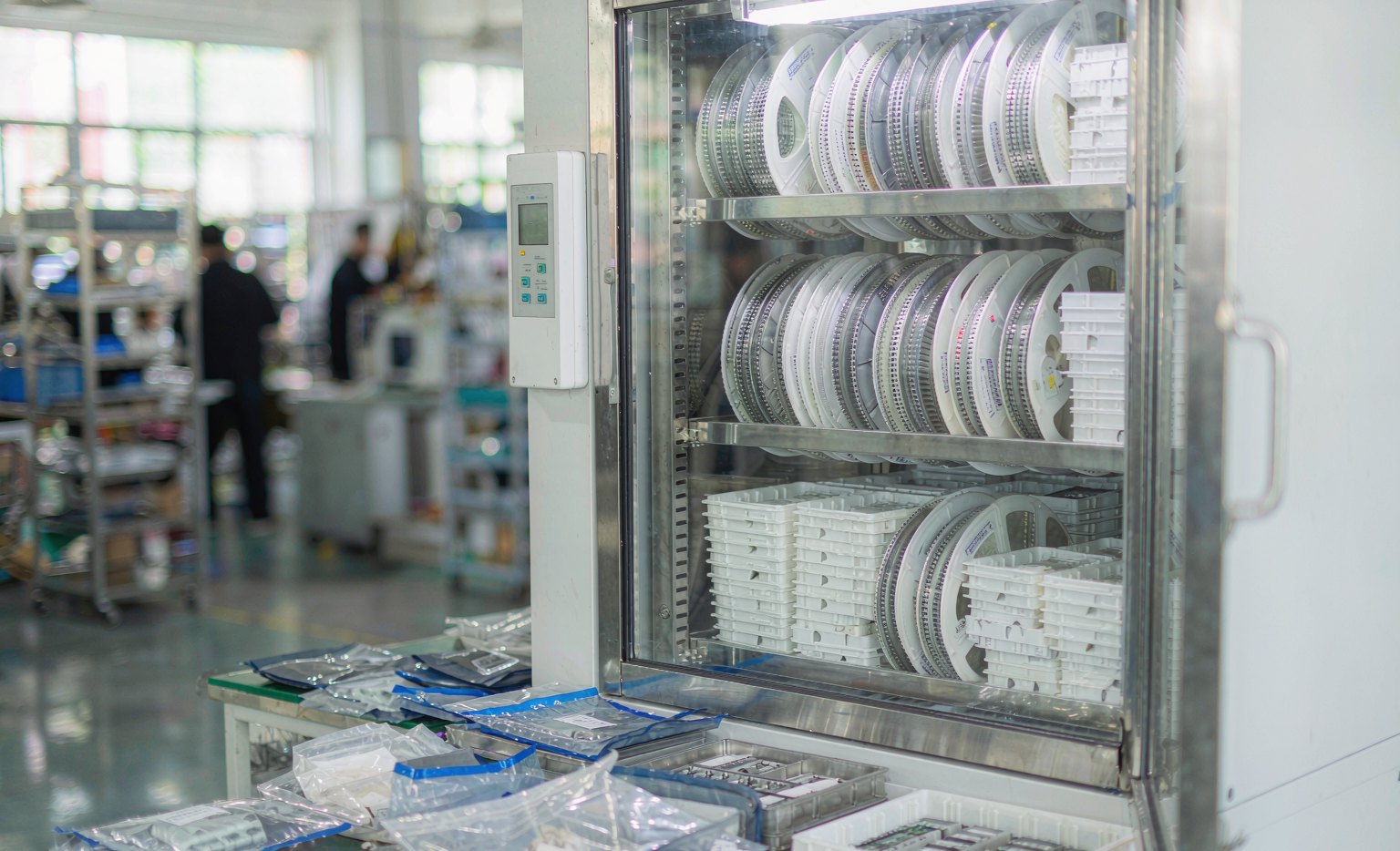
This guide is written for the people who own the inventory but not always the humidity specification: warehouse managers, incoming quality, sourcing and operations. It covers what degrades in storage, how to pick a humidity band per commodity, and what a workable warehouse workflow looks like.
Where Storage Damage Actually Happens
Metal surfaces in air are never dry. Water adsorbs onto oxides in molecular layers, and the number of layers rises steeply with relative humidity. Below roughly 40% RH the film is thin and mostly bound; above 60% RH it becomes thick enough to behave like a solvent, dissolving surface ions and atmospheric contaminants into a conductive, corrosive electrolyte. That is why corrosion and leakage currents accelerate above a humidity threshold rather than in a straight line.
Two details matter for components specifically. Crevices — between a lead and its tape, under a label, inside a connector housing — condense water at lower bulk humidity than an open flat surface, so a cabinet reading 45% RH can still mean a wet interface inside a reel. And contamination: cardboard, foam and some paper labels release chloride and sulfur species that turn a thin water film into an aggressive one. Storing reels in their shipping cartons inside a dry cabinet is a common and expensive mistake.
The chemistry that follows is finish-specific. Tin platings grow an oxide film that flux must dissolve before the alloy can wet; copper grows cuprite; immersion silver tarnishes in the presence of sulfur; OSP coatings hydrolyse. Temperature sets the rate, humidity decides whether the reaction has a medium to run in, and time does the rest.
Three Failure Modes a Warehouse Actually Sees
1. Wetting loss. The part still looks fine. Solderability testing per IPC/JEDEC J-STD-002 shows poor wetting or a wetting force below the acceptance limit, often only on the oldest stock, which shows up as intermittent defects that track reel age rather than any machine parameter.
2. Popcorning and delamination. Plastic packages absorb moisture into the mould compound. At reflow that moisture flashes to steam and the package cracks, delaminates or lifts a die attach. J-STD-020 profiles assume the moisture content set by the part's MSL and by J-STD-033 handling rules; storage above the specified RH invalidates both.
3. Tarnish, dendrites and contact resistance. Silver-plated hardware darkens, OSP-coated boards lose their protective layer, and under bias a humid, contaminated surface can grow dendritic shorts between fine-pitch features. None of this shows up at incoming inspection, which is why it surfaces months later as field returns.
Dry Pack Is a Timer, Not a Room
Moisture-barrier bags with desiccant and a humidity indicator card are excellent protection and a poor storage strategy. The bag gives a defined shelf life — commonly twelve months from the seal date — and that clock only runs while the bag is intact and closed. In a working warehouse, bags are cut open at goods-in, partially consumed and resealed hours later with a desiccant sachet that has already been exposed, while punctures in a pallet stack go unnoticed. The material is nominally dry-packed and practically unprotected.
The correction is not to abandon dry pack, which remains right for untouched inbound stock. Separate the two jobs: the bag protects the part until first opening, and a controlled cabinet protects it from first opening to the line, with the opening date recorded.
Choosing the Storage RH Band
No single setpoint suits a whole warehouse, because the right band depends on what is in the box. The table below maps common inventory types to practical bands; treat them as engineering starting points to confirm against supplier data and the current revision of the relevant standard.
| Inventory type | Storage RH band | What the band protects | Notes |
|---|---|---|---|
| Moisture-sensitive ICs in trays, tubes or reels (MSL 2a–5a) | <5–10% RH | Absorbed moisture that drives popcorning at reflow; also resets floor life | J-STD-033 storage environment; keep parts in original carriers |
| Passives, connectors, stamped terminals (Sn, SnPb, Ni-plated) | 20–30% RH | Thick oxide and hydroxide films that consume flux and slow wetting | Below ~40% RH the film stays thin enough for normal flux activity |
| Immersion silver and OSP-finished bare PCB | <10% RH | Sulfide tarnish on Ag; OSP coating degradation | Sulfur in cardboard and foam is the usual co-conspirator |
| Bare copper, brass and beryllium-copper contacts | 20–30% RH + low sulfur | Cuprite growth and contact-resistance drift | Do not store in corrugated cartons inside the cabinet |
| Solder preforms, wire and flux-coated parts | <10% RH | Moisture pick-up in flux residue and paste-style coatings | Flux chemistry degrades faster than the alloy |
| Obsolete and long-term spares (12 months+) | 10–20% RH | Combined oxidation and MSL risk where re-qualification is impossible | Treat as a controlled vault, not overflow shelving |
RH bands above are indicative engineering guidance based on common industry practice and standard handling documents. They are not manufacturer guarantees; confirm final setpoints with your component suppliers and quality function.
Two rules apply. Take the lowest band present in a cabinet as that cabinet's setpoint, and do not mix commodities that need different bands in one chamber. And remember that a very low setpoint is not automatically better: below about 5% RH, static charging on insulating surfaces becomes a real risk to unprotected devices, a trade-off we examined in ESD at ultra-low humidity.
Dry Cabinet, Nitrogen Cabinet or Nothing at All
Once the band is known, the equipment question is mostly about how the parts are used. Stock picked daily needs a controlled chamber with fast recovery; stock that sits untouched is better served by sealed packaging; oxidation-critical finishes may justify removing oxygen as well as water.
| Approach | Typical achievable condition | Indicative capex* | Indicative running cost* | Best for | Main limitation |
|---|---|---|---|---|---|
| Sealed MBB with desiccant only | <10% RH inside the bag | Very low | Bag + desiccant per pack | Inbound parts, untouched stock | One puncture or daily opening ends protection |
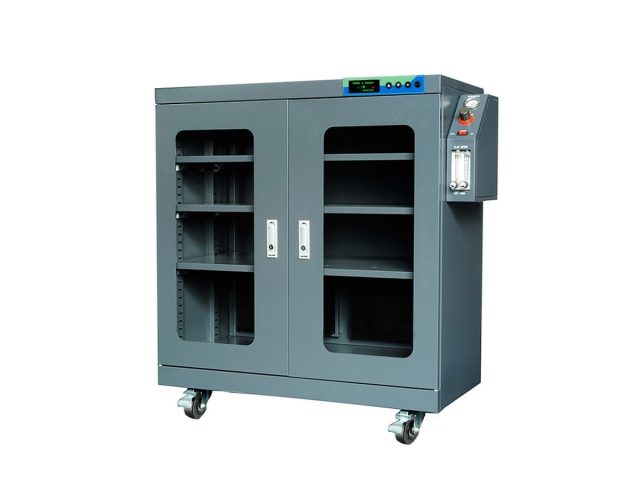
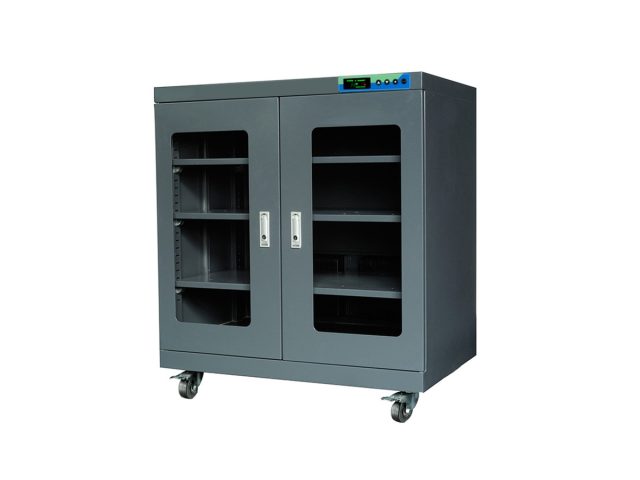
| Desiccant dry cabinet (YSM) | 1–50% RH, setpoint controlled | Low to moderate | Electricity only, a few tens of watts | Daily-picked reels, trays, PCBs | Needs spare capacity; door discipline matters |
| Nitrogen cabinet (YSN) | Low RH plus reduced oxygen | Moderate | Nitrogen consumption dominates | Oxidation-critical finishes, Ag, bare Cu | Gas supply, regulator and leak discipline |
| VCI bags or emitters | No RH control; vapour-phase protection | Low | Consumable per pack | Ferrous spares, machined parts | Not a humidity solution; film compatibility issues |
| Conditioned warehouse (HVAC) | 30–55% RH for the whole room | High | High, driven by air volume | Bulk non-critical stock | Cannot reach MSD bands; energy scales with room size |
*Cost columns are indicative assumptions for relative comparison only, based on typical site economics; they are not quotations and vary with local energy and gas prices, cabinet size and duty cycle.
The practical distinction is what you are trying to stop. A desiccant dry cabinet removes water, which is enough for most MSD and solderability work. A nitrogen cabinet also displaces oxygen, which matters for bare copper, silver and alloy surfaces where oxide growth continues slowly even in fairly dry air.
Sizing a Storage Cell Without Guessing
Sizing fails in both directions: undersized cabinets get propped open, which destroys the setpoint for everything inside, and oversized ones sit half empty while dehumidifying air. Start from physical counts, not litres.
- Count by carrier, not part number. A 7-inch reel, a matrix tray stack and a tube magazine occupy very different volumes.
- Use a working capacity. A 1430 L cabinet with five shelf levels holds on the order of 150–250 7-inch reels depending on diameter and tray mix, but plan to fill 70–80% so there is room to load and pick.
- Add the door-open duty. A cabinet opened forty times a shift recovers more slowly than one opened twice, so either add capacity or split fast-pick from bulk stock.
- Keep one cabinet per value stream. Central vaults look efficient on paper and cost more in handling, misplacement and open-door time than they save.
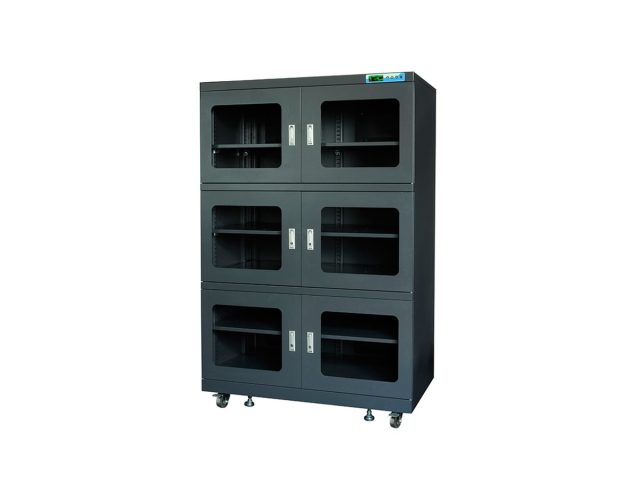
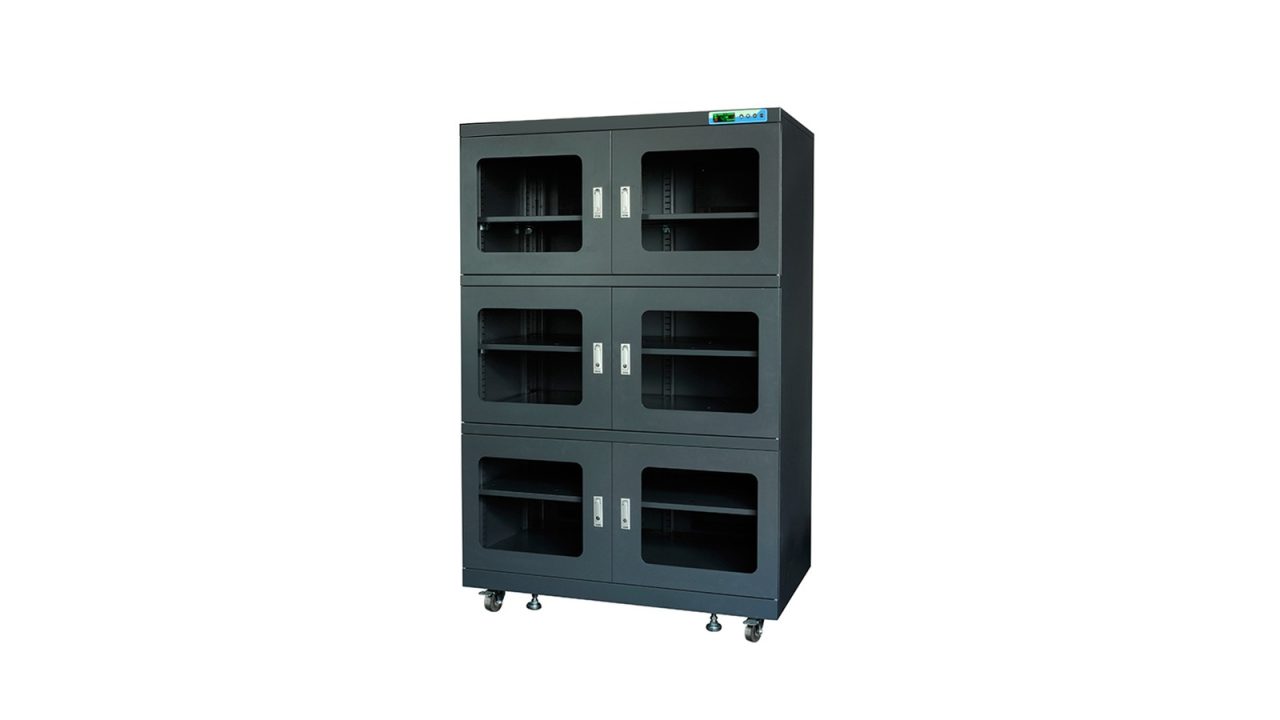
For reference, YanSyn's YSM 1430-6 moisture-proof cabinet is the size most warehouses land on for a central cell, while a YSN 450 nitrogen cabinet covers the oxidation-critical subset in the same footprint logic.
A Six-Step Warehouse Workflow
- Classify at goods-in. Assign every receipt a storage class — MSD band, finish type, shelf-life sensitivity — from supplier data and your commodity matrix, and label the carrier, not just the carton.
- Record the clock. Log seal date, bag-opening date and MSL. A part without a date is a part without a floor life, and auditors know it.
- Move opened material the same shift. Do not stage opened bags on a bench "until tomorrow", which is where most of the damage happens.
- Respect the setpoint. Close the door. Do not use the cabinet as a shelf for tools, documents or coffee, and do not store corrugated cartons inside.
- Pick oldest first, and prove it. FIFO by receipt date, with the date visible on the carrier, is the cheapest solderability insurance available.
- Bake or verify before the line. Where floor life is exceeded or records are missing, follow the J-STD-033 bake schedule rather than hoping, and requalify suspect lots. Our IPC/JEDEC floor-life cheat sheet condenses the decision rules for operators.
What to Audit Every Quarter
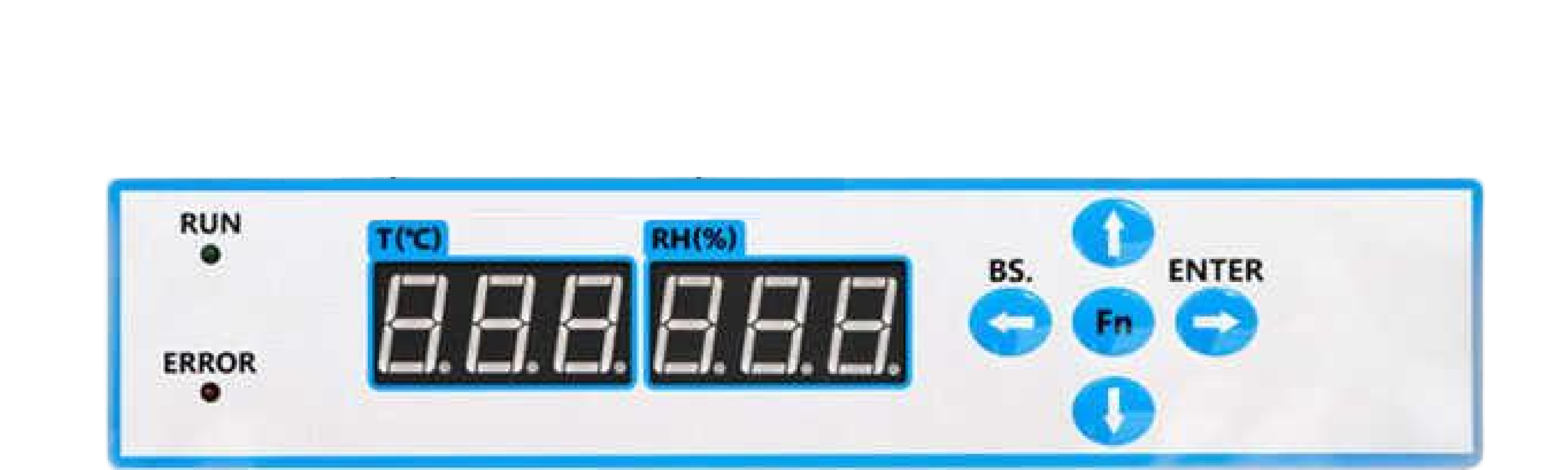
A humidity specification that is not audited decays into a number on a screen. Read the cabinet's logged data rather than the instantaneous display, and confirm the setpoint held through weekends and shutdowns. Verify the sensor against a reference at least annually — drift is normal, and a two-point error is enough to move a compliant cabinet out of band, as described in our guide to RH display accuracy. Sample the oldest stock in each commodity class for solderability. Then walk the floor and look for the tells: bags with fresh tape and no desiccant, cartons inside cabinets, doors that do not seal, reels stored on top of the cabinet.
Frequently Asked Questions
Does a dry cabinet reset the floor life clock?
Desiccation can extend or reset floor life, and J-STD-033 defines the conditions and multipliers — generally a very low RH environment held for a defined multiple of the floor life, with documentation. It is not automatic and not unlimited: the current revision of the standard, your MSL and your records govern. Treat "we put it in the cabinet" as the start of the evidence, not the end of it.
Is 40% RH good enough for a component warehouse?
For mechanical spares, tooling and general hardware, yes — 40% RH or below is far better than an uncontrolled room. For moisture-sensitive devices it misses the <10% RH storage requirement, and for silver or bare copper it is too humid to stop tarnish.
If I control humidity, do I still need nitrogen?
Only if oxygen itself is the problem. Nitrogen cabinets earn their cost on bare copper, silver finishes, alloy powders and parts where even slow oxide growth changes contact resistance or wetting. For packaged ICs and passives, dry air is sufficient.
Can reels and bare PCBs share one cabinet?
If the setpoint suits both — usually the lower of the two bands, around 5–10% RH. Keep boards in their own sealed bag or slot, keep cardboard out, and expect the cabinet to work harder because laminate releases moisture slowly after each opening.
What about cold deliveries in winter?
Let sealed material reach room temperature before opening. A cold bag carried into a warm, humid room condenses water on the film's inside, and that water lands on the parts the moment the bag is cut.
The Takeaway
Solderability is purchased twice: once from the supplier, and again from your storage environment every month the part sits on a shelf. The controls are not exotic — a defined RH band per commodity, a cabinet that holds its setpoint, dates on carriers, FIFO and an annual calibration — but they have to be assigned to someone. Warehouses that do this find oxidation in a quarterly sample instead of at reflow.
If you are sizing a storage cell or deciding between desiccant and nitrogen for a mixed inventory, send us your commodity list, carrier counts and target bands. YanSyn can map them to YSM dry cabinets from 100 L to 1430 L, or to YSN nitrogen cabinets where oxygen is the real constraint.
Talk to a YanSyn storage engineer about your warehouse layout →