PID Temperature Control Explained: What It Does and Does Not Guarantee in an Industrial Oven
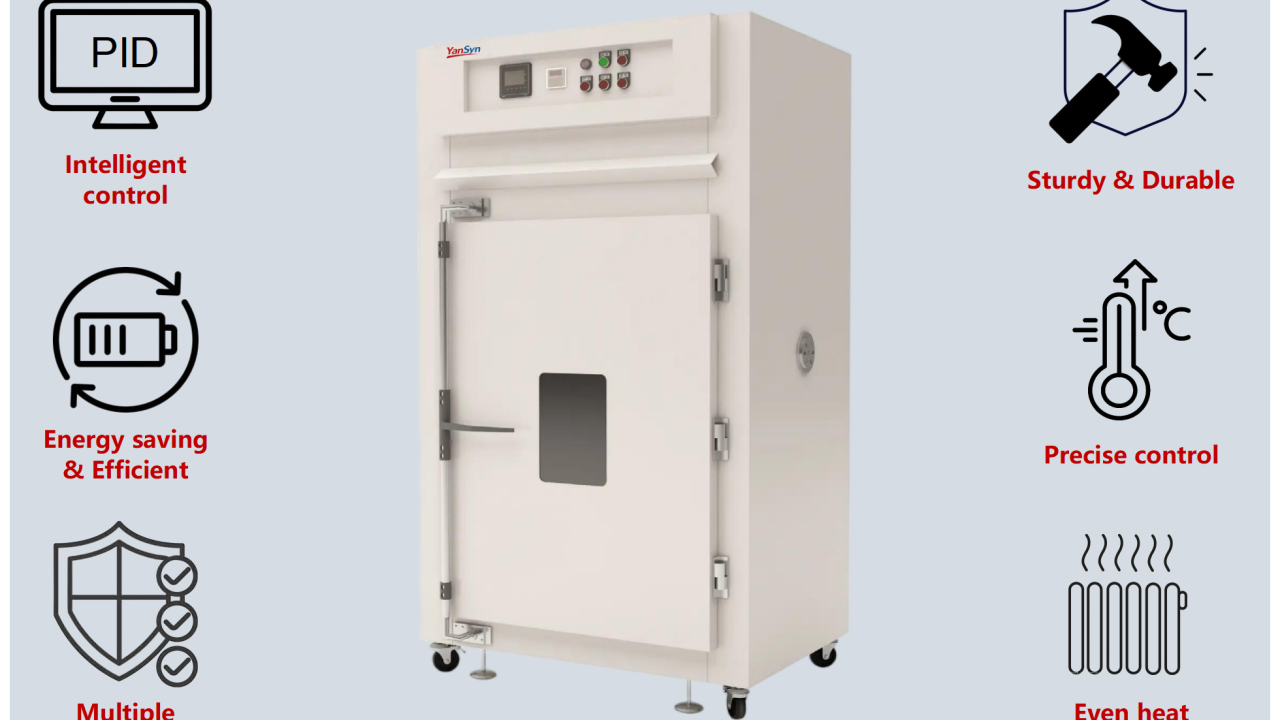
In most industrial oven purchase decisions, the comparison starts and ends with temperature range and chamber uniformity. Both matter, but neither tells you how the oven behaves between setpoint changes, how it recovers after a door opening, or how repeatable tomorrow’s batch will be. Those behaviors are decided by the temperature control strategy — and in any serious industrial oven today, that strategy is a PID loop.
This article explains what PID control actually does, why a simple on/off thermostat cannot deliver the same stability, and how to verify controller behavior with a data logger before you sign off on a purchase.
The Three Terms in a PID Loop
PID stands for Proportional, Integral, Derivative. At every control cycle the controller computes the gap between the measured temperature and the setpoint (the error) and adjusts heater power accordingly:
- Proportional (P) reacts to the size of the current error. Close to the setpoint, heater power tapers off instead of running flat out. A narrow proportional band responds quickly but invites oscillation; a wide band is stable but slow to close the final degrees.
- Integral (I) accumulates small, persistent errors over time and eliminates the steady-state droop that proportional-only control leaves behind — the classic symptom of an oven that settles a few degrees below setpoint under load.
- Derivative (D) watches the rate of change and backs the heater off early as the temperature climbs toward the setpoint, which suppresses overshoot. It is the most sensitive term to sensor noise, so cheap or poorly seated thermocouples can make D act against you.
The controller output typically drives the heaters through a solid-state relay (SSR) at a resolution of seconds. That fast, proportional modulation — rather than a coarse on/off decision — is the whole point of the architecture.
Why an On/Off Thermostat Is Not Enough
The simplest controller strategy is bang-bang: heater fully on below the setpoint, fully off above it. In a small, lightly loaded chamber this can look acceptable, but the oscillation amplitude is dictated by thermal lag, not by the dial. When the heater de-energizes, the walls and the air stream are still hotter than the displayed value, and the product keeps absorbing that stored energy. In practice an on/off oven commonly swings several degrees around the setpoint and overshoots noticeably on start-up (indicative assumption; the actual amplitude depends on heater sizing, chamber mass and airflow).
For simple preheating or non-critical drying that may be fine. But for curing coatings and adhesives, baking moisture-sensitive components after a pre-bake, or any process where a brief excursion past the setpoint degrades the part, bang-bang control costs you yield and repeatability. Mechanical contactors switching several times per minute also wear out, and their failure mode — welded closed — is the worst possible one for an oven.
How Tuning and Autotune Work
PID parameters interact, which is why "just tighten the proportional band" is not a tuning method. Modern industrial controllers ship with an autotune routine: it deliberately perturbs the chamber, measures the response, and estimates P, I and D for the specific thermal system — chamber volume, heater power, airflow and load. Two practical rules follow:
- Autotune with a representative load. A loop tuned empty will overshoot when you load twelve aluminum trays of parts, because the thermal dynamics changed. Run autotune with the trays, fixtures and typical product mass you will actually process.
- Retune after any significant change. New product family, different rack layout, added fixture mass, or a heater group change all justify a fresh autotune cycle. Tuning is not a one-time event.
Equally important is where the control thermocouple sits. A sensor placed in the return-air stream can produce a beautifully stable display while the product itself wanders. The control sensor should represent the thermal environment of the product — and process validation should measure the product, not just the display.
Controller Stability Is Not Chamber Uniformity
These two specifications are often confused, and vendors are not always in a hurry to clarify. Control stability describes how tightly the loop holds temperature over time at a given point — for example, ±0.5°C after settling. Chamber uniformity describes the spread between the coldest and hottest measured positions across the working volume at a steady state — for example ±2°C, which is the specification we publish for the YSHG series (with ±1°C available as an option).
A PID loop can be rock-stable at the control sensor while the corners of a loaded chamber drift several degrees away. Uniformity is determined by airflow design, heater placement, insulation and how you load the shelves — it is verified by a spatial survey, not by watching the display. We covered that survey method, survey-point placement and what a ±2°C uniformity guarantee actually means in a separate article: Oven Temperature Uniformity: Mapping, Survey Points and What ±2°C Really Guarantees. Ask for both numbers and for the measurement method behind each.
Hardware That Makes or Breaks the Loop
The algorithm is only as good as the hardware around it:
- SSR versus mechanical relay. A solid-state relay can modulate once per second or faster without arcing; a mechanical contactor needs long cycle times, which effectively degrades the proportional action back toward on/off behavior. For a PID oven, SSR drive is the sensible baseline.
- Thermocouple type and seating. Type K is the common default; what matters more is that the probe is fully seated in the air stream it is meant to represent and that extension wiring is correct. A loose probe turns the derivative term into an amplifier of contact noise.
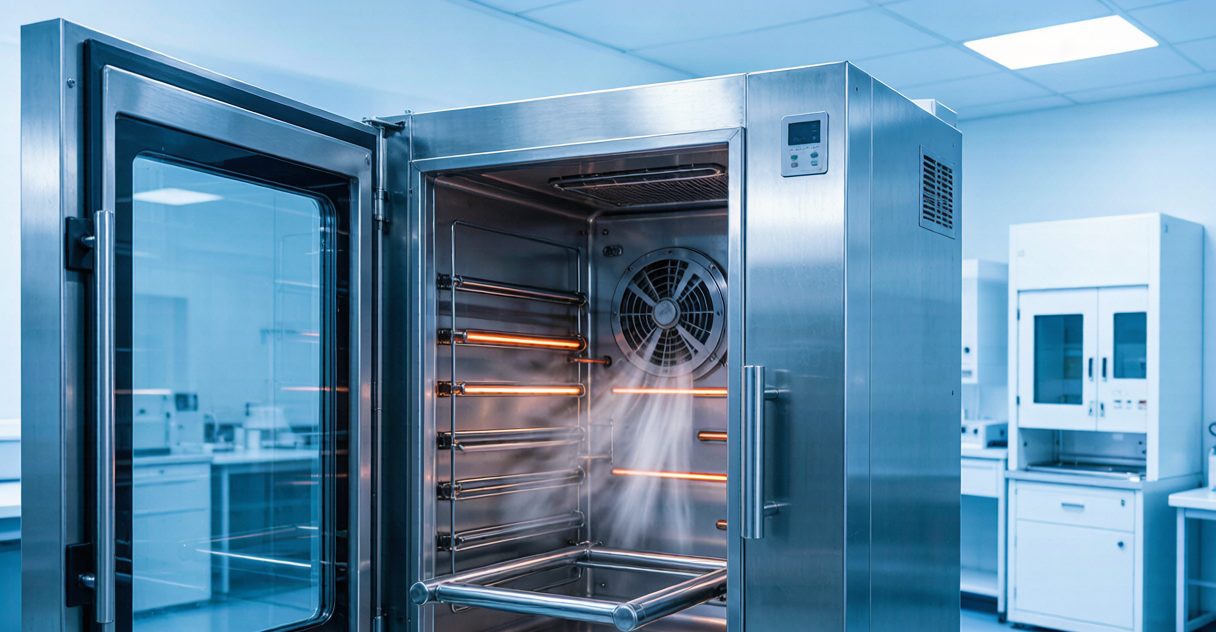
- Forced-air circulation. The loop controls what it measures; uniform convection makes the measured point meaningful for the whole chamber. Dead zones and stratification destabilize any controller. The differences between forced-circulation and vacuum drying are compared in Hot-Air Circulation vs Vacuum Oven: Drying Mechanisms Compared.
- Heater sizing. An oversized heater shortens ramp time but narrows the usable proportional band and makes the loop harder to tune without overshoot. Right-sized heating is a control decision, not only a power decision.
Control Strategies Compared
The table below summarizes what changes when you move from a basic thermostat to a tuned PID loop with SSR drive. Numeric values are indicative assumptions for a mid-size forced-air industrial oven — they illustrate typical behavior, not vendor-guaranteed figures, and every real chamber should be verified by test.
| Aspect | On/off thermostat | PID, factory defaults | PID + autotune + SSR drive |
|---|---|---|---|
| Oscillation at setpoint | Several °C swing, load-dependent (indicative) | Reduced, but often with droop under load | Fraction of a degree after settling (indicative, verify by test) |
| Overshoot on ramp | Large; stored heat keeps pushing past setpoint | Depends on tuning quality and load | Small; derivative term and tuning tailored to the load |
| Cycle time to stable soak | Longest; oscillation takes time to damp | Faster, but default parameters may not suit your load | Fastest and most repeatable across products |
| Heater-switching hardware | Mechanical contactor, audible, wears with cycling | SSR recommended for full benefit | SSR drive at fast cycle rate, minimal wear |
| Best suited for | Preheating, non-critical drying | General process work after a proper retune | Curing, pre-bake, moisture-sensitive and yield-critical processes |
A Five-Step Verification Workflow Before Sign-Off
Whether you are qualifying a new oven or auditing an installed one, the loop can be verified in an afternoon with a portable data logger. The indicative acceptance figures below are starting points — tighten or relax them to match your process specification.
- Ramp test, empty chamber. Command a ramp to a mid-range setpoint (for example 150°C) and log at 1 s resolution. Note the overshoot above setpoint and the time to first stabilize. A tuned PID should settle without a large excursion (indicative acceptance: overshoot within a few degrees, per your process).
- Soak stability test. Hold the setpoint for at least 60 minutes and compute the peak-to-peak variation at a fixed reference point. This is your stability number, and it is the one to compare against the controller specification.
- Loaded test. Repeat the soak with your real trays, fixtures and product mass. Loaded dynamics are what the loop must actually handle; this is also the right moment to run the controller’s autotune if parameters were never fitted to the load.
- Door-recovery test. Open the door for 30 seconds at steady state and log the recovery curve. Note the dip depth and the time to return to the stability band — this predicts how the oven behaves in a real production rhythm.
- Repeatability across cycles. Run the ramp-and-soak sequence three times and overlay the curves. Consistent curves are the evidence that the process will be repeatable tomorrow, not just today.
Note what this workflow does not cover: the spatial spread across the working volume. That is a uniformity survey with a multi-point grid, as described in the uniformity article linked above. Stability and uniformity together, plus build quality, define an oven you can validate against a customer requirement.
Frequently Asked Questions
1. My oven overshoots by several degrees on start-up. Is the PID broken?
Usually not. The most common causes are a loop tuned empty then run loaded, an oversized heater, or autotune never having been run at all. Run autotune with a representative load and re-test before suspecting hardware.
2. Can PID control be retrofitted to an older on/off oven?
Often yes, by replacing the controller and switching the heater switching to an SSR rated for the load. Check the thermocouple condition and seating at the same time — a retrofit inherits whatever the sensor quality allows.
3. Does PID matter at low temperatures, below 100°C?
It matters more, not less. The absolute error margin is small, ambient draft influence is proportionally larger, and the tuning must be finer. Many drying processes for electronics and coatings live exactly in this range.
4. How often should the loop be retuned?
After any significant change in load mass, fixture layout or heater configuration, and whenever the verification workflow shows overshoot or slow damping that was not present before. There is no fixed calendar interval; verify, and retune when the data says so.
5. What is the difference between ±1°C stability and ±1°C uniformity?
Stability is time-domain at one point; uniformity is space-domain across the chamber. A vendor quoting only one of the two is telling you half the story — ask for both, and for the test method.
Conclusion: Buy on Verified Behavior, Not Algorithm Names
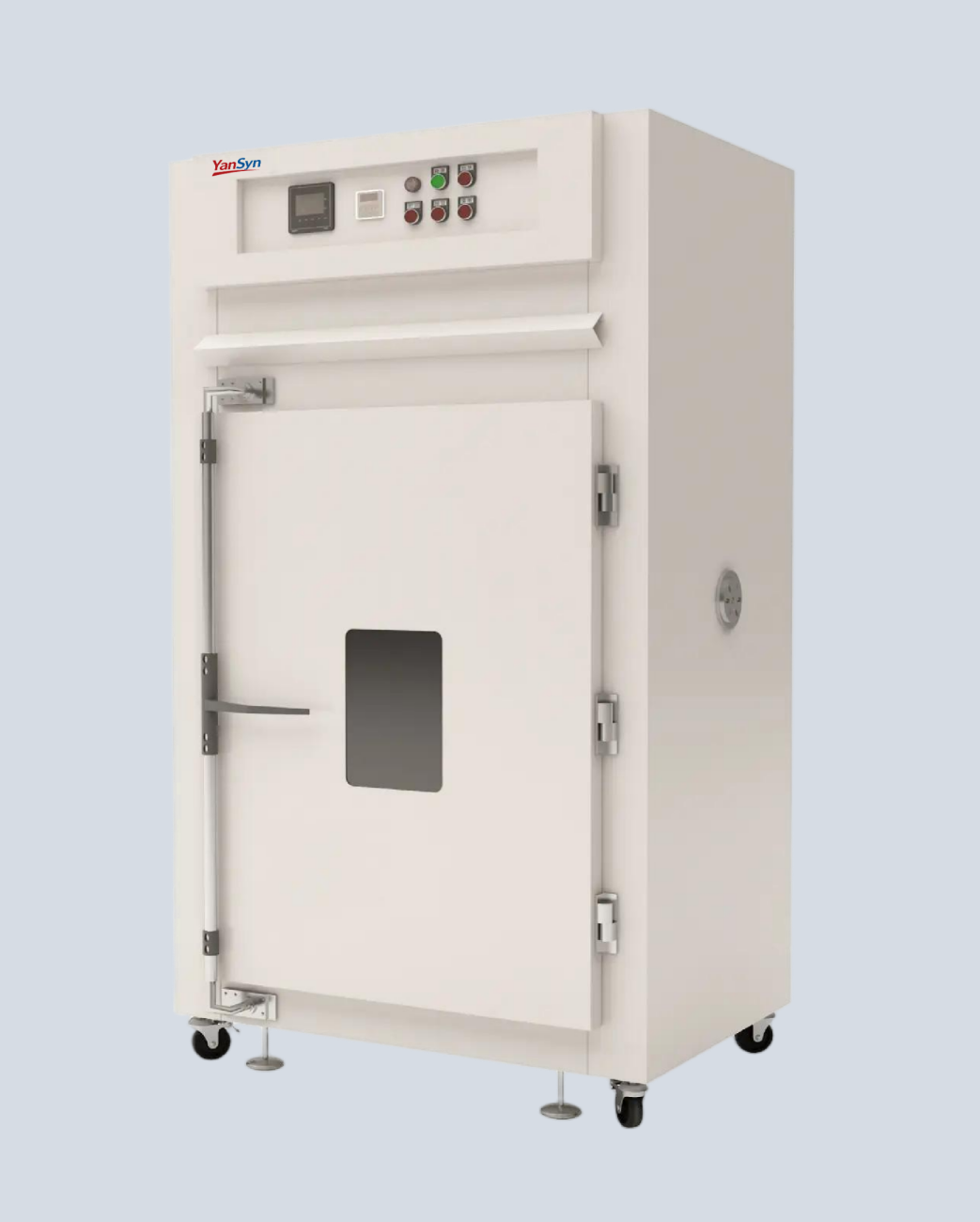
"PID" on a datasheet is a starting point, not a guarantee. What protects your process is a properly sized loop, SSR heater drive, a well-seated control sensor, and a documented verification test — ramp, soak, loaded, door recovery, repeat. Combined with a surveyed chamber uniformity of ±2°C (±1°C optional) and a working range from ambient to 500°C, the YSHG industrial drying ovens are built around exactly these controllable, verifiable behaviors, with PID control and optional Class 100 cleanroom, nitrogen-purge and IoT monitoring configurations.
If you need help matching an oven configuration to your process specification, contact the YanSyn team with your temperature range, load profile and uniformity requirement, and we will propose a configuration with the verification data to back it up.