Photoresist Ages in the Bottle: Temperature, Humidity and Shelf-Life Control in the Lithography Bay
Photoresist is one of the few materials on a fab floor that behaves like a perishable grocery. It ships with a manufacturing date, a recommended storage envelope and a shelf life, and it degrades quietly the whole time it sits in the bay. There is no alarm. Sensitivity drifts a few percent, contrast softens, residue appears after develop — and one morning a lot that processed perfectly last week starts throwing scumming defects nobody can explain.
Most fabs blame the resist supplier first. In practice, a large share of these mysteries trace back to how the bottles were stored between delivery and point of use: a loading dock in summer heat, a cabinet next to a heat source, a cold bottle opened immediately in a humid room, a working bottle left uncapped overnight at the coater.
This article covers why photoresist ages, the three storage variables that decide its real shelf life — temperature, humidity and airborne molecular contamination — how the storage options compare, and a seven-step workflow you can implement with existing equipment.
Why Photoresist Has an Expiry Date
A photoresist is a formulated system: a photosensitive component (photoacid generator or photoinitiator), a base resin, solvents, and small amounts of additives that control coating behavior. Every one of these can move over time, and they move for different reasons.
- Solvent loss. Every bottle opening lets solvent vapor escape; viscosity creeps up and spin-coated film thickness changes at the same program.
- Photoactive component aging. Photoacid generators and photoinitiators degrade thermally and photochemically; heat and stray light accelerate it.
- Moisture uptake. Some chemistries react slowly with water entering through headspace or a loose cap, shifting sensitivity.
- Amine contamination. Chemically amplified resists are sensitive to airborne amines, which neutralize generated acid and show up as T-topping and footing.
None of these mechanisms waits politely for the printed expiration date. The date assumes the storage envelope on the datasheet is actually respected. If your storage reality is warmer, more humid or chemically dirtier than the datasheet assumption, the effective shelf life is shorter. As an indicative assumption used in yield discussions, a resist stored 10°C above its recommended envelope can lose usable life several times faster than one stored correctly — the exact factor depends on the chemistry, so treat it as a planning caution, not a specification.
Three Storage Variables: Temperature, Humidity, Airborne Contamination
Temperature is the primary lever. Most i-line and KrF resists specify storage somewhere in the range of roughly 5–25°C, away from sunlight and heat sources (always confirm the exact envelope on your datasheet). Chemistries that demand 2–8°C need a dedicated refrigerator — never a shared lab fridge, and never one with a defrost cycle that repeatedly warms the product.
Humidity matters in two places. Inside a sealed bottle, RH has little direct effect — the formulation is already a liquid equilibrium. Where it bites is around the bottle: condensation on cold surfaces, moisture uptake by substrates and trays, and the room the bottle equilibrates in. A stable moderate RH beats one swinging between 30% and 70% with the seasons.
Airborne molecular contamination is the variable nobody priced until chemically amplified resists arrived. Amines from adjacent processes, outgassing shelf liners, even certain plasticizers can poison a resist before it is dispensed. CA resists belong away from amine sources, in closed cabinets rather than open shelving.
The Condensation Trap: When a Cold Bottle Meets a Warm Room
Here is a failure mode that has nothing to do with the resist chemistry and everything to do with physics. A bottle stored at 5°C is moved into a litho bay at 23°C and 50% RH. The contents stay cold for hours — a full 500 mL bottle can take several hours to equilibrate (an indicative planning figure; verify with a probe thermometer). Moisture condenses on the bottle, the cap threads, and later on the dispense nozzle that touches it.
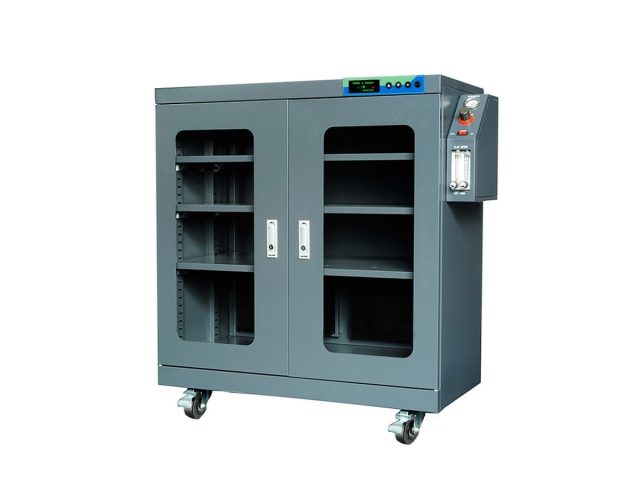
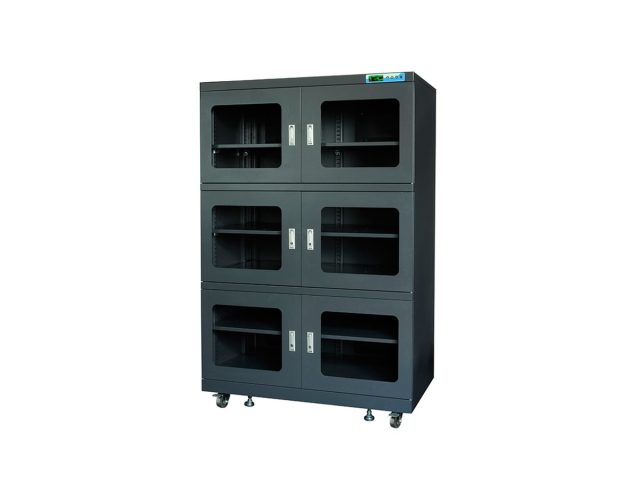
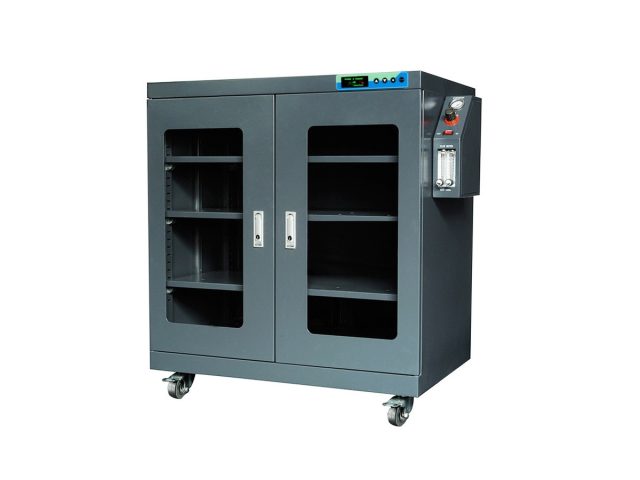
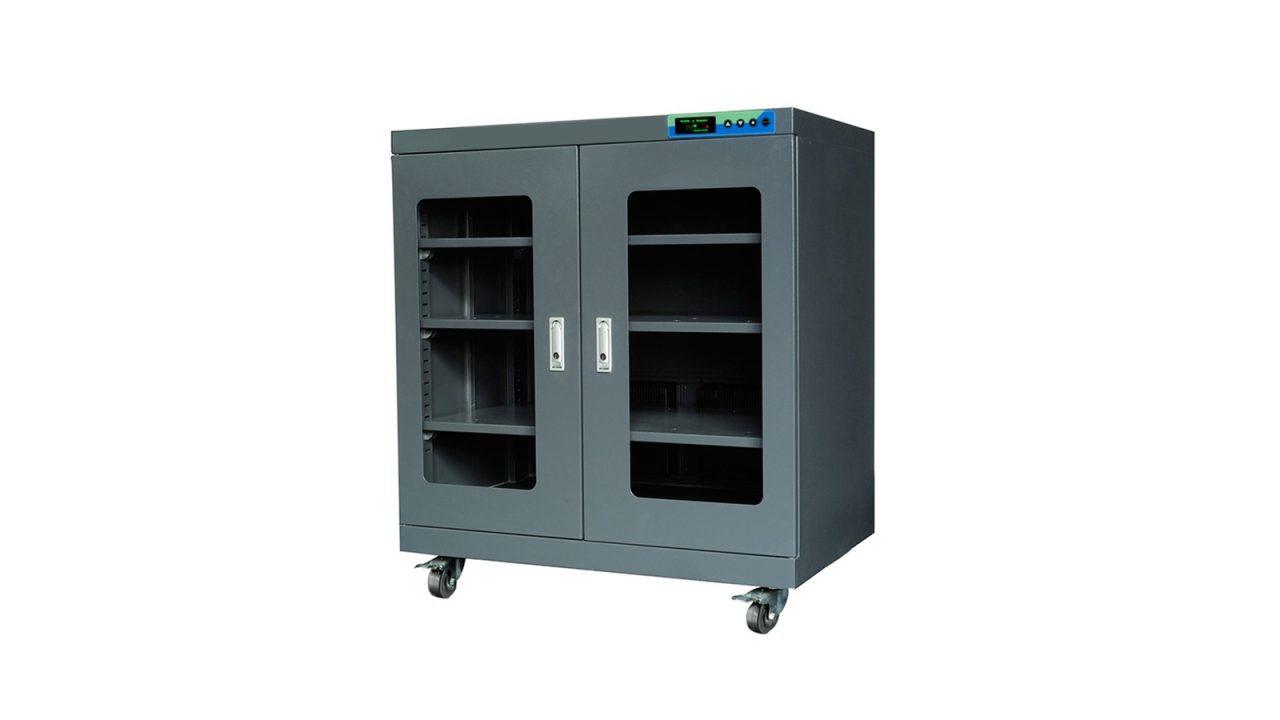
Condensation water is not just a wet label. It can wick into cap threads, dilute the first dispenses, and — most expensively — transfer onto substrates. The countermeasure costs nothing: let bottles equilibrate sealed, inside a humidity-controlled cabinet, before opening. A desiccant dry cabinet such as the YSM 450 moisture-proof cabinet is a practical equilibration and staging location: it holds temperature stable (±1°C class around ambient) and suppresses the RH that drives condensation.
One honest boundary: a PTC-heated dry cabinet is not a refrigerator. It stabilizes temperature around ambient and controls humidity precisely; it does not pull a bottle down to 2–8°C. If your datasheet demands cold storage, the architecture is refrigerator for sealed reserve stock, dry cabinet for equilibration and working bottles, and a logged warm-up step between the two.
Storage Options Compared
The table below compares the storage options most litho bays actually choose between. RH and temperature figures are indicative planning values — confirm your chemistry’s datasheet before assigning a storage class.
| Storage option | Typical RH capability | Temperature behavior | Best suited for | Watch-outs |
|---|---|---|---|---|
| Open shelf / fume hood | Ambient (uncontrolled) | Follows room swings | Same-day consumables only | No protection from heat, humidity swings or amines |
| Dedicated refrigerator (2–8°C) | Ambient, condensation risk on removal | Actively cooled | Chemistries specifying cold storage | Warm-up logging mandatory; condensation on cold surfaces |
| Desiccant dry cabinet (e.g. YSM) | 1–60% RH selectable by grade | Stable around ambient (±1°C class) | Working bottles, equilibration, substrates, trays | Not a substitute for a refrigerator |
| Nitrogen-purge cabinet (e.g. YSN) | <1–5% RH with low O₂ | Stable around ambient | Oxygen- and amine-sensitive materials, long-hold items | Consumes N₂; door discipline still required |
| Walk-in dry room | Whole-room low RH | HVAC controlled | High-throughput coater supply | Capital-intensive; discipline leaks at every doorway |
For a mid-size bay the practical pattern is simple: sealed reserve stock in the refrigerator (if the datasheet says so), everything in active rotation in a dry cabinet or nitrogen cabinet by chemistry group, and a written warm-up step bridging the two. Where a material is genuinely oxygen-sensitive, a nitrogen cabinet protects it; where the enemy is only moisture, a desiccant cabinet does the same job without gas consumption.
Bake Steps Are Part of the Same Chain
Storage discipline ends at the hotplate, and the oven takes over. Soft bake drives off excess solvent; post-exposure bake completes the chemical amplification; hard bake improves adhesion and etch resistance. Each is a controlled thermal process, and its reproducibility matters exactly as much as your storage envelope — a perfectly stored resist baked on an oven with poor uniformity produces the same mysterious lot-to-lot drift you were trying to eliminate.
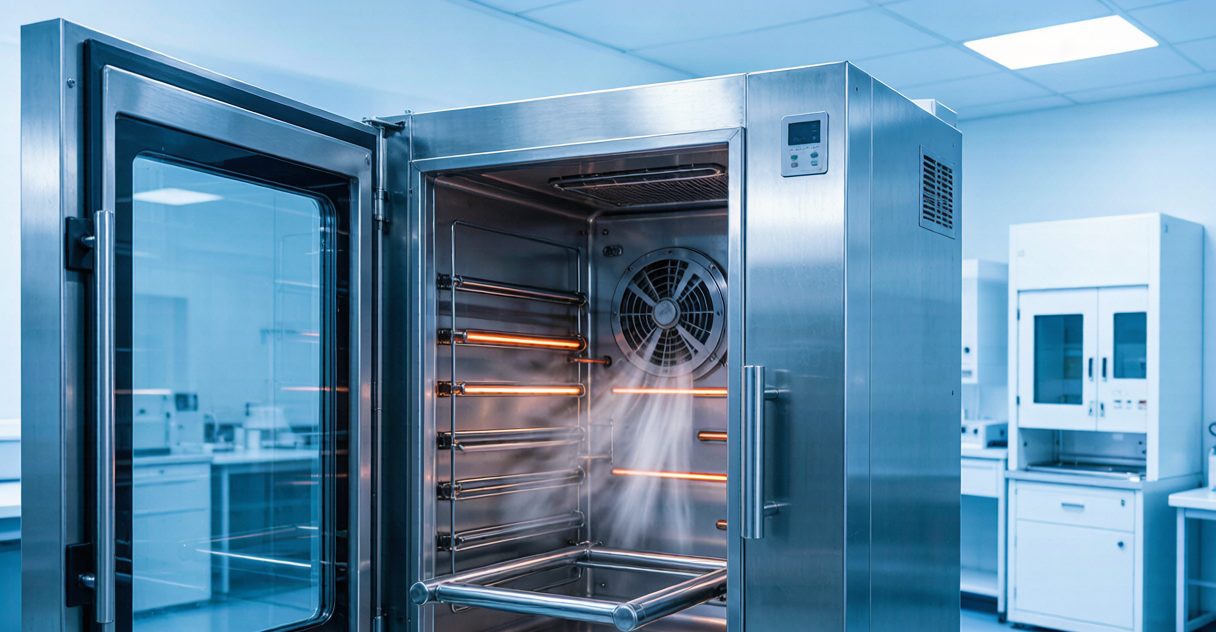
This is where a forced-air industrial oven earns its place next to the litho line. A unit such as the YSHG 620A holds chamber uniformity at ≤±2°C (±1°C optional) with PID control from room temperature to 500°C, with Class 100 filtration, nitrogen atmosphere and IoT monitoring as options — the same discipline you apply to the bottle, extended to the bake. The control mechanics behind this are covered in our article on PID control and what it does and does not guarantee.
The link is bidirectional: moisture absorbed by a substrate during long storage outgasses violently during bake, causing film defects. Substrates coming out of long storage deserve the same low-humidity staging as your working bottles.
A Seven-Step Storage Workflow for the Litho Bay
- Receive and log. Record manufacturing date, lot, shelf life and the datasheet storage envelope the moment the box opens. Flag anything that spent unknown time on a summer dock.
- Equilibrate sealed. Cold stock goes into the dry cabinet, capped, for the full warm-up period before anything is opened. Log in-time and open-time on the bottle tag.
- Assign by chemistry. CA resists away from amine sources and in closed cabinets; oxygen-sensitive materials in nitrogen storage; the rest in low-humidity dry cabinets.
- Monitor daily. One glance at cabinet temperature and RH, recorded with alarm thresholds. Sensor drift is real — see our article on RH sensor accuracy and calibration.
- Rotate FIFO by lot. Physical first-in-first-out, not spreadsheet FIFO: oldest lot at the front, at grab height, date facing out.
- Issue with a warm-up trail. Every bottle leaving cold storage carries a warm-up record; every opened working bottle gets an opened date. Cumulative warm hours decide retirement.
- Disposition at end of life. Expired stock does not silently migrate to R&D. Log it, quarantine it, and decide deliberately: extend with documented test data, or discard.
Steps 1–3 are a one-time design decision; steps 4–6 are a habit; step 7 separates a controlled bay from a warehouse with opinions. The same staging logic applies to any moisture-sensitive process material — the MSD baking and floor-life logic follows the identical structure.
Troubleshooting: When Drift Appears, Check Storage First
Before opening a supplier complaint, spend one hour on this table. It lists the storage causes behind the five most common resist symptoms.
| Symptom | Likely storage cause | First check | Countermeasure |
|---|---|---|---|
| CD drift on the same lot over weeks | Cumulative warm time exceeded; solvent loss | Bottle open/close log; storage temperature record | Tighten FIFO and warm-up logging; split working bottles |
| Scumming / undeveloped residue | Amine contamination or over-aged PAG | Storage near amine sources; shelf liner material | Move to closed cabinet; request fresh lot for A/B test |
| T-topping / footing | Airborne amine exposure before or after coat | Open shelving vs closed storage; bay air quality | Closed low-humidity storage; review nearby chemistries |
| Defect spike (particles, blobs) | Condensation on cold bottles or substrates | Refrigerator-to-bay warm-up step; bottle surfaces | Sealed equilibration in dry cabinet before opening |
| Viscosity change, skinning | Repeated open/close; cap left loose | Working bottle age and cap condition | Smaller working bottles; nitrogen blanket for sensitive systems |
Frequently Asked Questions
Can I store sealed photoresist bottles in a 1% RH dry cabinet?
You can, and it prevents condensation, but sealed bottles gain little from ultra-low RH — temperature stability protects them. The cabinet earns its keep after the bottle is opened, and for substrates, trays and working containers that genuinely absorb moisture.
Is a refrigerator always required?
No. Follow the datasheet. Many i-line and KrF resists accept roughly 5–25°C; chemistries that specify 2–8°C need a real refrigerator. What is never optional is stability: swings are worse than a moderately elevated but steady value (indicative rule of thumb, not a spec).
Does nitrogen storage extend photoresist life?
Only for systems with an oxidation sensitivity; nitrogen does not stop thermal aging or amine poisoning, and it does not replace temperature control. Choose nitrogen because the chemistry demands low oxygen, not as a general preservative.
How long can a working bottle stay at the coater?
As an indicative assumption, many bays retire a working bottle after a fixed cumulative open-time budget (days to weeks depending on chemistry) regardless of remaining volume. Set the budget from your own defect data, then enforce it with the opened-date tag.
How do I prove my storage is actually stable?
Place independent data loggers beside the bottles for at least a week, including a door-opening simulation, and compare against the cabinet display. Seasonal extremes deserve a second mapping round. If the two disagree, calibrate before trusting either.
Conclusion
Photoresist shelf life is not a date on a label — it is the integral of every hour the bottle spent outside its envelope. Temperature stability, controlled humidity, closed storage away from amines, a written warm-up step and reproducible bakes cost almost nothing compared with a single chase of a mysterious defect, and they compound: each discipline removes one more variable from a process that has too many already.
YanSyn builds the dry cabinets, nitrogen cabinets and industrial ovens that hold this envelope in place — YSM moisture-proof cabinets for equilibration and working stock, YSN nitrogen cabinets for oxygen-sensitive materials, and YSHG industrial ovens for bake steps with ≤±2°C uniformity. If you are mapping a litho bay storage upgrade, or want help sizing cabinets against your throughput, contact our team for a specification discussion.