Setpoint Is Not Part Temperature: Thermocouples, Thermal Mass and Soak Time in a Drying Oven
An operator sets an oven to 150 C, watches the controller settle on 150 C, and pulls the tray an hour later expecting a fully cured part. The part is at 122 C. Nobody lied: the controller reported the temperature at its own sensor, accurately, for the whole hour. The gap between that number and the temperature inside the product is the single most common source of "the oven worked but the batch failed" investigations.
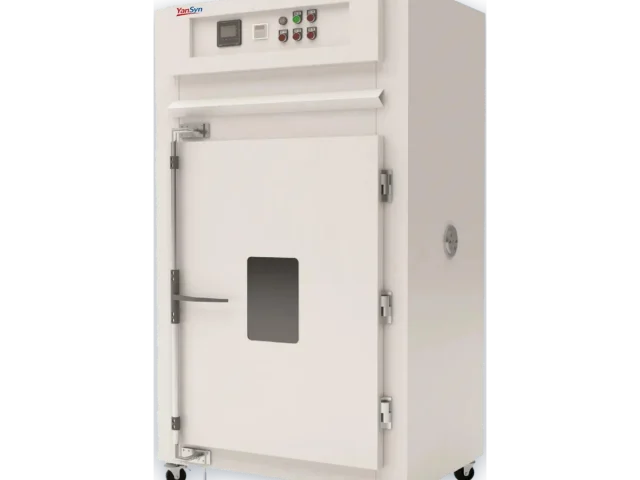
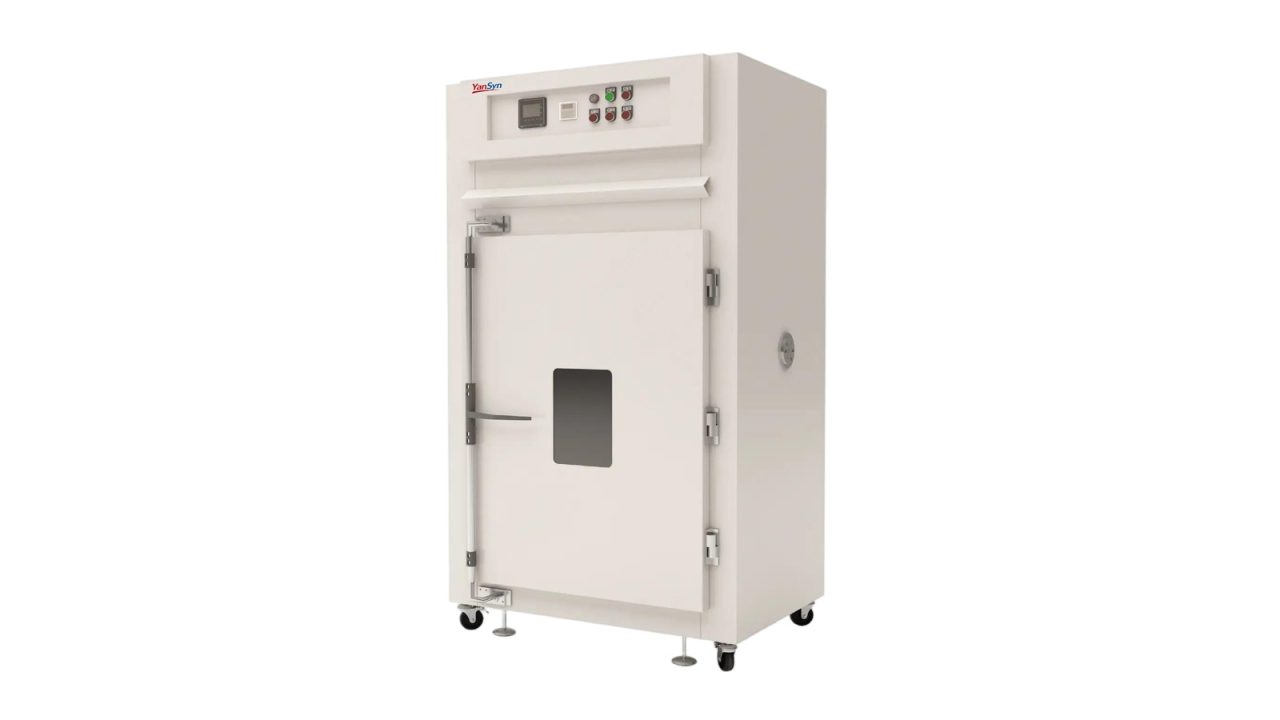
Closing the gap is not a matter of buying a more accurate controller. It is a measurement problem: you have to know which temperature you are controlling, where the sensor sits, how fast the load can absorb heat, and when the part has actually caught up. This article walks through those four questions for a forced-air industrial drying oven such as the YanSyn YSHG series.
Three Temperatures, Not One
It helps to name the three quantities that get collapsed into the word "temperature". The setpoint is a number in the controller. The chamber air temperature is what the control thermocouple measures near the recirculation path. The part temperature is the value inside the slowest-heating point of the actual load. In a well-tuned empty oven the first two can sit within a degree of each other while the third lags by tens of degrees for most of the cycle.
PID tuning, the subject of a separate article, only governs how tightly the controller holds its own sensor at the setpoint. A perfectly tuned loop holds the wrong number just as faithfully as the right one. Uniformity mapping answers a different question, how even the air is across the chamber; our note on uniformity survey points covers that. Neither tells you when the part is done.
Where the Thermocouple Lives Changes the Answer
Control sensors are normally mounted in the airflow, close to the recirculation outlet, because that gives the loop a fast, stable signal. That is exactly the wrong place to infer part temperature. Air near the outlet responds within seconds to a heater duty change; a dense load responds over minutes. The controller therefore sees the oven reach temperature long before the product does, and starts the clock early.
For validation you need a second, independent measurement: a thermocouple attached to or embedded in a representative part, or placed in a dummy part with the same mass and geometry. Attach it with high-temperature tape or a small mechanical clamp, keep the junction in firm contact, and avoid routing the lead along a hot wall where it will pick up radiant heat. A bead hanging in air next to the tray measures air, not product. Use the smallest practical bead so the sensor itself does not dominate the thermal mass of a small component.
Thermal Mass: Why the Load Lags the Air
Heating rate is a balance. The heater and blower deliver energy; the load absorbs it in proportion to its mass and specific heat, while the chamber loses some to the walls and exhaust. An empty oven has almost no thermal mass, so it ramps quickly and recovery after a door opening is short. Fill it with steel fixtures, ceramic substrates or a dense reel of connectors and the same heater now serves a heat sink many times larger. Ramp rate falls and the air-to-part gap widens.
Load geometry matters as much as mass. A single thick block heats from the outside in; its core can trail its surface by a wide margin. A shallow, well-spaced tray lets forced air wash both faces and narrows that gradient. This is why a profile validated on three trays cannot simply be transferred to a full trolley without re-measurement. For a useful mental model, assume the heating time of a given part scales roughly with its thickness rather than its total batch size when airflow is not blocked.
Soak Time Is Measured, Not Guessed
Soak time is the interval the slowest part must stay within the process band, counted from the moment that part enters the band, not from the moment the setpoint is reached. That distinction is the whole point. A recipe that says "150 C for 60 minutes" is ambiguous unless everyone agrees whether the clock starts at setpoint or at part temperature.
Measure it once per load configuration: run a trial with the part thermocouple connected, log at a sensible interval, and mark two timestamps on the curve, when the part first reaches the lower process limit and when the required exposure ends. The difference is the real soak. Keep the resulting loading rule next to the oven, because the next shift will inherit the trays even if they inherit nothing else.
The table below is an indicative assumption to illustrate the shape of a profile, not a guarantee of any YanSyn oven or any specific process. Ramp rates and hold times must be established from your own part measurements and material data.
| Stage | Air setpoint | Part state | What ends the stage |
|---|---|---|---|
| Ramp | Room to 150 C at max rate | Part trails air; gradient across thickness | Part thermocouple reaches lower process limit |
| Soak, core | 150 C hold | Slowest core point still climbing | Core holds within band for the specified dwell |
| Equalise | 150 C hold | Surface and core converge | Spread between part points falls below the target |
| Cool | Controlled or natural | Part above storage limit | Part reaches handling temperature |
Indicative profile stages for a thermal process. Values and dwell times are assumptions for illustration only.
A Practical Workflow for a Loaded Oven
The following sequence is deliberately boring. It is the shortest path from a setpoint you trust to a part temperature you can defend.
1. Define the process band. Write down the lower and upper part temperature limits and the required dwell, from the material supplier or your own qualification data. Without a band there is nothing to measure against.
2. Pick the worst-case part. Choose the heaviest, thickest or most shielded item in the load, and place a thermocouple at its slowest point. Include a second point near a tray edge if gradients matter.
3. Load the real pattern. Use the same trays, fixtures and shelf spacing as production, including any trolley or inner door. A validation on an empty chamber is a different oven.
4. Run and log. Record part temperature, chamber air temperature and time together. Many ovens, including the YSHG620A and smaller YSHG030A, offer data logging so the run can be reviewed instead of remembered.
5. Set the soak from the curve. Start the dwell clock at the part threshold, not at setpoint, and write the resulting ramp and hold into the work instruction.
6. Re-check on change. Repeat the profile when tray geometry, load mass, shelf count or door seal changes. Treat the curve as a controlled document.
What a Uniformity Spec Does and Does Not Tell You
A chamber quoted at ±2 C, or ±1 C where specified, describes spatial variation of air temperature at survey points with a defined load. It says nothing about how quickly that air transfers heat into your product, and it is measured under a survey condition you may not be running. A tight uniformity number is necessary for repeatable processing but not sufficient to conclude that two differently loaded batches received the same thermal dose.
The same applies to the controller display. Repeatability of the sensor, not its absolute accuracy, is what keeps a loop stable; a sensor can be reliably wrong by a few degrees. If the setpoint and a calibrated reference disagree, verify the sensor before re-tuning the loop. Treat every number on the panel as a measurement with a traceable uncertainty, not as truth.
FAQ
Why does my oven reach setpoint so fast when empty but slowly when loaded? Because an empty chamber has little thermal mass to absorb heat. The heater size is unchanged, so adding mass reduces the ramp rate and increases the air-to-part lag.
Can I just raise the setpoint to make the part heat faster? You can shorten the ramp, but the air near the product may then exceed the upper process limit before the core catches up. Raising setpoint trades one defect mode for another; validate the whole band.
Where should the validation thermocouple go? At the slowest-heating point of a representative part, in firm thermal contact. An air bead beside the tray measures air, not product.
How often should a thermal profile be repeated? At qualification, after any change to load, trays, fixtures or seals, and on a sensible audit interval agreed with your quality system.
Does data logging replace profiling? No. Logging records what happened; profiling establishes what the part needs. You need both, and the log is only useful once the soak criterion is defined.
Conclusion
The controller setpoint is the beginning of a thermal process, not the end of it. Between the two sits a measurement chain: a control sensor in the airflow, a load with its own mass and geometry, and a part temperature that crosses the process band on its own schedule. Name the three temperatures, attach a sensor to the worst-case part, and start the dwell clock when that part actually enters the band. That converts a hopeful hour at 150 C into a process you can reproduce and audit.
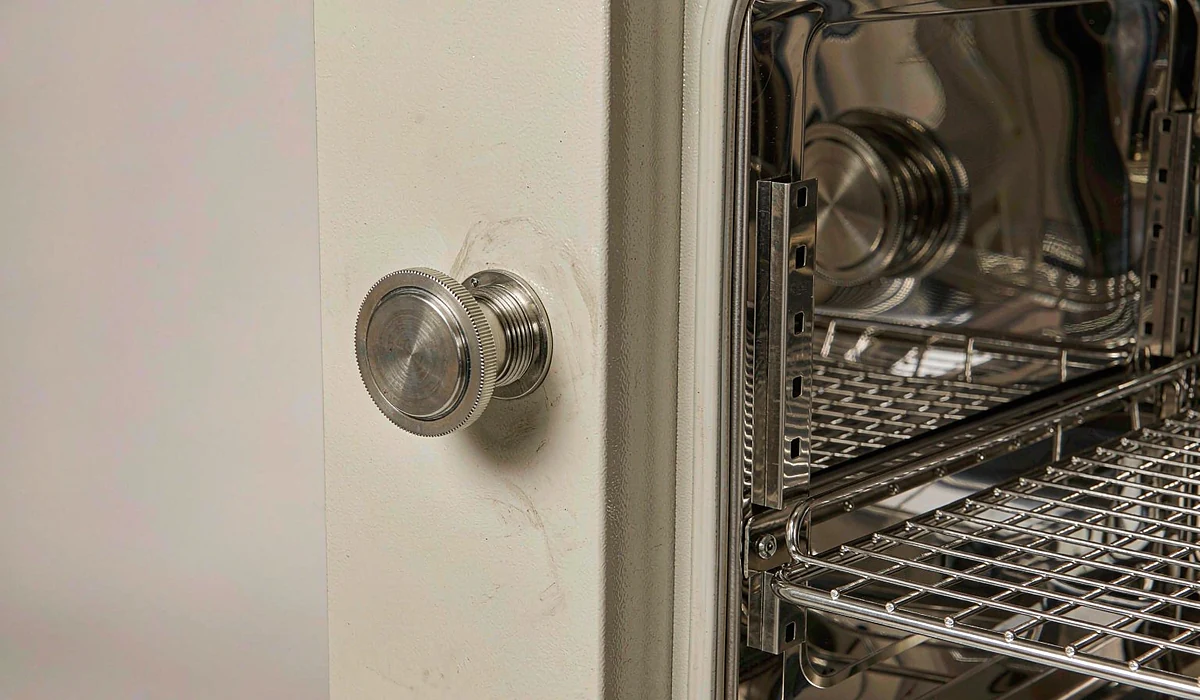
YanSyn builds the hardware around that discipline: the YSHG series of forced-air industrial drying ovens offers PID temperature control, stainless steel chambers, adjustable shelves and a 25 mm test port for validation thermocouples, with optional data logging and nitrogen or clean-room configurations. Tell us the load and the process band and we will help you choose the cabinet and the profiling points.
Ready to turn a setpoint into a qualified process? Send our engineers your load drawing and thermal requirement and we will come back with a recommended profile to test.
Related reading: Oven temperature uniformity and survey points, and PID temperature control explained.