Automotive ECU & Sensor Storage: A Moisture Control Guide
A modern vehicle depends on dozens of electronic control units, a growing population of ADAS sensors, and kilometre-scale wiring harnesses. Every one of those parts has to survive fifteen years of vibration, thermal cycling, road salt and humidity. Automotive quality targets are unforgiving: a single field failure can trigger a recall, and a recall costs far more than the component that caused it.
What is easy to miss is that a meaningful share of automotive electronic failures is decided long before the vehicle is built. It is decided in the store, in the goods-in area, and on the shelf where bare boards, ICs and connectors wait for the SMT line. Moisture absorbed during storage does its damage later — during reflow, during damp-heat operation, or slowly, through corrosion that takes months to show up as an intermittent fault.
This guide looks at how moisture damages automotive electronics, what the relevant standards actually ask for, how to set a storage humidity target, and how to choose between a dry cabinet and a nitrogen cabinet for automotive parts.
What moisture actually does to automotive electronics
Corrosion and electrochemical migration
When humidity sits above roughly 60% RH, a thin adsorbed water film forms on every surface — lead frames, pad finishes, connector plating. Add ionic residues from flux or handling and you have an electrolyte. Under bias, metal migrates from anode to cathode and grows dendrites. In a consumer device that produces a nuisance failure; in a braking or steering ECU it is a safety problem. Corrosion also attacks the nickel-palladium-gold and tin finishes that are supposed to guarantee solderability, so the same moisture that creates dendrites also degrades the joint you are about to form.
Popcorning and delamination at reflow
Plastic-encapsulated ICs absorb moisture from ambient air. During reflow, that moisture turns to steam in seconds. The expansion can crack the package from the inside — the classic popcorn effect — or separate the moulding compound from the die pad, leaving a void that later becomes a thermal or electrical problem. The failure is invisible on the line and expensive in the field. We covered the baking curves and profile choices in detail in The Popcorn Effect Deep-Dive: MSD Baking Curves That Save Yield.

Sensor drift and connector oxidation
Not every moisture effect is catastrophic. Some are quietly expensive. MEMS inertial sensors, humidity sensors and optical modules can drift out of calibration when stored damp, which shows up as end-of-line test failures or, worse, as units that pass test and drift in service. Connector contacts oxidise, contact resistance rises, and the harness fault that appears two years later traces back to a shelf, not a design.
What the standards require
Automotive electronics storage sits at the intersection of several documents. None of them prescribe a single humidity number, but together they define what "controlled storage" has to demonstrate.
| Standard | What it covers | What it means for storage |
|---|---|---|
| AEC-Q100 | Stress-test qualification for integrated circuits | Qualification assumes parts were handled inside MSL floor life. Storage must not silently consume it. |
| AEC-Q200 | Passive component qualification, including humidity bias testing | Passives corrode and drift too. Resistor networks and MLCCs need the same humidity discipline as ICs. |
| ISO 16750-4 | Climatic loads, including damp-heat exposure | The product is tested for humidity resistance — but that is a design test, not a licence to store parts damp. |
| IPC/JEDEC J-STD-033 | Handling, packing, shipping and use of moisture-sensitive devices | Defines MSL, floor life, dry packing and baking. This is the document your dry storage policy should reference directly. |
| IATF 16949 | Quality management and traceability for automotive production | Auditors will ask for evidence: logged humidity, alarm history, and defined action when limits are exceeded. |
Choosing a humidity target for automotive parts
The practical question is not "how dry can we go" but "how dry does this part need to be". Two constraints pull against each other: MSD floor life argues for very low RH, while electrostatic discharge risk rises as RH falls. The following targets are a working starting point — always confirm against the component datasheet and your own process rules.
| Stored item | Suggested RH | Why |
|---|---|---|
| MSD ICs, MSL 2–3 | ≤ 10% RH | Pauses floor-life countdown per J-STD-033 and removes the need for re-baking before reflow. |
| MSL 4–6, thin packages | ≤ 5% RH | Shorter floor life leaves less margin; lower RH buys back schedule flexibility. |
| Bare PCBs, laminates | ≤ 10% RH | Limits absorbed moisture before reflow and reduces delamination risk on thick boards. |
| Connectors, plated terminals | ≤ 20% RH | Slows oxidation of plating without driving ESD risk unnecessarily low. |
| Camera modules, optical sensors | 20–40% RH | Fungus and condensation control matters more than ultra-low RH; some adhesives and coatings dislike extreme dryness. |
Note the trade-off: below roughly 10% RH, static generation rises sharply, so ionisers, grounding and ESD-safe handling are not optional. We examined that side of the problem in ESD & Humidity protection at low RH. If you are setting targets from scratch, the framework in How to Choose the Humidity for an Electronic Dry Cabinet walks through the same decision in more depth.
Dry cabinet or nitrogen cabinet?
Both approaches remove water, but they solve different problems. A desiccant-based dry cabinet controls relative humidity. A nitrogen cabinet displaces air, so it controls oxygen as well as humidity. For automotive parts the choice usually comes down to whether oxidation or moisture absorption is the dominant risk.
| Factor | YSM dry cabinet | YSN nitrogen cabinet |
|---|---|---|
| Controls | Relative humidity, roughly 1–50% RH depending on model | Relative humidity and oxygen concentration via dry N₂ purge |
| Best for | MSD floor-life control, PCB storage, general automotive electronics | Oxidation-sensitive parts: bare copper, silver-plated surfaces, precision contacts |
| Standards fit | IPC/JEDEC J-STD-033 dry storage | Anti-oxidation storage where RH alone is not enough |
| Running cost | Electricity for the dehumidifying host and regeneration | Electricity plus nitrogen consumption, which depends on purge rate and door-opening habits |
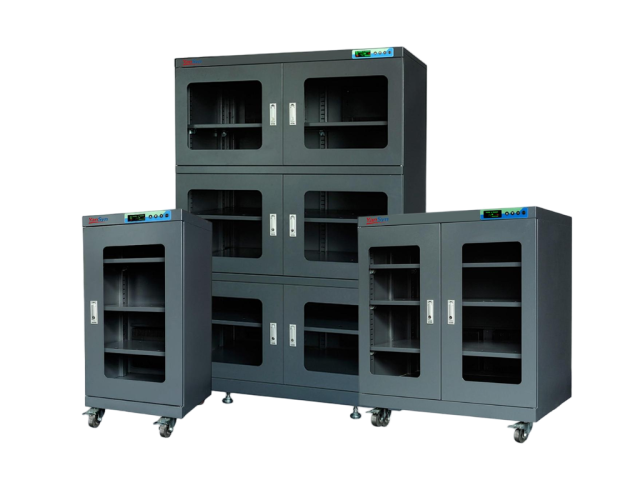
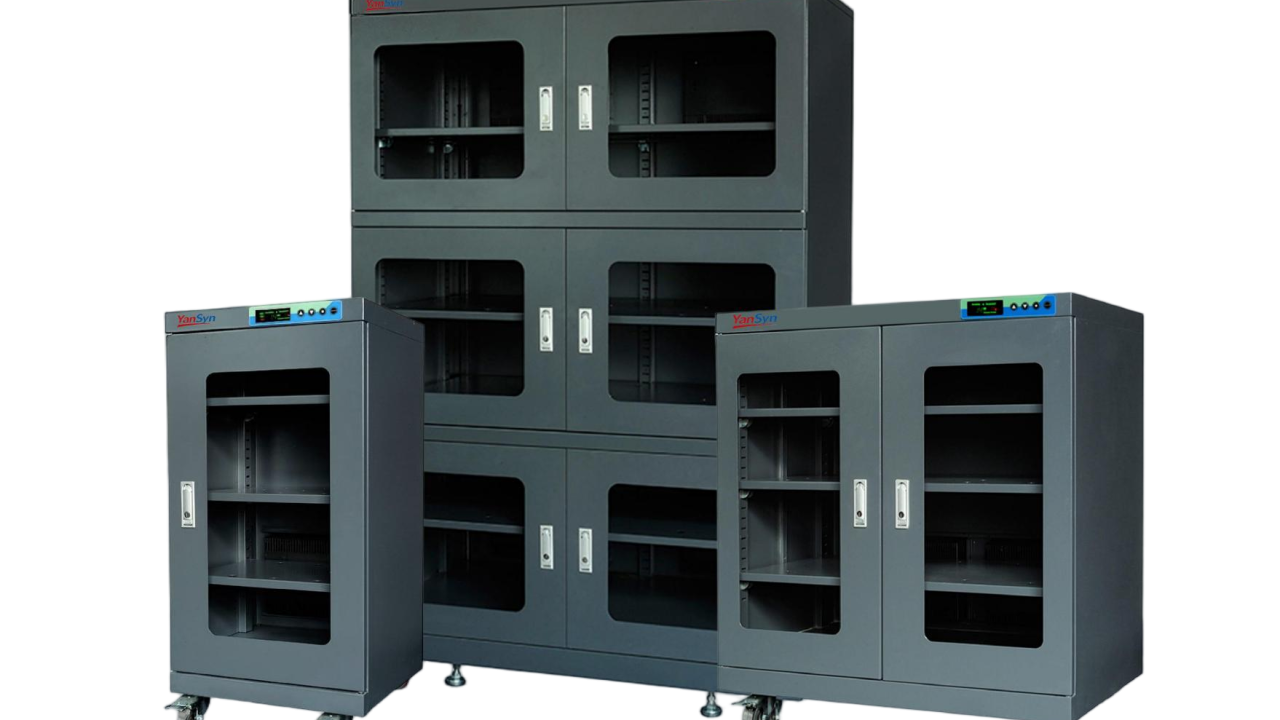
Two honest caveats on cost. Nitrogen consumption figures quoted in any comparison — including ours — are indicative assumptions based on illustrative purge rates and door-opening frequency, not measured performance at your site. Replace them with your own metered data before making a purchasing decision. And if a part only needs humidity control, paying for oxygen control is money spent on a problem you do not have. Our YSM series moisture-proof cabinet covers most automotive storage cases; the YSN series nitrogen cabinet is the answer when oxidation is the failure mode you are chasing.
A practical workflow from goods-in to the SMT line
- Classify at goods-in. Identify MSL for every moisture-sensitive part and label the reel or tray. If a supplier ships without MSL marking, treat it as sensitive until proven otherwise.
- Store by target, not by convenience. Give each class of part its own cabinet or its own zone, set to the RH its datasheet or your process rule requires.
- Log, do not trust. Record RH continuously and keep the alarm history. IATF 16949 auditors ask for evidence, and a cabinet with a data log turns a subjective argument into a fact.
- Track floor life. Dry storage pauses the J-STD-033 floor-life clock; time on the bench does not. The clock resumes the moment parts leave controlled storage, so exposure time must be recorded.
- Bake when the rules say bake. If parts exceed floor life or a bag is opened and left out, follow the baking table in J-STD-033 for that MSL and package thickness rather than improvising. A YSHG series industrial oven with PID control and uniform chamber temperature is the tool for the job.
The underlying MSD rules are explained in MSD Management: Why IPC/JEDEC J-STD-033D Matters.
Frequently asked questions
Is 10% RH dry enough for automotive ECUs?
For most moisture-sensitive semiconductors and bare boards, yes — 10% RH or below pauses floor-life accumulation under J-STD-033. The exception is thin, high-MSL packages, where 5% RH or lower gives useful margin. Always check the datasheet first.
Do I need a nitrogen cabinet for automotive electronics?
Only when oxidation, not moisture absorption, is the dominant failure mode. Nitrogen makes sense for bare copper, silver-plated contacts and parts stored for long periods before assembly. For standard MSD control, a desiccant dry cabinet is usually sufficient and cheaper to run.
Can very dry storage damage components?
Two risks worth managing. Static generation rises as RH falls, so ESD controls are mandatory below about 10% RH. Some materials — certain adhesives, coatings and optical assemblies — are specified with a lower humidity bound, so check before putting everything into the driest cabinet you own.
How long can parts stay in a dry cabinet?
There is no fixed limit in J-STD-033 for storage inside a qualified dry cabinet; the standard is written around floor life after removal. In practice, set an internal maximum storage age for review and keep the humidity log as supporting evidence.
What should we log for an IATF 16949 audit?
At minimum: cabinet identification, the RH set point and actual readings over time, alarm events and the action taken, MSL classification of stored parts, floor-life exposure records, and any baking performed with its profile.
Where to start
Moisture damage in automotive electronics is decided on the shelf, not in the vehicle. The sequence is simple: classify parts by moisture sensitivity, set a humidity target per class, store to that target with logging, and bake only when the standard says so. Doing those four things consistently removes a whole category of latent field failures — and gives you the documentation trail that automotive customers and auditors expect.
If you are unsure which storage class your parts belong in, or whether humidity control alone is enough, talk to us about your line. Request a storage assessment for your automotive components.