Rare-Earth Magnets Don't Forgive Humidity: Nitrogen Storage for NdFeB and SmCo Components
Sintered rare-earth magnets have become the quiet backbone of modern manufacturing. Traction motors for electric vehicles, servo motors in robotics, wind turbine generators, hard disk drives voice-coil actuators, sensors and loudspeakers — all of them depend on neodymium-iron-boron (NdFeB) magnets that deliver their flux density in a fraction of the volume of ferrite alternatives. Yet from a materials standpoint, NdFeB is one of the most corrosion-vulnerable engineering components a factory handles. The gap between a magnet that performs for twenty years and one that rusts in a warehouse aisle is usually not the magnet itself — it is the humidity of the air around it between plating, storage and final assembly.
Most corrosion failures traced back to production do not happen in the field. They start during storage: magnets stacked in open tote boxes overnight, waiting for assembly in a room where relative humidity drifts with the weather. This article explains the corrosion mechanism, what storage environment different magnet types actually need, and a practical workflow for magnet and magnet-assembly producers.
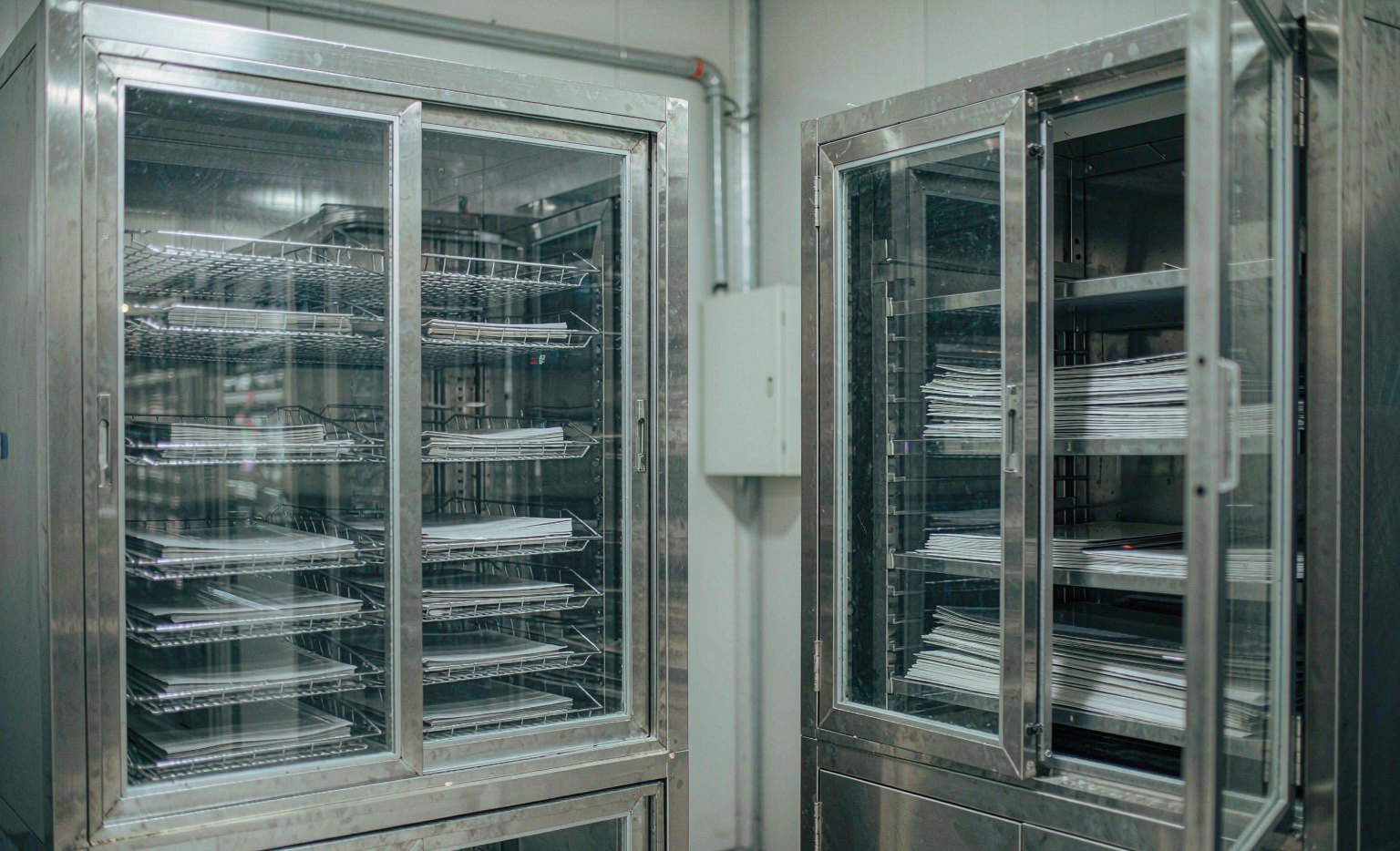
Why Humidity Attacks Sintered NdFeB from the Inside Out
NdFeB is made by powder metallurgy: tiny magnetically aligned grains are sintered and then tempered. The resulting microstructure is a composite of hard magnetic grains surrounded by a neodymium-rich grain-boundary phase — and that phase is the problem. Neodymium is highly reactive, far more anodic than iron, so moisture sitting on the surface drives rapid galvanic corrosion along the grain boundaries. Instead of forming a protective oxide like aluminium or stainless steel, the material corrodes preferentially along its internal skeleton: a small surface defect can migrate into intergranular attack, causing swelling, powdering and eventually structural cracking of the magnet.
This is why the industry plates almost every sintered NdFeB part — commonly with a nickel-copper-nickel stack (typically in the 10–20 µm range, indicative assumption), sometimes with epoxy or phosphate conversion layers on top. But coatings on this substrate are difficult: the intergranular phase can be attacked by aggressive plating chemistry (and hydrogen absorbed during electroplating must be baked out afterwards), and any pinhole or edge defect in the coating becomes a direct path to the reactive phase underneath. A magnet that looks perfect out of the plating line can still corrode if it waits weeks in humid air before assembly — corrosion simply begins where the coating is thinnest.
SmCo, Bare Surfaces and Magnet Powders
Samarium-cobalt (SmCo) magnets are considerably more corrosion-resistant than NdFeB and keep more of their flux at high temperatures, which is why they dominate in aerospace, defence and downhole applications. They generally do not require plating for corrosion protection. Still, their surfaces oxidise in humid air, and for precision assemblies — Hall-sensor gaps, optical encoders, torque couplings — surface oxidation and particle shedding are cleanliness problems even when bulk corrosion is not.
The most exposed categories are the ones without a coating at all: sintered blocks and ground blanks between process steps, magnet assemblies where parts of the magnet are machined bare after bonding, and quickly corroding bonded-magnet powders and injection-moulding compounds used to make compression- or injection-bonded rotors. For these, ambient storage is not a matter of slightly reduced shelf life — uncoated NdFeB left at high humidity can show visible rust within hours to days.
Choosing the Storage Environment: RH Is Not the Whole Story
For plated or coated magnets, keeping the surrounding air at or below 10% RH is widely accepted practice and removes the water film that drives corrosion. A well-built desiccant dry cabinet maintains this comfortably and adds no consumable gas cost — see our comparison of nitrogen purge versus desiccant dry cabinets and their five-year cost of ownership.
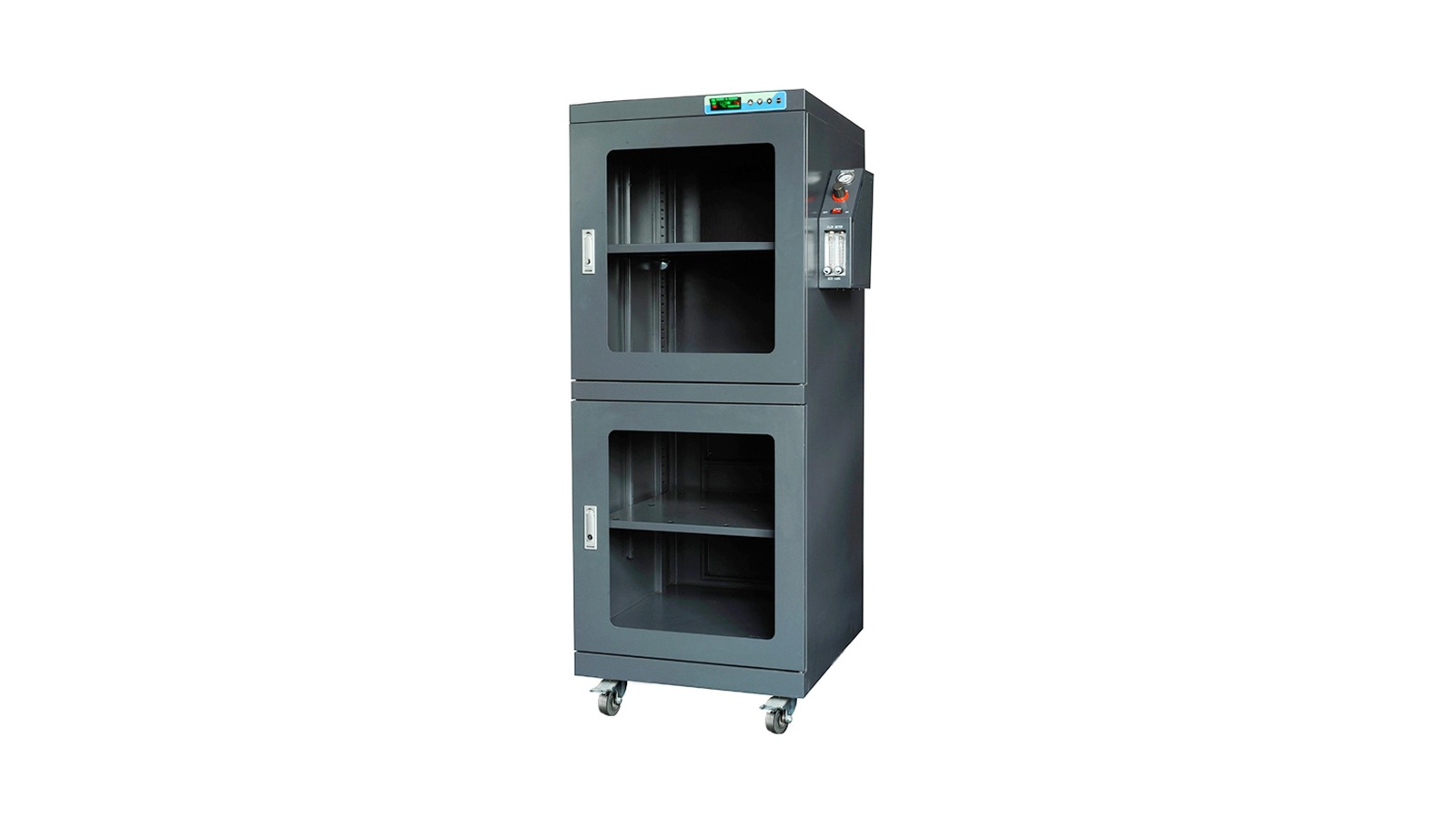
For bare, ground or powdered material, humidity control alone is not enough, because oxygen is also a reactant. The standard approach is a nitrogen purge cabinet: a low-humidity environment and an oxygen level typically held below 1% (indicative assumption; actual value depends on model, purge flow and how often doors are opened). The nitrogen flow continuously displaces moist air, so every door opening recovers within minutes instead of letting a whole shelf load absorb a day's worth of moisture.
Temperature stability matters too. A cabinet sitting in a room that swings from 18 °C in the morning to 26 °C in the afternoon creates condensation risk on every part moved in and out. Keep the storage area temperate, and let parts that arrive cold from a truck equilibrate inside the cabinet — never outside it.
Storage Options Compared
| Storage option | Typical environment (indicative) | Best suited for | Watch-outs |
|---|---|---|---|
| Ambient storeroom (uncontrolled) | Season-dependent, often 40–80% RH | Short buffers only; fully sealed, plated parts | Condensation risk after temperature swings; oxidation starts at coating defects |
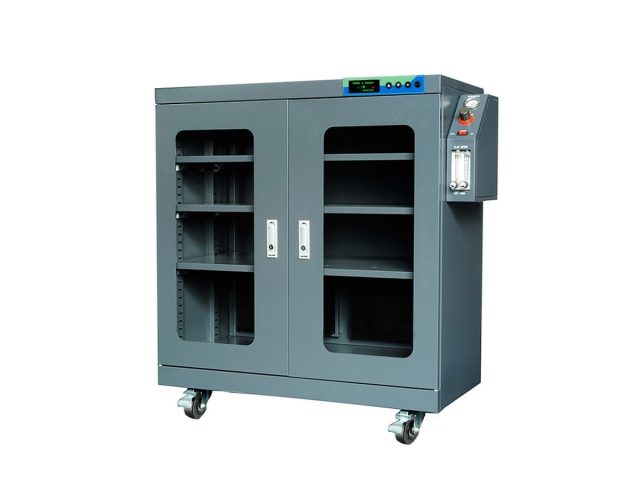
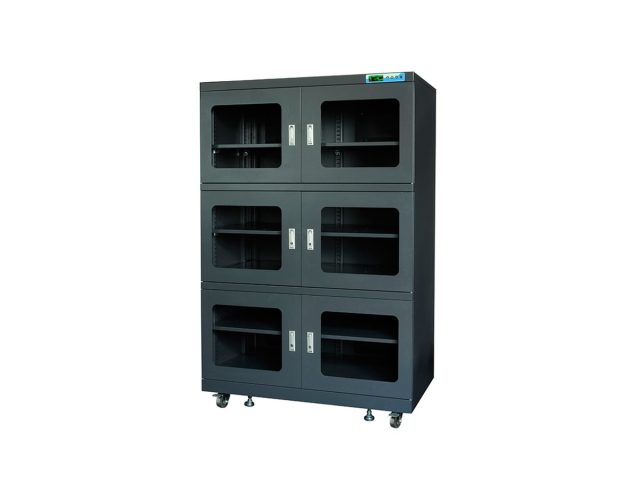
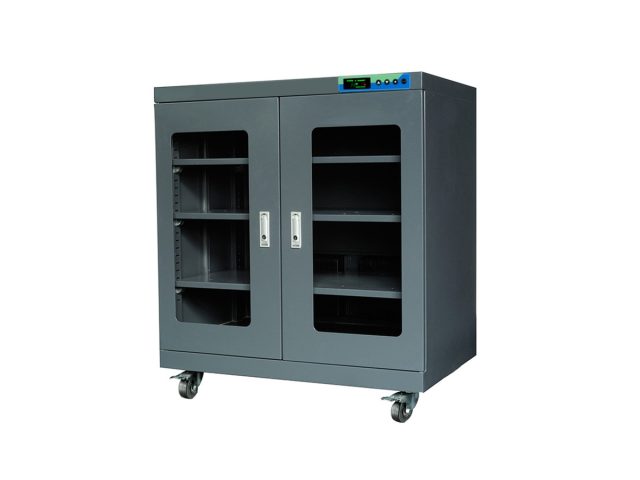
| Desiccant dry cabinet (e.g. YSM series) | ≤10% RH typical setpoint, down to 1–5% RH | Plated or coated magnets, magnets in sealed intermediate packaging | Desiccant needs regeneration/maintenance; oxygen level is not actively controlled |
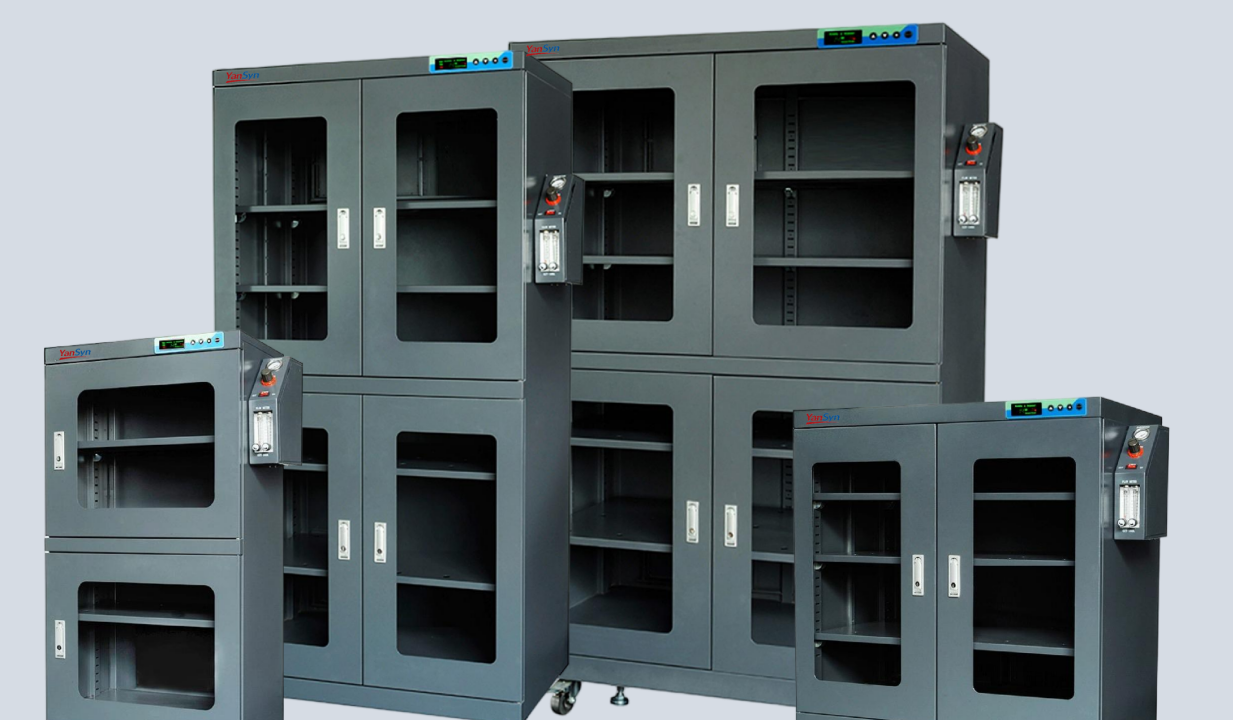
| Nitrogen purge cabinet (e.g. YSN series) | 1–5% RH, O2 below 1% (indicative assumption, model-dependent) | Bare or ground NdFeB, magnet powders, sub-assemblies awaiting welding | N2 consumption and cost depend on door openings and cabinet leak rate |
| Vacuum packaging (bagged, with desiccant) | Near-zero moisture inside the bag until opened | Long-distance shipping, long-term warehousing | Once opened, protection is gone; parts must move into a controlled cabinet |
A Storage Workflow That Survives Audits
In magnet plants and motor assembly lines we work with, a workable flow looks like this:
- Incoming inspection. Check plated magnets visually for coating defects before they enter storage; segregate any suspect batch so humidity exposure cannot spread the problem through your WIP.
- Post-plating handling. After hydrogen-relief baking and drying, parts should move directly from the oven into the controlled cabinet — not onto an open bench "just for the afternoon".
- Controlled storage. Set the cabinet to the right class for the material: dry-cabinet storage at ≤10% RH for coated magnets, nitrogen purge below 1% O2 (indicative assumption) for bare or powdered material. Label shelves by material class so operators cannot mix them.
- Kitting and line-side WIP. Release only what the shift can assemble. Keep kitted parts in smaller cabinets at the line, so the main storage cabinet is not opened twenty times per hour — every door cycle is a purge cost and a humidity excursion.
- Monitoring. Cabinet RH/O2 readings should be logged and reviewable, not just displayed. If your quality system is ISO 9001 or automotive-grade, data logger integration (available on the IoT-equipped options) turns storage into evidence rather than a promise.
- Outbound packaging. Vacuum-bag or heat-seal with desiccant for anything shipping by sea or sitting in a warehouse, and treat the bag opening as the start of a countdown back into controlled storage.
Frequently Asked Questions
Do plated NdFeB magnets really need controlled storage?
Yes — and for two reasons. Plating coverage on complex geometries is never perfect, and edge and hole defects concentrate attack. Also, corrosion that starts in storage is counted as your scrap, not the plater's.
What humidity setpoint should I use for coated magnets?
A common and defensible choice is ≤10% RH; some producers specify 1–5% RH for long-term warehousing of high-value material (indicative assumption — match it to your own corrosion test data and customer requirements).
Is nitrogen purge mandatory for SmCo?
Not for bulk corrosion resistance. It is worth it when cleanliness matters — bare SmCo in sensor assemblies — or when SmCo and NdFeB parts share one storage workflow and you want a single, simple rule.
How much nitrogen does a purge cabinet use?
It depends on cabinet volume, leak rate and door-opening frequency. As an indicative assumption only, a mid-size cabinet purged to below 1% O2 with moderate door traffic is typically counted in fractions of a cubic metre per hour at rest, rising with each opening — size your supply with your cabinet supplier's flow data, not a rule of thumb.
Can magnets and MSD electronic components share one cabinet?
Usually yes, if both tolerate the lower setpoint and segregation rules are respected. Nitrogen cabinets are frequently used for exactly this mixed load on SMT and motor lines.
The Takeaway
Rare-earth magnet corrosion is cheap to prevent and expensive to discover. The mechanism — galvanic attack of the Nd-rich grain-boundary phase under a water film — is unforgiving, and it is triggered by ordinary warehouse air. A storage class matched to the material (dry cabinet for coated parts, nitrogen purge for bare and powdered ones), a disciplined in-and-out workflow and logged environmental data close the gap between the corrosion spec on the drawing and what actually happens on your floor.
If you are building or upgrading magnet storage for motor, sensor or powder-bonding production, the YanSyn YSN nitrogen cabinet series covers benchtop to multi-cabinet capacities with dual-flow purge and digital monitoring, and our engineers can help you match the storage class to your material mix. Contact us to discuss your application.